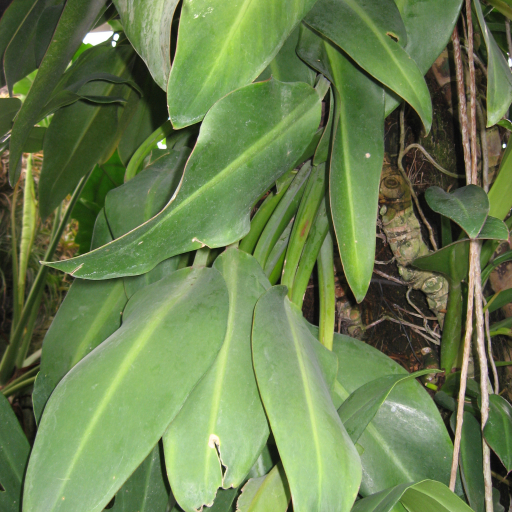
Plant Overview
Often called the "Fat Boy" or "Flask Philodendron," this Brazilian native is the bodybuilder of the houseplant world. Unlike its climbing cousins that sprawl over shelves, Philodendron martianum stands firm and upright with a unique, bulbous silhouette that looks more like a designer sculpture than a typical vine. It’s a perfect pick for collectors who want a lush, tropical vibe without the mess of trailing stems.
🔍 How to Identify
- 💪 Swollen Petioles: The most striking feature is the thick, flask-shaped leaf stalks (petioles) that are noticeably bloated at the base.
- 🍃 Leathery Foliage: The leaves are glossy, deep green, and oval-shaped with a tough, waxy texture that feels sturdy to the touch.
- ☀️ Rosette Growth: It is a "self-heading" Philodendron, meaning it grows in a tight, circular pattern from a central point rather than climbing up a trellis.
🏡 In Your Garden
- 🏺 Built-in Canteens: Those fat stems are actually evolved water-storage organs. Because it holds its own moisture, it is far more forgiving of a missed watering than thinner-stemmed tropicals.
- 🌬️ Breathable Roots: In its native Brazilian habitat, it often grows as an epiphyte (on trees). To keep it happy at home, use a chunky "aroid mix" with plenty of bark and perlite to prevent the roots from suffocating in heavy soil.
⚠️ Safety & Toxicity
- 🚫 Toxic Status: Like all Philodendrons, this plant contains insoluble calcium oxalate crystals.
- 🐾 Pets & Kids: If leaves or stems are chewed, these crystals cause immediate mouth pain, swelling of the throat, and digestive upset. It is best kept on a high table or shelf away from curious pets and toddlers.
✨ Fun Fact
This plant was named in honor of Carl Friedrich Philipp von Martius, a legendary 19th-century German botanist who traveled over 6,000 miles through the Brazilian Amazon to document thousands of new species!

Detailed Care Instructions
| Soil Ph | Acidic |
| Humidity | Normal |
| Lighting | Part Sun |
| Toxicity | Poisonous |
| Soil Type | Well Drained Rich Soil |
| Difficulty | Medium |
| Plant Type | Aroids |
| Mature Size | 1-2 Feet Approximately |
| Native Area | Brazil |
| Temperature | 18°C - 29°C |
| Sun Exposure | Part Sun |
| Hardiness Zones | 9-11 |
To grow Philodendron Martianum plant, you can follow these steps:
- Choose a suitable location: Philodendron Martianum thrives in bright, indirect light. Avoid direct sunlight as it can scorch the leaves. Place the plant near a window that receives filtered light or in a semi-shaded spot.
- Provide the right temperature and humidity: Philodendron Martianum prefers temperatures between 60-75°F (15-24°C). Maintain a relatively high humidity level around the plant by misting it regularly or using a humidifier.
- Use well-draining soil: Plant the Philodendron Martianum in a pot with well-draining soil that retains some moisture but doesn't become waterlogged. A mixture of peat moss, perlite, and orchid bark can work well.
- Water properly: Keep the soil slightly moist, but avoid overwatering. Wait for the top inch of soil to dry out before watering again. Philodendron Martianum likes a consistent level of moisture, so water it whenever the topsoil feels dry to the touch.
- Fertilize regularly: During the growing season (spring and summer), feed the Philodendron Martianum with a balanced houseplant fertilizer every 4-6 weeks. Dilute the fertilizer to half the recommended strength to prevent burn.
- Provide support: Philodendron Martianum is a climbing plant, so provide a support structure like a moss pole or trellis for it to climb on. This will help it grow upright and prevent it from sprawling.
- Propagation: Philodendron Martianum can be propagated through stem cuttings. Take a 4-6 inch cutting with at least one leaf node and place it in a jar of water or in moist soil. Keep the cutting in a warm, humid environment until roots develop.
- Repotting: As the Philodendron Martianum grows, you may need to repot it into a larger container. Choose a pot that is one size larger than the current one and use fresh potting soil. Gently loosen the roots during repotting to encourage healthy growth.
Remember to regularly inspect your Philodendron Martianum for pests like spider mites, mealybugs, or aphids. If any pests are detected, treat them promptly using appropriate methods. Overall, with proper care and a suitable environment, your Philodendron Martianum plant should grow well and thrive.

Place in a dark room with little light, like a dark bedroom or a spot far away from a window or directly in a north-facing window.

To water this particular plant, first you should ensure that the soil is completely dry before watering. When watering, slowly pour water over the soil until it starts to drain out of the bottom of the pot. It's important not to overwater, as this can lead to root rot. This plant prefers well-draining soil, so ensure that the pot has adequate drainage holes. It's recommended to water this plant once every week or two, depending on the humidity and temperature of its environment.
To fertilize this plant, you should use a balanced fertilizer with equal parts nitrogen, phosphorus, and potassium. This should be applied during the spring and summer months, every four to six weeks. It is important to dilute the fertilizer to half strength before applying it to the soil around the plant. Over-fertilizing can lead to leaf burn and other issues, so be sure to follow the instructions carefully. It is also recommended to water the plant before and after fertilizing.
Philodendron Martianum requires a well-draining soil mix that is rich in organic matter. The soil should have good aeration and moisture retention properties. A suitable soil mix can be made by combining peat moss, perlite, and coarse sand in equal parts. You can also add some charcoal to the soil mix to improve drainage and prevent rot. The soil pH should be slightly acidic, with a range of 5.5 to 6.5. Avoid using heavy clay soils or heavily compacted soils, as they can restrict root growth and lead to waterlogging. In general, the soil should be loose, friable, and airy, with good drainage properties. Regular fertilization with a balanced NPK fertilizer is also recommended to promote healthy growth of the plant.
To propagate this plant, you first need to select a healthy stem cutting. The cutting should be taken from an established plant that is in good health. It should be about 6-8 inches long and have at least two or three leaves.
Next, remove the lower leaves of the cutting, leaving only the top two or three leaves. This will give the cutting enough energy to grow roots.
Then, dip the cut end of the stem into rooting hormone powder, which will help the plant grow roots faster. Place the stem cutting into a small pot filled with moist soil.
Cover the pot with a clear plastic bag to create a humid environment and place it in a warm spot with bright, indirect light. Keep the soil moist but not waterlogged.
After a few weeks, the cutting should begin to grow roots. To verify this, gently tug on the stem. If you feel resistance, the roots have started to grow. Once the roots are well established, the plant can be transplanted into a larger pot or into the ground.








