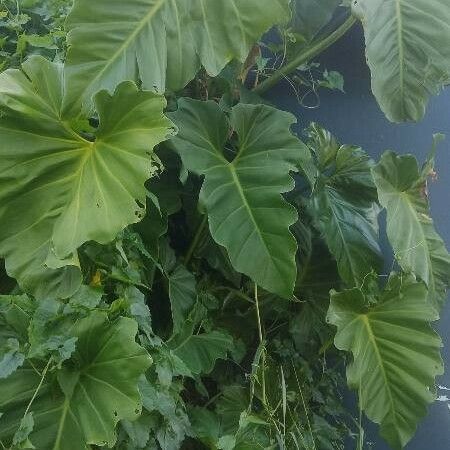
Plant Overview
Often called the "Giant Leaf Philodendron," this Mexican native is a showstopper for those with plenty of vertical space. It starts its life looking relatively modest, but it quickly transforms into a tropical titan with leaves that look like they’ve been intricately carved by hand. In its natural habitat, it scales massive trees to reach the jungle canopy, making it a true master of vertical transformation.
🔍 How to Identify
- 🍃 Leaf Shape: Juvenile leaves are simple and heart-shaped, but as the plant matures, they develop deep, elegant slits (pinnatifid lobes) that reach nearly to the central vein.
- 🪵 Growth Habit: This is a vigorous climber. It produces thick, sturdy stems and strong, brown aerial roots used to anchor itself to bark or moss poles.
- ✨ Luster & Texture: The foliage has a semi-glossy, vibrant green finish with a leathery texture that becomes more pronounced as the plant ages.
🏡 In Your Garden
- 🪜 The Need to Climb: This Philodendron has a "climb or crawl" mentality. If left to trail, the leaves will remain small and juvenile; providing a sturdy moss pole or cedar plank triggers the plant to produce its signature giant, lobed foliage.
- 🚿 Emergence Issues: Because it hails from humid rainforests, it thrives when moisture is high. In dry indoor air, the new leaves often get "stuck" in their protective sheaths (cataphylls), which can lead to torn or deformed foliage if not misted regularly.
⚠️ Safety & Toxicity
- 🚫 Toxic Status: Toxic to humans and pets.
- 🐾 The Risk: Like most members of the Araceae family, it contains insoluble calcium oxalate crystals. If the leaves are chewed or swallowed, they cause immediate stinging, mouth swelling, and digestive distress in cats, dogs, and curious children.
✨ Fun Fact
- 📏 Jungle Giants: While it stays a manageable size in most living rooms, in the wilds of Mexico, a single leaf of Philodendron subincisum can grow to be over 3 feet (1 meter) long!

Detailed Care Instructions
To grow a Philodendron Subincisum plant, follow these steps:
- Choose a suitable location: Find a spot in your home with bright, indirect sunlight. This plant also tolerates low light conditions, but its growth may be slower.
- Select a container: Use a well-draining pot with drainage holes to prevent waterlogging. The size of the pot should be appropriate for the current size of the plant, with some extra room for growth.
- Soil: Use a well-draining, rich potting mix that retains moisture but doesn't get waterlogged. A mixture of potting soil, perlite, and peat moss works well.
- Planting: Gently remove the plant from its nursery pot and place it in the new container, making sure the roots are properly spread out. Add enough potting mix to cover the roots and fill the container, leaving a small space at the top for watering.
- Watering: Water the plant thoroughly, until water drains out of the bottom of the pot. Allow the top inch of soil to dry out before watering again. Avoid overwatering, as it can lead to root rot.
- Humidity: Philodendron Subincisum appreciates high humidity. You can increase humidity by placing a tray of water near the plant or using a humidifier. Regularly misting the leaves also helps.
- Temperature and humidity: Maintain temperatures between 65-85°F (18-29°C). Avoid extreme temperature fluctuations as it can stress the plant.
- Fertilization: During the growing season (spring and summer), use a balanced, water-soluble houseplant fertilizer every 4-6 weeks. Follow the instructions on the fertilizer package for dosage.
- Pruning: To keep the plant neat and encourage bushier growth, trim back any leggy or overgrown stems. You can also propagate new plants from the cuttings.
- Support: Philodendron Subincisum is a vining plant that benefits from support. You can provide a moss pole or trellis for the plant to climb on.
- Propagation: Philodendron Subincisum can be easily propagated through stem cuttings. Simply take a 4-6 inch cutting, remove the lower leaves, and place it in a glass of water or directly into moist potting soil. Keep it in a warm spot with indirect light until roots develop.
With proper care and attention, your Philodendron Subincisum plant should thrive and grow into a lush and beautiful specimen.

Place in a window with dappled sun or a spot in the middle of a room. Or directly in a window facing west or east.

To ensure proper watering for Philodendron Subincisum, follow these guidelines:
1. Observe the soil moisture: Check the soil regularly to determine if it is dry or moist. Insert your finger into the soil about an inch deep to assess moisture levels.
2. Watering frequency: Water the plant when the top inch of the soil feels dry to the touch. This allows the roots to absorb water without sitting in excess moisture.
3. Watering method: Use a watering can or a small jug to apply water gently to the base of the plant. Avoid watering the leaves as it may cause fungal diseases or damage the foliage.
4. Water quantity: Water the plant until you see water draining out from the bottom of the pot. This ensures that the entire root system is adequately saturated.
5. Drainage: Ensure that the pot has drainage holes to prevent water from becoming trapped at the bottom, which may lead to root rot. It is recommended to place a tray or saucer underneath to catch excess water which can be emptied after watering.
6. Room humidity: Philodendron Subincisum prefers average to moderate humidity levels. If the air is dry, you can provide extra humidity by misting the leaves with a spray bottle or placing a water tray near the plant.
7. Avoid over-watering: It is important not to over-water as it can lead to root rot. Make sure that the soil dries out between watering sessions.
8. Temperature considerations: Higher temperatures and bright light may increase the plant's water requirements. Adjust your watering schedule accordingly during warmer months.
9. Adjust to environmental conditions: Factors such as the size of the pot, the room's humidity, and the season influence the plant's water needs. Monitor the plant closely and adjust your watering routine accordingly.
Following these guidelines will help ensure that your Philodendron Subincisum plant receives the appropriate amount of water, promoting its healthy growth and overall well-being.
To fertilize your Philodendron plant, follow these instructions:
- Choose a balanced, water-soluble fertilizer with an NPK ratio of 20-20-20 or similar. This means the fertilizer contains equal amounts of nitrogen (N), phosphorus (P), and potassium (K).
- Dilute the fertilizer according to the manufacturer's instructions. Generally, a concentration of 1/4 to 1/2 the recommended strength is suitable for houseplants like Philodendron.
- Water the plant thoroughly before applying fertilizer to prevent root burn. Allow any excess water to drain away.
- Apply the diluted fertilizer directly to the soil, avoiding contact with the leaves and stem. Pour the fertilizer evenly around the base of the plant, taking care not to over-apply.
- After fertilizing, ensure proper drainage by allowing any excess water to drain away again.
- Repeat the fertilization process every 4 to 6 weeks during the growing season (typically spring and summer). Reduce or stop fertilizing during the dormant period in fall and winter.
- Monitor your plant for any signs of over-fertilization, such as yellowing or burning leaves. If this occurs, flush the soil with plenty of water to remove excess nutrients.
Remember, each plant has its own specific requirements, so it's always best to research the needs of your specific Philodendron Subincisum or consult with a local horticulturist for tailored advice.
When choosing soil for Philodendron Subincisum, it is important to consider its natural habitat and growth requirements. This plant is native to tropical rainforests and is commonly found growing on trees or rocky surfaces.
The ideal soil for Philodendron Subincisum should be well-draining yet moisture-retentive. It should provide good aeration to the roots while retaining sufficient moisture to support healthy growth. A suitable soil mixture can be created by combining equal parts of organic matter such as peat moss or well-rotted compost, perlite or coarse sand, and a small amount of sphagnum moss or orchid bark to enhance drainage.
Organic matter in the soil will provide nutrients and improve the soil's water-holding capacity. Perlite or coarse sand helps to prevent waterlogging and promote root aeration, ensuring that excess water can drain away easily. The addition of sphagnum moss or orchid bark aids in moisture retention while also improving soil structure.
Avoid using heavy soils or those that tend to compact, as they can retain too much water and deprive the roots of oxygen. It is also ideal to use a slightly acidic soil with a pH between 6.0 and 6.5, as Philodendron Subincisum generally prefers slightly acidic conditions.
It's worth noting that these guidelines are general recommendations for Philodendron Subincisum, and individual plant care may vary based on specific conditions and preferences.
To propagate Philodendron Subincisum, you can follow these steps:
- Start by selecting a healthy parent plant with vigorous growth. Ensure that the plant has several mature leaves and a well-established root system.
- Sterilize your cutting tools (such as pruning shears or a sharp knife) with rubbing alcohol or a solution of one part bleach and nine parts water. This step helps prevent the transmission of diseases or pests.
- Identify a suitable stem section for propagation. Look for a stem that is at least 4-6 inches long, with a few mature leaves towards the top.
- Using your sterilized cutting tool, make a clean, diagonal cut just below a node (the point where a leaf grows from the stem). Nodes are essential as they allow the development of new roots.
- Remove any lower leaves or nodes from the stem, leaving only a few leaves at the tip. This helps redirect the plant's energy towards root development.
- If desired, you can apply a rooting hormone to the base of the cutting to stimulate root growth. This step is optional but can potentially increase success rates.
- Prepare a well-draining potting mix for the cutting. A mixture of equal parts perlite and peat moss or a commercial potting mix can work well.
- If you plan to root the cutting in water instead of soil, fill a glass or jar with distilled water and submerge the cutting, making sure the bottom node is fully submerged while the upper leaves remain above the waterline.
- If rooting in soil, create a small hole in the pre-moistened potting mix using a pencil or your finger. Insert the cutting into the hole, ensuring that the bottom node is buried in the soil.
- Place the cutting in a warm, bright location, away from direct sunlight. Maintain a consistently warm temperature between 65-75°F (18-24°C).
- Keep the soil or water consistently moist, but not overly saturated, to prevent waterlogging or rot. Check regularly and water as needed.
- After a few weeks, new root growth should begin to appear. Once the roots are about 1-2 inches long, it is an indication that the cutting has successfully rooted.
- At this stage, you can carefully transplant the rooted cutting into a slightly larger pot with regular potting soil. Be gentle while removing the cutting from its original container to protect the delicate roots.
- Continue caring for the newly propagated Philodendron Subincisum, providing it with bright, indirect light, regular water, and balanced fertilization to support its growth.
Remember, the propagation success rate may vary, and it's always good to take multiple cuttings to increase the chances of success.
Common pests of the philodendron subincisum include Scale insect, mealybugs, spider mites, thrips. Make a habit of checking your philodendron subincisum frequently for pests so that any infestations can be caught and managed early.








