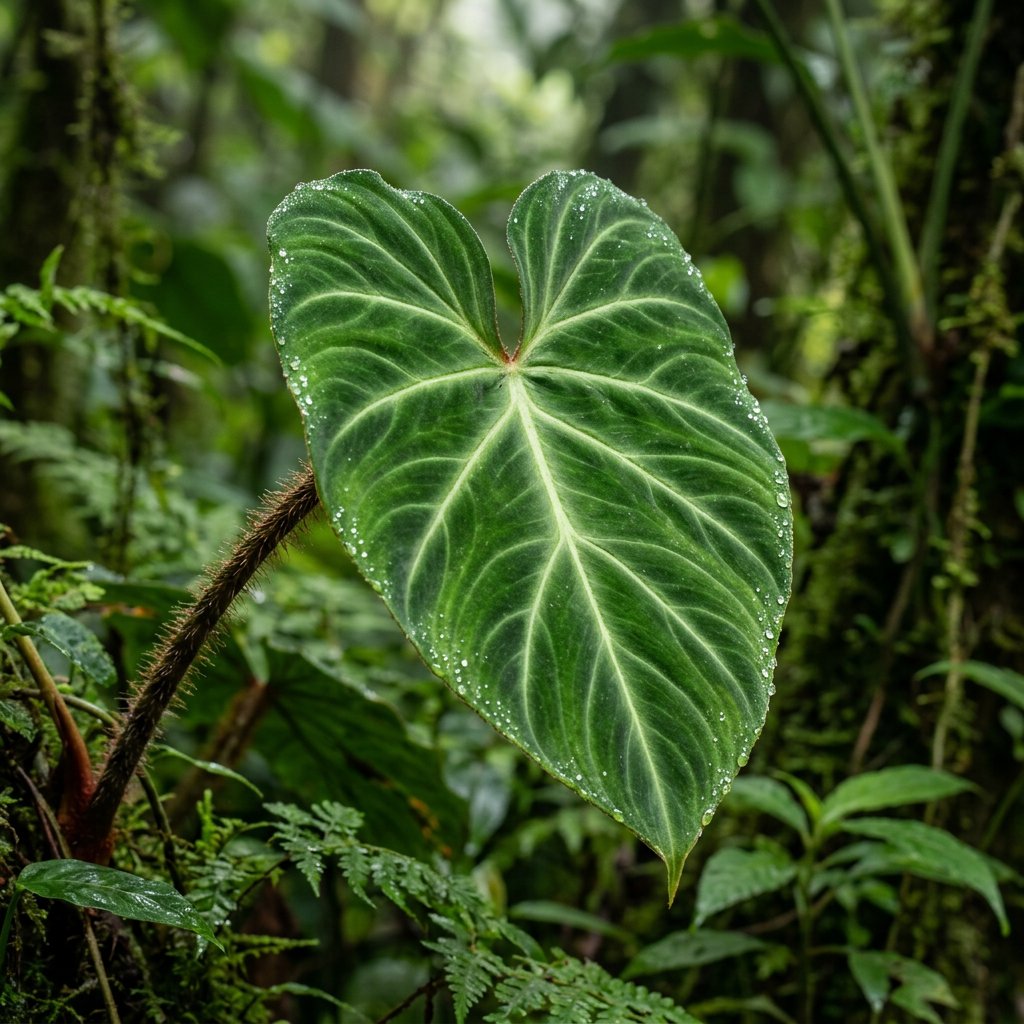
Plant Overview
The Philodendron verrucosum is often hailed as the "Velvet King" of the indoor jungle. Known for its deep emerald, heart-shaped leaves and distinctively fuzzy stems, it looks like it belongs in a mystical cloud forest rather than a standard living room. While it has a reputation for being a bit of a "drama queen" compared to hardier vines, its iridescent foliage and striking red undersides make it a prized jewel for any plant collector.
🔍 How to Identify
- 🌿 Velvet Foliage: The leaves are large, heart-shaped, and possess a luxurious, velvety texture that shimmers under the light with an almost iridescent green glow.
- 🪶 Pubescent Petioles: One of its most iconic features is its stems (petioles), which are densely covered in soft, hair-like structures that can range from green to a deep burgundy.
- 🎨 Intricate Veining: Look for prominent, light-green or neon-colored veins that radiate from the center, contrasting sharply against the dark, moody background of the leaf.
🏡 In Your Garden
- ☁️ Humidity is Non-Negotiable: Because this plant originates from high-altitude cloud forests, it lacks the waxy coating of other Philodendrons. It requires high humidity (at least 60%) to prevent the delicate leaf edges from turning crisp and brown.
- 🧗 The Need to Climb: This is a hemiepiphytic species, meaning it loves to scale trees in the wild. Providing a moss pole is essential; as it climbs, the leaves will naturally increase in size and the plant will feel more "at home."
- 💧 Sensitive Roots: It prefers a "chunky" soil mix (bark, perlite, and peat) that stays moist but never soggy. It is particularly sensitive to salt buildup from tap water, so using filtered water can prevent leaf spotting.
⚠️ Safety & Toxicity
- 🚫 Toxic Status: Like almost all members of the Araceae family, this plant is considered toxic if ingested.
- 🧪 The Culprit: It contains insoluble calcium oxalate crystals. If chewed, these crystals act like tiny needles, causing immediate mouth irritation, swelling of the throat, and digestive distress. Keep it on a high shelf away from curious cats, dogs, and toddlers.
✨ Fun Fact
The Philodendron verrucosum is a "color-shifter." When the leaves are young, the undersides are often a brilliant, solid red to protect them from intense light and pests. As the leaf matures and thickens, this red often fades into a more subtle mahogany or green, marking the leaf’s transition into adulthood.

Detailed Care Instructions
| Soil Ph | Neutral, Alkaline |
| Lighting | Part Sun |
| Soil Type | Loamy, Moist But Well-Draining |
| Plant Type | Evergreen Shrub |
| Native Area | South America |
| Sun Exposure | Partial Sun |
| Hardiness Zones | 9-11 |
To grow a Philodendron Verrucosum plant, follow these steps:
- Start with a healthy Philodendron Verrucosum plant or purchase a well-rooted cutting. You can find these plants at nurseries or online plant stores.
- Choose a suitable pot with good drainage. Philodendron Verrucosum prefers slightly acidic and well-draining soil. A peat-based potting mix with added perlite or orchid bark works well.
- Place the plant in a bright location with indirect sunlight. Avoid direct sunlight as it can scorch the leaves. A north-facing or east-facing window is usually ideal.
- Maintain a warm temperature range of 65-85°F (18-29°C). Philodendron Verrucosum prefers a tropical climate, so a warmer environment is ideal.
- Water the plant regularly, keeping the soil moist but not soggy. Ensure proper drainage to prevent root rot. Allow the top inch of soil to dry out between waterings.
- Provide high humidity for the plant. Mist the leaves regularly or place a tray filled with water and pebbles near the plant to increase humidity. You can also use a humidifier.
- Fertilize the plant every 2-4 weeks during the growing season (spring and summer) with a balanced houseplant fertilizer. Do not fertilize during the dormant period in winter.
- Philodendron Verrucosum is a climbing plant, so provide a support structure or moss pole for it to climb on. You can gently tie the vines to the support with soft plant ties.
- Prune the plant occasionally to shape it and remove any yellow or dead leaves. You can also propagate new plants by taking stem cuttings with at least two nodes and planting them in a separate pot.
- Keep an eye out for common plant pests like spider mites, mealybugs, or aphids. Treat any infestations promptly using organic or chemical pest control methods.
By following these steps, you can successfully grow and care for a Philodendron Verrucosum plant.

Place in a window with dappled sun or a spot in the middle of a room. Or directly in a window facing west or east.

To water this particular plant, it is important to first observe the soil moisture level. Water only when the top layer of soil feels dry to the touch. When watering, make sure to water thoroughly until water starts to drain out of the drainage holes at the bottom of the pot. It is important not to let the plant sit in standing water as this can cause root rot. Additionally, this plant prefers moist but well-draining soil, so it is important to avoid letting the soil dry out completely between waterings. It is recommended to use room temperature water and to avoid using tap water with a high salt content which can damage the plant's leaves.
To fertilize your plant, mix a balanced fertilizer with equal parts nitrogen, phosphorus, and potassium in water according to the package instructions. Apply this mixture every two weeks in the growing season, which is typically spring and summer. During the dormant season, withhold fertilization or reduce the feeding frequency to once a month. It's essential not to over-fertilize, as this can cause leaf burn and stunt growth. Always water your plant thoroughly before applying fertilizer and avoid getting the solution on the leaves and stem.
The soil type preferred by the Philodendron Verrucosum plant is loamy soil that is well-draining, loose, and rich in nutrients. It is recommended to use a mixture that comprises one-third of peat moss, one-third of perlite, and one-third of garden soil. The peat moss helps to retain water, while perlite provides good drainage. The garden soil should be rich in organic matter, such as compost or well-rotted manure, to ensure the plant receives all the necessary nutrients. The soil pH of the mixture should be around 6.0-7.5. The plant prefers a slightly acidic to neutral soil pH. It is important not to use heavy, clayey soil or soil that retains too much moisture, as it can lead to root rot. Plants grown in a well-draining mixture will grow better, have larger leaves, and not suffer from mold and mildew.
To propagate this plant, first, select a healthy and mature stem. Using a sharp and sterile knife or scissors, make a clean cut at a 45-degree angle just below a node or a leaf. Then, remove the lower leaves on the stem leaving only two or three leaves on the top. Dip the cut end into rooting hormone powder to speed up the rooting process.
Next, prepare a small pot filled with a well-draining potting mix and make a small hole in the center. Insert the cut end of the stem into the hole and gently press down the soil around it. Water the soil lightly but do not overwater. Cover the pot with a plastic bag or a clear plastic wrap to create a humid environment. Place the pot in a warm and bright place but avoid direct sunlight.
Check the soil regularly to maintain its moisture level and mist the plant occasionally to keep the humidity high. After a few weeks, the stem should start to root and produce new growth. Once the roots are well-established and the plant has grown a few more leaves, it can be transferred to a larger pot with regular potting soil.
Propagation through stem cuttings is a simple and effective way to create new plants from existing ones and is a common method used for Philodendron Verrucosum plants.
Common pests of the warty philodendron include Mealybugs, spider mites, thrips. Make a habit of checking your warty philodendron frequently for pests so that any infestations can be caught and managed early.








