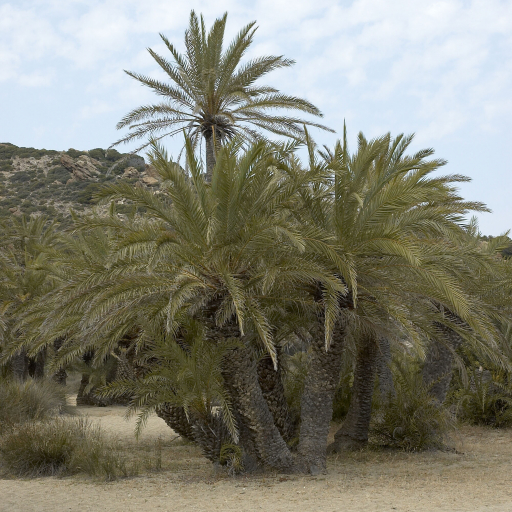
Plant Overview
Often called the Cretan Date Palm, this rare beauty is one of only two palm species native to Europe. Legend has it that the vast palm forests in Crete grew from date pits discarded by Egyptian soldiers or Phoenician sailors, though science tells us it has been a local resident since the last Ice Age. It brings a wild, architectural "prehistoric" look to any Mediterranean-style landscape.
🔍 How to Identify
- 🌿 Silvery Foliage: The fronds are a striking grayish-green or silvery-blue, appearing much stiffer and more rigid than those of the common Canary Island Date Palm.
- 🌴 Clumping Habit: Unlike many palms that grow a single tall trunk, this species naturally "suckers," meaning it often grows in clusters with several trunks leaning away from a central base.
- ⚔️ Formidable Spines: The base of each leaf stalk is armed with incredibly sharp, long, yellow needles that serve as a natural defense against grazers.
🏡 In Your Garden
- 🌊 Coastal Warrior: This palm is exceptionally resistant to salt spray and high winds, making it a perfect choice for seaside gardens where other plants might wither.
- 🏜️ Drainage is Key: While it loves sunshine, its biggest enemy is "wet feet." In its native habitat, it grows in rocky gullies and sandy banks, so ensure your soil is gritty and fast-draining to prevent root rot.
- ✂️ Slow & Steady: It is a slow grower compared to its cousins. Avoid the temptation to over-prune the lower fronds; wait until they are completely brown before removing them to avoid stressing the tree.
⚠️ Safety & Toxicity
- 📍 Mechanical Injury: While not chemically toxic, the spines at the base of the leaves are "bayonet-sharp." They can easily puncture skin or clothing and are known to cause painful inflammation if a tip breaks off under the skin.
- 🐾 Pet & Child Safety: Keep this plant away from high-traffic areas or play zones. It is a "look but don't touch" plant.
- 🍒 The Fruit: The small dates are technically edible but are thin-fleshed, fibrous, and quite astringent compared to commercial dates. They aren't harmful, just not very tasty!
✨ Fun Fact
The largest natural palm forest in Europe is located at Vai Beach in Crete, consisting entirely of Phoenix theophrasti. It is so lush that it has served as a filming location for movies and commercials to stand in for tropical Caribbean or African locations!

Detailed Care Instructions
| Humidity | Normal |
| Lighting | Full Sun |
| Difficulty | Medium |
| Hardiness Zones | 8B - 11 |
To grow Phoenix theophrasti, commonly known as Cretan date palm, follow these steps:
- Climate and soil requirements: Phoenix theophrasti thrives in Mediterranean climates with mild, wet winters and hot, dry summers. It prefers well-draining soil with a pH level between 6 and 7.
- Propagation: The plant can be grown from seeds or by dividing the offshoots from an existing plant. If using seeds, soak them in warm water for 24 hours before planting.
- Germination: Plant the seeds in a pot filled with a mixture of well-draining soil and sand. Keep the soil moist but not waterlogged. Place the pot in a warm and sunny spot, ideally at a temperature of around 25-30°C (77-86°F). Germination can take anywhere from a few weeks to several months.
- Transplanting: Once the seedlings have developed a few sturdy leaves, you can transplant them into larger pots or directly into the garden. Choose a sunny location with protection from strong winds, as the Cretan date palm can be sensitive to cold drafts.
- Watering and fertilizing: Water the plant regularly, especially during the growing season. Ensure that the soil stays slightly moist but not waterlogged. Fertilize the plant every three months with a balanced, slow-release fertilizer to promote healthy growth.
- Pruning: Remove any dead or damaged fronds to maintain the plant's appearance. Be careful not to remove too many fronds at once, as this can stress the palm.
- Protection from cold: If you live in an area with occasional frost or cold winters, provide protection to the plant. Cover it with a frost blanket or move it indoors to protect it from freezing temperatures.
- Pest and disease control: Monitor the plant for any signs of pests such as scale insects or aphids. Treat any infestations promptly with appropriate insecticides. Additionally, ensure good air circulation around the plant to prevent fungal diseases.
Remember, growing a Phoenix theophrasti plant requires patience, as it takes several years for the tree to mature and start producing its characteristic date-like fruits.

Place in a bright room that is sun drenched almost all day. Or directly in a south-facing window.

Phoenix Theophrasti is a plant that requires regular watering to thrive. To water the plant properly, it is advised to use a soil moisture meter to determine the level of moisture in the soil.
The watering frequency should be adjusted based on the season, temperature, and humidity of the environment. During the hotter months, the plant may require more frequent watering.
When watering, it is recommended to soak the soil thoroughly and wait until the water drains from the bottom of the pot. The plant should not be left in standing water as it can cause root rot.
It is important to avoid letting the soil dry out completely as it can lead to stress and damage to the plant. However, overwatering should also be avoided as it can drown the plant.
Overall, it is essential to maintain a consistent watering schedule to ensure the health and growth of Phoenix Theophrasti.
Fertilize the plant every four to six weeks during the growing season with a balanced, slow-release fertilizer. Do not over-fertilize, as this can damage the roots. Water the plant before fertilizing to avoid burning the roots. Apply the fertilizer around the base of the plant, avoiding contact with the foliage.
The best soil for the Phoenix Theophrasti plant is one that is well-draining and has good aeration. It should also be rich in nutrients, particularly organic matter. This plant prefers a soil pH that is slightly acidic to neutral, with a range of 6.0 to 7.5. Sandy loam or loamy soil is ideal, as it provides good drainage and aeration. A soil mix of sand, clay, and a small amount of organic matter can be used to create the best soil conditions for Phoenix Theophrasti plant. Avoid using heavy clay soils or those that are prone to waterlogging, as these conditions will negatively impact the plant's growth and development.
Phoenix Theophrasti can be propagated by seed or by vegetative methods. Propagation by seed is the simplest way to grow this plant, and it is also the preferred method in many cases. The seeds should be harvested when they are fully ripe, and then soaked in water for several days to soften the seed coat. After this, the seeds can be planted in a suitable growing medium and kept moist until they germinate.
Vegetative propagation can also be used to grow Phoenix Theophrasti. This can be done by taking cuttings from mature plants, and planting them in a suitable growing medium. The cuttings should be taken in the spring, and the leaves should be removed from the lower part of the stem. The cuttings should then be treated with a rooting hormone and planted in a suitable growing medium. They should be kept moist until they have developed roots and can be transplanted to their final location.
Another method of propagating Phoenix Theophrasti is by division. This can be done by carefully dividing the root system of mature plants into smaller sections, which can then be replanted in a suitable growing medium. Care should be taken when dividing the root system to avoid damaging the plant, and the newly replanted sections should be kept moist until they have established a new root system.
In conclusion, Phoenix Theophrasti can be propagated by seed, cuttings, or division. Each method has its own set of advantages and disadvantages, and the choice of propagation method will depend on the specific situation and the grower's preferences.








