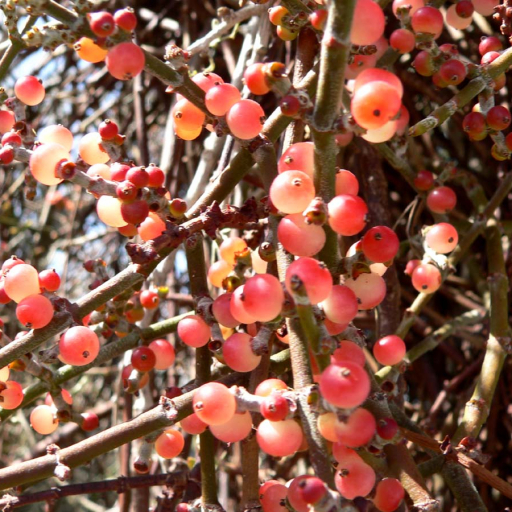
Plant Overview
Often called the Desert Mistletoe or Mesquite Mistletoe, this plant is a fascinating desert survivor that lives a "double life." As a hemiparasite, it can photosynthesize on its own, but it prefers to anchor itself into the branches of desert trees to steal water and minerals. In the Southwest, these dense, tangled clumps are iconic silhouettes against the desert sunset, serving as a vital "supermarket" for local wildlife during the dry season.
🔍 How to Identify
- 🌵 Leafless Stems: Instead of broad leaves, it consists of brittle, jointed green or reddish-brown stems that grow in pendulous, "witch’s broom" clusters.
- 🌸 Fragrant Blooms: In late winter, it produces tiny, inconspicuous yellowish flowers that release a surprisingly heavy, sweet scent into the desert air.
- 🍒 Waxy Berries: It is easily recognized by its clusters of translucent, pearl-like berries which range in color from snowy white to blush pink or deep coral red.
🏡 In Your Garden
- 🌳 Host Dependency: You won't find this plant in the soil; it grows exclusively on the branches of "host" trees like Mesquite, Palo Verde, and Acacia. If it appears in your garden, it’s usually a sign of a healthy ecosystem, though a heavy infestation can stress a tree during a drought.
- 🐦 Wildlife Magnet: This plant is the primary food source for the Phainopepla, a sleek, silky-black bird with a prominent crest. If you want to see these beautiful birds in your yard, leaving some mistletoe in your trees is the best way to invite them.
⚠️ Safety & Toxicity
- 🚫 Toxic to Mammals: While birds eat the berries by the hundreds, they are toxic to humans, dogs, and cats.
- 🤢 Ingestion Risk: The berries and stems contain phoratoxins which, if swallowed, can cause stomach cramps, blurred vision, and a dangerous drop in blood pressure. Always keep children and pets away from fallen clumps after a storm.
✨ Fun Fact
The seeds of the Desert Mistletoe are coated in a natural "super-glue" called viscin. This substance is so sticky that once a bird wipes a seed off its beak onto a branch, it is nearly impossible to remove, ensuring the plant stays exactly where it needs to be to sprout into its new host!

Detailed Care Instructions
To grow Phoradendron californicum, also known as California mistletoe, you can follow these steps:
- Source a healthy specimen: Obtain a fresh, natural mistletoe cutting from an established plant. Make sure it is free from disease or pest infestations.
- Identify a host tree: California mistletoe is a hemiparasitic plant, meaning it requires a host tree for support and some nutrients. It commonly attaches to various tree species such as oak, sycamore, or alder. Choose a tree species compatible with mistletoe.
- Prepare the host tree: Before attaching the mistletoe cutting, ensure the tree is healthy and well-established. Prune any dead or damaged branches, as this will promote overall tree health.
- Create a site for attachment: Make a shallow cut or notch on one of the tree branches, preferably ½ to ¾ inches deep, where the mistletoe stem will be inserted. This will encourage a more secure and stable attachment.
- Attach the cutting: Dip the cut end of the mistletoe cutting into a rooting hormone powder to promote root development. Insert the cutting into the prepared notch or cut on the branch. Press firmly to create a secure connection between the mistletoe and the tree.
- Provide water and light: Water the mistletoe cutting regularly to keep the surrounding area moist. Avoid overwatering, as it may lead to root rot. Place the mistletoe in a location where it can receive partial sunlight to promote growth.
- Monitor and support growth: Regularly inspect the mistletoe cutting for any signs of disease or pest infestation. Prune away any affected parts promptly. Additionally, consider providing additional support to the mistletoe as it grows, such as tying it gently to the branch.
- Be patient: Growing mistletoe from cuttings can be a slow process. It may take several months to a year before you start noticing significant growth. Keep providing proper care and maintain patience during the process.
Remember that mistletoe is a parasitic plant and may impact the health of the host tree, especially if it becomes aggressive or infested. Observe the interaction between the mistletoe and the host tree, and consult with a knowledgeable garden or plant expert if any concerns arise.

Place in a bright room that is sun drenched almost all day. Or directly in a south-facing window.

To properly water this plant, it is important to consider its natural environment and habitats. Phoradendron Californicum is an epiphytic plant that typically grows on the branches of trees and derives all its nutrients and water from the host plant. Therefore, it is recommended to simulate the same conditions by watering this plant regularly but not excessively.
The best way to water this plant is by misting it with a spray bottle. Alternatively, you can also water it by setting it on a tray with some water in it, allowing the plant to absorb the water through the pot's drainage holes. It is important to ensure that the water is not stagnant and change it frequently to prevent the growth of algae or other harmful bacteria.
This plant also prefers moist soil, so it is necessary to check the soil moisture level before watering. To do this, simply insert a finger into the soil to feel if it is damp or dry. If the soil feels dry, it is time to water the plant. However, if the soil feels damp, wait a few more days before watering again.
It is also essential to avoid getting the leaves wet while watering as this can cause fungal diseases and damage the plant. Lastly, this plant prefers bright, indirect light and moderate humidity levels, so make sure to place it in an appropriate location to ensure its proper growth and health.
To fertilize this plant, use a balanced fertilizer that contains equal amounts of nitrogen, phosphorus, and potassium. Apply the fertilizer during the growing season, which is typically in the spring and summer months. Be careful not to over-fertilize, as this can cause damage to the plant. It is recommended to dilute the fertilizer to half strength and apply it every four to six weeks. Water the plant thoroughly after fertilizing to help distribute the nutrients evenly. Avoid fertilizing during the dormant season, which is typically in the fall and winter months.
The most suitable soil for the plant is one that is well-draining and has a slightly acidic pH level. The soil should be composed of a mix of organic matter such as peat moss or leaf mold, sand, and loam. This type of soil provides the necessary nutrients and oxygen for healthy growth. The plant also benefits from a good layer of mulch on top of the soil to help retain moisture and suppress weeds. It is important not to use heavy clay soils as they can lead to waterlogging, which can be harmful to the plant.
Phoradendron Californicum is a plant that can be propagated through stem cuttings. First, select a healthy stem with several leaves attached. Using sharp, clean scissors or pruning shears, cut the stem at a 45-degree angle to prevent water from accumulating on the wound. Remove any leaves from the lower one-third of the stem.
Fill a small pot with a well-draining potting mix, dampen it, and make a small hole with your finger or a pencil. Dip the cut end of the stem in rooting hormone powder, shake off the excess, and place it in the hole. Firm the soil around the stem to provide stability, and mist the cutting with water.
Cover the pot with a clear plastic bag to create a humid environment. Place it in a warm, bright spot, avoiding direct sunlight. Mist the cutting occasionally to keep it moist but not waterlogged.
After about a month, check for roots by gently tugging on the stem. If you feel resistance, roots have formed. Remove the bag and move the pot to a sunny location with well-draining soil. Water the plant regularly and fertilize it with a balanced liquid fertilizer during its growing season.
Phoradendron Californicum can also be propagated via layering, which involves bending a low-hanging branch to the ground, covering part of it with soil, and waiting for roots to develop before cutting it from the mother plant.








