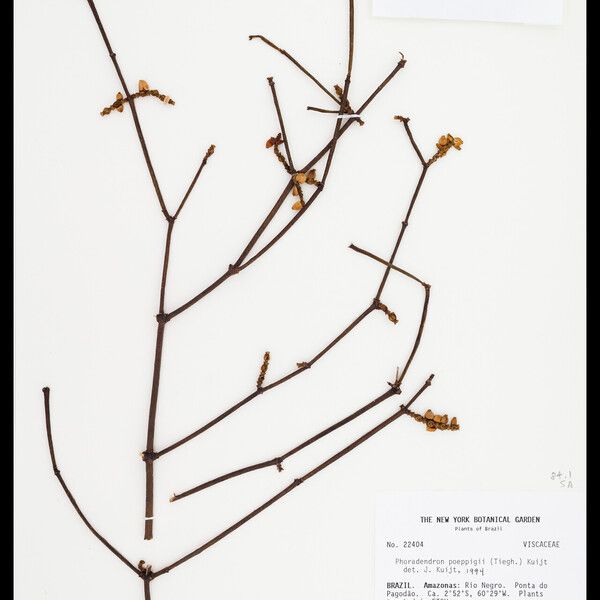
Plant Overview
Often referred to as the "Tree Thief," Phoradendron poeppigii is a fascinating green hitchhiker commonly found clinging to the high branches of tropical hardwoods. This hemiparasitic mistletoe is a master of survival, blending the ability to perform photosynthesis with a clever strategy of "stealing" water and minerals from its host tree. In many cultures, its evergreen presence high in the canopy has linked it to themes of persistence and hidden life.
🔍 How to Identify
- 🌿 Leathery Foliage: The leaves are thick, waxy, and yellowish-green, typically shaped like elongated ovals. They grow in "opposite" pairs, meaning two leaves emerge from the same point on the stem.
- 🎋 Jointed Stems: The branches are notably brittle and segmented. They often form dense, spherical "bushes" that can grow up to a meter wide, looking like a bird's nest tucked into the tree.
- ⚪ Translucent Berries: It produces small, pearl-like berries that are fleshy and filled with a remarkably sticky, glue-like pulp.
🏡 In Your Garden
- 🌳 The Guest from Above: Unlike most garden plants, this mistletoe doesn't use soil. It uses specialized roots called haustoria to pierce the bark of a host tree (often legumes or citrus) to siphon off sap. While a small amount is harmless, a heavy "infestation" can weaken the host tree over several years.
- ✂️ Control and Management: Because the "roots" of Phoradendron poeppigii live inside the wood of the host, simply pulling it off won't work—it will grow back. If it appears on a prized garden tree, the best way to remove it is to prune the entire infested branch at least 12 inches below the point of attachment.
⚠️ Safety & Toxicity
- 🚫 Toxic Status: All parts of the plant, especially the white berries, contain phoratoxins which are poisonous if ingested.
- 🐾 Pets & Children: Keep fallen berries away from curious toddlers and pets. Ingestion can lead to severe stomach upset, a slowed heart rate, and blurred vision. Always wear gloves when handling or pruning it to avoid potential skin irritation.
✨ Fun Fact
The name Phoradendron literally translates from Greek as "Tree Thief." Its seeds are coated in a substance called viscin, a biological superglue so strong that it allows the seed to stick to a slippery branch—even through heavy tropical rainstorms—until it can germinate.

Detailed Care Instructions







