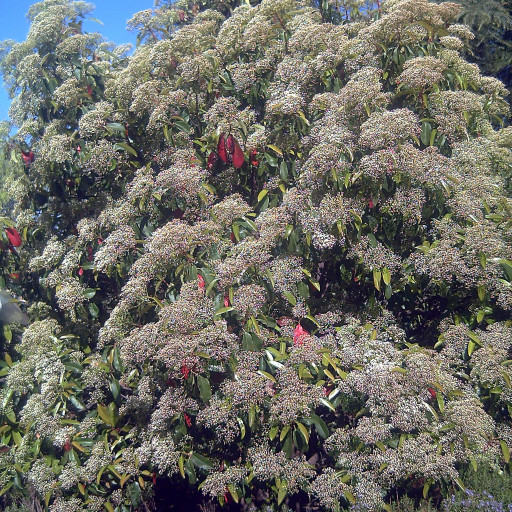
Plant Overview
Known as the Chinese Photinia, this evergreen giant is the rugged ancestor of many popular hedge plants. While it is often used to create dense, "living walls" for privacy, it can naturally grow into a magnificent, wide-spreading tree. In early spring, it transforms with a flush of bronze-red new leaves and massive clusters of creamy flowers that dominate the landscape.
🔍 How to Identify
- 🍃 Saw-Toothed Leaves: The foliage is thick, glossy, and oblong, featuring very distinct "serrated" edges (hence the name serratifolia) that look like a fine-toothed saw.
- 🌿 Color Transition: New spring growth emerges in a striking copper or bronze-red hue, eventually maturing into a deep, leathery emerald green.
- 🌸 Flat Flower Clusters: It produces large, flat-topped bunches (corymbs) of tiny white flowers, which are followed by small, round berries that turn from bright red to purplish-black.
🏡 In Your Garden
- 🧱 The Privacy Specialist: Because it grows rapidly and maintains dense foliage year-round, it is one of the best choices for sound barriers or tall privacy screens. However, it requires regular pruning if you want to keep it in "shrub" form.
- 🌬️ Airflow is Key: This species is famously susceptible to "Leaf Spot" (dark circular dots on the leaves). To prevent this, avoid overhead watering and ensure the plant isn't crowded, allowing the wind to dry the leaves quickly.
- 🍂 Self-Cleaning Habit: Don't be alarmed if you see yellow or red leaves dropping in summer; the plant naturally sheds its older interior leaves to make room for fresh growth.
⚠️ Safety & Toxicity
- 🐾 Toxic to Pets: Caution is advised. The leaves and berries contain cyanogenic glycosides. If chewed or swallowed in large quantities, they can cause respiratory distress, drooling, and stomach upset in dogs, cats, and horses.
- 👃 Scent Warning: The spring flowers have a very strong, musky scent that some find unpleasant. It is often described as "hawthorn-like" or slightly "fishy," designed to attract flies and beetles for pollination rather than bees.
✨ Fun Fact
- 🧬 A Famous Parent: Photinia serratifolia is one of the proud parents of the world-famous 'Red Robin' (Photinia x fraseri). While 'Red Robin' is more popular for its bright red leaves, the original Chinese Photinia is much hardier and can live for over 50 years!

Detailed Care Instructions
To grow a Photinia Serratifolia plant, also known as Chinese Photinia or Photinia serrulata, you can follow these steps:
- Choose the right location: Photinia Serratifolia plants thrive in full sun to partial shade. Select a spot in your garden that receives at least 6 hours of sunlight per day.
- Soil preparation: Ensure the soil is well-drained and fertile. If the soil is heavy clay, you can amend it with organic matter like compost to improve drainage.
- Planting: Dig a hole twice as wide and slightly deeper than the root ball of the plant. Gently remove the plant from its container and place it in the hole. Backfill the hole with soil, firming it gently around the base of the plant.
- Watering: Water the newly planted Photinia Serratifolia deeply to settle the soil and help the plant establish its root system. Keep the soil moist but not overly saturated. Once established, water the plant deeply once or twice a week, depending on weather conditions.
- Mulching: Apply a layer of organic mulch around the base of the plant to conserve moisture, suppress weeds, and keep the soil cool. Keep the mulch a few inches away from the plant's stem to avoid root rot.
- Pruning: Photinia Serratifolia plants can benefit from regular pruning to maintain their shape and encourage dense growth. Prune in early spring before new growth appears. Remove any dead or damaged branches and shape the plant as desired. Avoid excessive pruning during the growing season to prevent stress to the plant.
- Fertilizing: Apply a balanced, slow-release fertilizer in early spring and early fall to provide essential nutrients to the plant. Follow the instructions on the fertilizer packaging for proper application.
- Pest and disease control: Photinia Serratifolia plants are generally resistant to pests and diseases. However, occasional pests like aphids or spider mites can infest them. Monitor the plant regularly, and if necessary, use organic pest control methods or contact a local nursery for advice.
By following these steps and providing proper care, your Photinia Serratifolia plant should grow well and thrive in your garden.

Place in a bright room that is sun drenched almost all day. Or directly in a south-facing window.

Photinia Serratifolia plant should be watered regularly to keep the soil moist but not waterlogged. The best way to water it is to pour water at the base of the plant so that the water reaches the roots directly. It is important to avoid getting the leaves wet as this can lead to fungal diseases. The frequency of watering will depend on the environment and weather conditions, but generally, the plant should be watered once or twice a week. In hot and dry conditions, it may need to be watered more frequently. Regularly checking the soil moisture level is a good practice to ensure the plant is getting enough water. If the top layer of soil feels dry to the touch, it is time to water it. Overwatering can damage the plant, so it is important to ensure that the soil has adequate drainage to prevent waterlogging.
To fertilize this plant, first, choose a balanced fertilizer with equal amounts of nitrogen, phosphorus, and potassium. During the growing season, apply the fertilizer every four to six weeks. Use a granular fertilizer and sprinkle it around the base of the plant, making sure not to get any on the leaves. Water the plant well after applying the fertilizer to help it absorb the nutrients. Be careful not to over-fertilize as this can harm the plant.
For optimal growth and health of the Photinia Serratifolia plant, it is recommended to use a well-draining soil mix with balanced nutrients. The soil should have a slightly acidic pH level ranging from 5.5 to 6.5. Adding organic matter to the soil mix can improve its structure and moisture-retaining capacity. Additionally, the soil should be supplied with regular fertilization during the growing season to promote healthy growth and foliage. It is important to refrain from overwatering, as this can cause root rot and other issues.
- Look for a healthy and mature Photinia Serratifolia plant.
- Locate a stem that has a green and pliable stem tip.
- Using a sharp and sterilized cutting tool, cut a 6-inch stem length from the chosen stem.
- Strip off any leaves from the lower one-third part of the stem.
- Dip the end of the stem in rooting hormone powder.
- Insert the stem 2 inches deep in a clear and clean container filled with peat moss and sand mix.
- Lightly water the soil mixture and cover the container with a plastic bag.
- Place the container in a shaded area with temperatures around 60-70°F.
- Check the soil moisture level every two days and water as needed to constantly keep the soil moist.
- After several weeks, the stem should develop roots and new leaves.
- Once the new plant has healthy leaves and a good root system, it can be transplanted to a larger container or directly into the ground.








