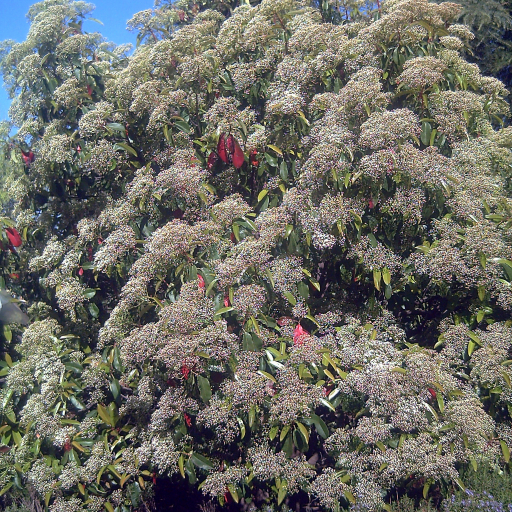
Plant Overview
Known as the Chinese Photinia, this robust evergreen is celebrated for its "shining" foliage that transitions through a palette of fiery reds and deep, leathery greens. Originally from East Asia, it has been a staple in grand estates for centuries, often acting as a living privacy wall that looks like a captured sunset during the spring growth spurt.
🔍 How to Identify
- 🍃 Serrated Leaves: Look for dark green, oblong leaves with distinct "saw-tooth" edges—the name serrulata actually means "finely sawed."
- 🔴 Fiery New Growth: In early spring, the young leaves emerge in a brilliant bronze or deep crimson, providing a sharp contrast against the older, darker foliage.
- 🌼 Lacy Clusters: It produces large, flat-topped clusters of tiny, creamy-white flowers that can span up to six inches across.
🏡 In Your Garden
- 🌳 The Living Screen: Because it can grow into a massive shrub or even a small tree, it is perfect for blocking out noisy neighbors or unsightly views. However, it requires regular pruning to maintain a dense shape.
- 🌬️ Space is Key: This plant is susceptible to "leaf spot" fungus in humid climates. To keep it healthy, plant it where there is plenty of air circulation rather than crowding it into a tight corner.
- 👃 The Scent Factor: Be aware that while the flowers are beautiful, their scent is quite polarizing—often described as musky or "hawthorn-like"—so you might not want it directly under a frequently opened window.
⚠️ Safety & Toxicity
- 🐾 Toxic to Pets: The leaves and fruit contain cyanogenic glycosides, which can be dangerous if chewed or swallowed by dogs, cats, or horses.
- 👶 Berries and Kids: While the small red berries (which turn black) look attractive to children, they can cause stomach upset and should never be ingested.
✨ Fun Fact
The genus name Photinia is derived from the Greek word photeinos, which means "shining." This is a tribute to the incredibly glossy, light-reflective surface of the leaves that makes the plant appear to glow after a rain shower.

Detailed Care Instructions
To grow Photinia serrulata, also known as Chinese photinia or Chinese hawthorn, follow these steps:
- Choose a suitable location: Chinese photinia prefers a sunny or partially shaded spot with well-draining soil.
- Propagation: Photinia serrulata can be propagated from seeds or stem cuttings. If starting from seeds, collect ripe berries from existing plants and remove the pulp. Rinse the seeds and sow them in a seed tray filled with a well-draining potting mix. Keep the soil moist and place the tray in a warm area with indirect sunlight until germination occurs. If using stem cuttings, take 4-6 inch cuttings from healthy growth, remove the lower leaves, and dip the cut end in rooting hormone. Plant the cuttings in a pot filled with a mixture of potting soil and perlite, keeping the soil consistently moist until rooted.
- Planting: Once the seedlings or rooted cuttings are ready for planting, choose a location with enough space for the mature size of the plant, as Chinese photinia can reach heights of 10-15 feet (3-4.5 meters) with a spread of 6-10 feet (1.8-3 meters). Dig a hole twice the size of the plant's root ball and amend the soil with organic matter if necessary. Gently place the plant in the hole, making sure the top of the root ball is level with the soil surface. Backfill the hole with soil and firm it gently around the base of the plant.
- Watering: Chinese photinia prefers evenly moist soil but can tolerate drought once established. Water regularly, especially during dry periods, and ensure the soil doesn't become waterlogged.
- Mulching: Apply a layer of organic mulch, such as wood chips or shredded bark, around the base of the plant. Mulch helps retain soil moisture, suppresses weeds, and keeps the root system cool.
- Pruning: Photinia serrulata benefits from regular pruning to maintain its shape and promote bushier growth. Prune in late winter or early spring before new growth emerges. Remove dead, damaged, or crossing branches and lightly trim the outermost growth to encourage dense foliage.
- Fertilization: Chinese photinia generally doesn't require excessive fertilization. In early spring, apply a balanced slow-release fertilizer according to package instructions to provide essential nutrients for healthy growth.
- Pest and disease management: Chinese photinia can be susceptible to various pests and diseases, including leaf spot, aphids, and scale insects. Monitor the plant regularly for signs of infestation or disease and take appropriate action, such as using organic pest control methods or seeking professional advice if necessary.
By following these guidelines, you can successfully grow and enjoy Photinia serrulata in your garden or landscape.
To water the plant, first, ensure that the soil is dry to the touch before watering. When watering, use a watering can or a hose with a gentle spray to avoid overwatering or damaging the plant's roots. Water around the base of the plant and avoid getting water on its leaves or foliage. Water in the early morning or evening to avoid evaporation in hot weather. Adjust the watering frequency according to the plant's needs in different seasons and weather conditions. It is essential to maintain adequate moisture in the soil, but avoid waterlogging. A properly watered plant will have healthy foliage and growth.
- Begin by selecting a water-soluble fertilizer specifically formulated for shrubs or evergreens.
- Follow the instructions for dilution, which are typically listed on the package or bottle. In general, a dilution ratio of 1 tablespoon of fertilizer per gallon of water is suitable for most plants.
- Apply the fertilizer to the soil around the base of the plant, making sure to avoid getting it on the leaves or stems.
- Use a watering can or hose to water the fertilizer into the soil, making sure to thoroughly saturate the area.
- Repeat the fertilization process every 4-6 weeks during the growing season, which is typically spring through fall. However, be sure to adjust the frequency and amount of fertilizer applied based on the specific needs of your plant and the environment it is growing in.
- Monitor the health and growth of the plant throughout the fertilization process to ensure the fertilizer is providing the proper nutrients and not causing any negative effects.
When planting the Photinia Serrulata plant, it is important to use a well-draining soil that is rich in organic matter. The soil pH should be slightly acidic, with a range of 5.5 to 6.5. It is recommended to use loamy soil that is well-aerated and retains moisture but does not become waterlogged. Sandy soils are also suitable for this plant, as they provide good drainage. The soil should be free from rocks, debris, and other foreign materials that can inhibit root development. A soil mix of equal parts garden soil, peat moss, and perlite can be used for planting the Photinia Serrulata plant. Organic fertilizers can be added to the soil to provide nutrients for the plant. It is important to keep the soil moist but not soggy, as overwatering can lead to root rot and other problems.
Propagation of this plant can be done by taking stem cuttings in the spring or early summer. Select a healthy, young stem with several leaves and remove any flowers or berries. Cut the stem at a 45-degree angle just below a node, which is where leaves attach to the stem.
Remove the lower leaves from the stem, leaving only a few at the top. Dip the cut end of the stem in rooting hormone powder and plant it in a well-draining potting mix. Water the plant and cover it with a clear plastic bag to create a humid environment.
Place the pot in a warm, bright location but out of direct sunlight. Mist the plant daily and monitor the soil moisture, keeping it consistently moist but not waterlogged. After a few weeks, the plant should start producing new growth, indicating it has rooted successfully.
Once the new plant has established roots, it can be gradually acclimated to lower humidity and bright, indirect sunlight. Once it has outgrown its container, it can be transplanted into the ground or a larger pot.








