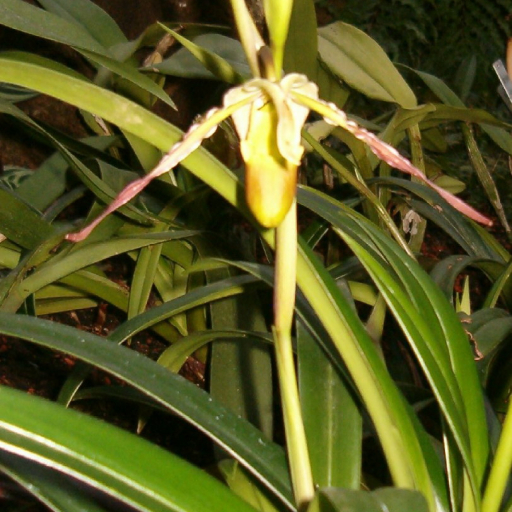
Plant Overview
Affectionately known as the Long-Leaved Slipper Orchid, this elegant species is a crown jewel of the Neotropics, ranging from Mexico down to the misty slopes of the Andes. Unlike many of its cousins that prefer a dry rest, this orchid is a thirsty traveler that thrives near splashing waterfalls and damp riverbanks. It is celebrated by collectors for its "ever-blooming" habit, where one flower opens just as another begins to fade, providing a nearly year-round display of prehistoric-looking beauty.
🔍 How to Identify
- 🍃 Sword-Like Foliage: The plant features long, arching, strap-shaped leaves that are a deep, waxy green. Unlike some orchids that grow in clumps, these leaves form a distinct fan-like shape.
- 👞 The Slipper Pouch: The most striking feature is the "labellum," a modified petal that forms a deep, hollow pouch. It is typically a blend of mahogany, lime green, and cream, designed to trap insects for pollination.
- 🎀 Ribbon Petals: Two long, narrow petals droop from the sides of the flower like elegant ribbons. These can sometimes twist slightly, adding a sense of movement to the bloom.
🏡 In Your Garden
- 💧 The "Wet Feet" Rule: While most orchids rot if kept too wet, Phragmipedium longifolium is a rare exception. It prefers to stay consistently moist and hates drying out completely; many growers keep the pot sitting in a shallow tray of fresh water.
- ☁️ Humidity is Key: Coming from cloud forests and riverbanks, it requires high humidity to thrive. If the air is too dry, the tips of those long, beautiful leaves will turn brown and crispy.
- 🧪 Mineral Sensitivity: This plant is a bit of a "clean water snob." It is highly sensitive to the salts and minerals found in tap water, so it performs best when hydrated with rainwater, distilled water, or reverse-osmosis water.
⚠️ Safety & Toxicity
- 🐾 Pet Friendly: Generally considered non-toxic to cats, dogs, and horses. It is a safe choice for a household with curious four-legged friends.
- 🧤 Skin Sensitivity: While not poisonous, the sap from a broken stem or the tiny hairs on the leaves can occasionally cause mild skin irritation for people with very sensitive skin. It’s always best to wash your hands after pruning.
✨ Fun Fact
The Phragmipedium longifolium is a "sequential bloomer." Instead of producing a giant cluster of flowers all at once, the flower spike grows slowly over many months, producing one or two flowers at a time. A single spike can keep a plant in bloom for over half a year!

Detailed Care Instructions
To grow Phragmipedium longifolium (also known as the Lady's Slipper orchid), follow these guidelines:
- Climate and lighting: Phragmipedium longifolium prefers a temperate climate with mild temperatures (around 20-25 degrees Celsius) during the day and slightly cooler temperatures at night. Provide it with bright, indirect sunlight. Avoid direct sunlight as it can scorch the leaves.
- Potting medium: Use a well-draining orchid mix or a combination of sphagnum moss, charcoal, and perlite. The medium should allow good air circulation and drainage.
- Watering regime: Water the plant thoroughly once the top layer of the potting medium feels dry. Avoid overwatering, as it can lead to root rot. The frequency of watering will depend on the climate and the potting medium used.
- Humidity: Maintain high humidity levels by placing a tray filled with water near the plant or using a humidifier. Mist the leaves occasionally to mimic the plant's natural environment.
- Fertilization: Use a balanced, water-soluble orchid fertilizer diluted to half strength. Apply every two to four weeks during the growing season (spring and summer). Reduce fertilization during the winter months.
- Repotting: Phragmipedium longifolium can be repotted every 2-3 years or when it outgrows its current container. Repot the orchid during spring or after flowering. Carefully remove the old potting medium and trim any dead or damaged roots before transferring it to a slightly larger pot with fresh medium.
- Grooming: Remove any dead or yellowing leaves to maintain the plant's appearance and prevent the spread of diseases.
- Temperature fluctuations: Some Phragmipedium species require a temperature drop at night to trigger blooming. You can simulate this by keeping the plant in a cooler area of your home during the night.
- Pests and diseases: Watch out for common orchid pests like aphids, mealybugs, and spider mites. Treat any infestations promptly using organic insecticides or by manually removing the pests. Ensure good air circulation around the plant to prevent fungal infections.
- Patience: Growing and blooming Phragmipedium longifolium can take time and patience. It may take a couple of years for the plant to mature and produce flowers.
Remember to research specific requirements for Phragmipedium longifolium as each orchid species may have slightly different care needs.

Place in a window with dappled sun or a spot in the middle of a room. Or directly in a window facing west or east.

To properly water this plant, it is important to first understand its growing environment and preferences. The Phragmipedium Longifolium plant requires consistent moisture in its soil, but not to the point of waterlogging. Therefore, the soil should be kept moist but well-drained.
To achieve this, you can water the plants deeply every four to five days, ensuring that the water seeps down into the roots. Always wait until the top layer of soil is dry before watering. It is also important to avoid allowing the plant to sit in standing water as this can lead to root rot.
When watering, it is recommended to use room temperature water to avoid shocking the roots with cold water. Additionally, avoid getting water on the leaves as this can increase the risk of fungal disease.
It is important to monitor the plant regularly and adjust watering as necessary based on environmental factors such as temperature and humidity. With proper care, the Phragmipedium Longifolium plant can thrive and produce beautiful blooms.
For best results, use a balanced fertilizer with an N-P-K ratio of 20-20-20 every other week during the growing season. During the dormant season, reduce fertilization to once a month. Always dilute the fertilizer to half strength and water the plant before and after fertilizing to prevent burning the roots. Use a fertilizer with micronutrients, such as iron, manganese, and zinc, to ensure the plant receives all essential nutrients. Avoid fertilizing during hot summer months or when the plant is under stress.
Phragmipedium Longifolium requires well-draining soil that has a slightly acidic to neutral pH range. The soil should be a mixture of organic matter, such as sphagnum peat moss and bark, combined with some perlite or sand to provide drainage. It is important to ensure that the soil is not waterlogged, as this can lead to root rot. Additionally, adding a slow-release fertilizer to the soil mix can provide the necessary nutrients for healthy growth. Overall, a well-draining, slightly acidic to neutral soil with organic matter and some perlite or sand is ideal for Phragmipedium Longifolium.
To propagate this plant, the first step is to prepare a cutting. Take a sharp, sterilized knife or scissors and make a clean cut just below a leaf node. The cutting should be around 3-4 inches long and have several leaves.
Next, dip the cut end into rooting hormone powder to encourage the formation of roots. Then, plant the cutting into a pot filled with a well-draining mix of soil and perlite. Make sure the soil is moist but not waterlogged.
Cover the pot with a plastic bag or wrap to create a humid environment for the cutting. Place the pot in a bright, warm location that receives indirect sunlight.
Over the next few weeks, the cutting should begin to root and new growth should appear. Once the plant has established roots and is growing well, it can be transplanted into a larger pot or planted outside in a suitable location.








