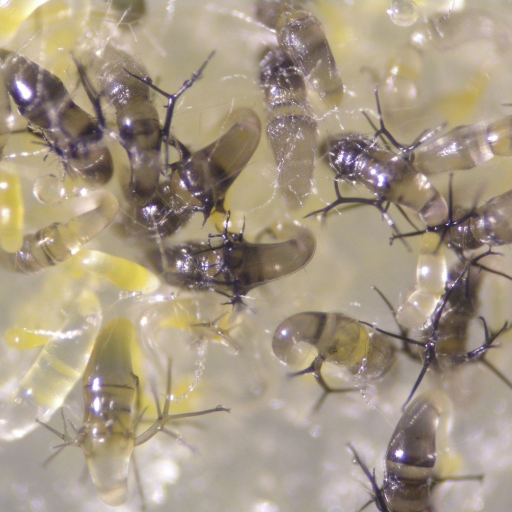
Plant Overview
Known as the "Light-Seeking Mold" or the "Scientific Pin Mold," Phycomyces blakesleeanus is a fascinating fungus that looks more like a collection of glass needles than a living organism. While it belongs to the mold family, it has gained fame in laboratories worldwide for its incredible "vision." It behaves almost like a plant, stretching its shimmering stalks toward the light with a level of precision that rivals many complex organisms.
🔍 How to Identify
- 🪡 The Sporangiophores: The most striking feature is its long, hair-like stalks that can reach up to 10 centimeters in length. They look like translucent, silver-grey threads.
- 📍 The "Pinhead": At the very tip of each thread sits a tiny, dark sphere called a sporangium. This "head" contains the spores and looks like a miniature black pearl.
- ✨ Metallic Luster: When hit by direct light, the entire colony often gives off a metallic or crystalline shimmer, making it appear far more beautiful than your average bread mold.
🌲 Habitat & Ecology
- 💩 Specific Substrate: In the wild, this fungus is a specialist. It is most commonly found growing on nutrient-rich organic matter, particularly the dung of herbivorous animals or oily seeds.
- 📡 Environmental Sensors: It acts like a biological satellite dish. It can detect light, gravity, wind, and even the presence of nearby solid objects (avoidance response) without ever touching them, allowing it to position its spores for the perfect wind-dispersal.
- 🧪 Laboratory Star: Because its stalks are giant single cells, it has been a favorite subject for scientists since the 19th century to study how living things respond to their environment.
⚠️ Safety & Toxicity
- 🛑 WARNING: While Phycomyces blakesleeanus is not considered a "deadly" mold like some household black molds, it is a fungus associated with decay and is not edible.
- 🤧 Allergy Alert: Like all molds, it reproduces via airborne spores. Inhaling large concentrations can cause respiratory irritation or allergic reactions in sensitive individuals, children, or pets. If found on old food or organic waste, it should be disposed of carefully.
✨ Fun Fact
Phycomyces is so sensitive to light that it can "see" and grow toward a light source as faint as a single candle burning 50 feet away. Its sensitivity to light is remarkably similar to that of the human eye!

Detailed Care Instructions
Phycomyces blakesleeanus is a type of fungus that grows on decaying organic matter and requires moist conditions to thrive. In order to water this plant, one should carefully moisten the soil or substrate on which it is grown and ensure that it remains damp but not overly wet. Watering frequency will depend on humidity levels and the moisture content of the growing medium, but generally, it should be watered when the soil feels dry to the touch. Overwatering should be avoided as it can lead to root rot and other fungal diseases, and the plant should be allowed to dry out slightly between waterings. Additionally, to prevent contamination, the watering container should be kept clean, and tap water should be allowed to stand for at least 24 hours to allow chlorine to dissipate before use.
Phycomyces blakesleeanus is a fungus that requires specific soil conditions for optimal growth. The recommended soil for this species has a neutral pH and is well-aerated, free-draining, and nutrient-rich. The ideal mix includes a combination of sand, peat moss, and perlite. The soil should be sterilized to prevent contamination by other microorganisms. Proper soil selection is crucial for the growth and development of Phycomyces blakesleeanus. It is important to note that this species may have different soil requirements depending on the specific strains and growing conditions.







