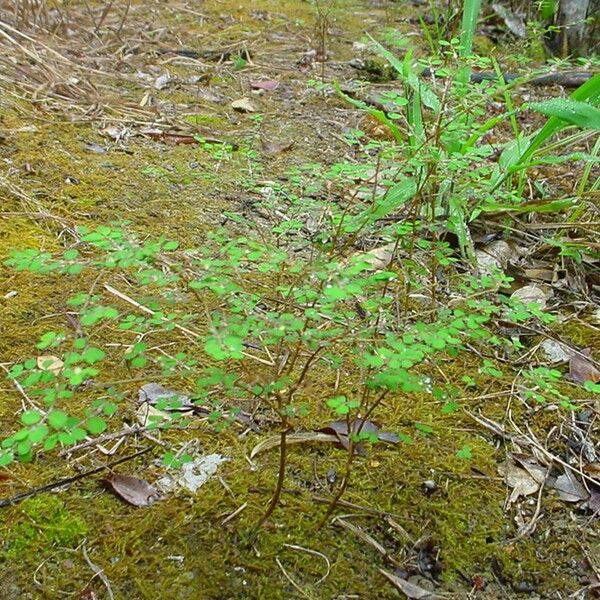
Plant Overview
Often called the Seed-under-leaf or Wiry Leaf-flower, Phyllanthus virgatus is a slender, architectural beauty that hides its treasures out of plain sight. Native to parts of Asia and Australia, this plant is frequently mistaken for a common weed due to its resilient nature, but it possesses a delicate, geometric charm. It is a master of camouflage, tucking its tiny flowers and seed pods beneath its branchlets to protect them from the harsh midday sun.
🔍 How to Identify
- 🌿 The Foliage: The leaves are small, oblong, and arranged in two neat rows along the stems. At first glance, they look like compound fern-like leaves, but they are actually simple leaves on very thin branchlets.
- 🎋 The Stems: It features thin, wiry stems that often take on a reddish or bronze hue as they age, growing upright or slightly spreading.
- 🎈 The "Hidden" Fruit: If you flip a branch over, you will see tiny, round seed capsules (fruits) hanging on short stalks directly beneath the leaves, giving the plant its famous nickname.
🏡 In Your Garden
- ☀️ Sun Seeker: This plant is incredibly hardy and thrives in full sun to partial shade. It is often found in grasslands and disturbed soils, meaning it can handle "tough love" and poor soil conditions where other plants might struggle.
- ⚓ Deep Roots: It develops a surprisingly strong taproot for such a thin plant. This makes it very drought-tolerant once established, but it also means it dislikes being moved. If you want it in a specific spot, it is best to let it grow from seed there rather than trying to transplant an older specimen.
⚠️ Safety & Toxicity
- 🟢 General Status: Generally considered non-toxic to humans and common livestock, but caution is always advised.
- 🐾 Pet Watch: While not listed as a major toxin, the milky sap found in many members of the Phyllanthaceae family can cause mild stomach upset or skin irritation in sensitive pets if chewed in large quantities.
✨ Fun Fact
The name Phyllanthus is derived from the Greek words "phyllon" (leaf) and "anthos" (flower). This is because the flowers of these plants are so closely tucked against the stems that they appear to be blooming directly out of the leaves themselves!

Detailed Care Instructions
Growing Phyllanthus virgatus, a member of the Phyllanthaceae family and known for its slender stems and small leaves, requires some specific steps to ensure healthy growth. Here’s a guide to help you:
1. Climate and Location:
Phyllanthus virgatus thrives in a warm climate and is commonly found in tropical and subtropical regions. Ensure you have a suitable climate or create a controlled environment if you're in a cooler area.
2. Sunlight:
This plant prefers full sun to partial shade. Ensure it receives at least 4-6 hours of direct sunlight daily for optimal growth.
3. Soil:
- Type: Well-draining soil is essential to prevent waterlogging and root rot. A sandy or loamy soil mix works well.
- pH: The plant prefers slightly acidic to neutral soil (pH 6.0-7.5).
4. Watering:
- Frequency: Water the plant regularly to keep the soil moist but not soggy. Overwatering can lead to root rot.
- Dry Periods: Ensure the soil dries out slightly between watering periods.
5. Planting:
- Seeds or Cuttings: Phyllanthus virgatus can be grown from seeds or stem cuttings.
- Depth: If using seeds, sow them about 1/4 inch deep in the soil. For cuttings, plant them directly in a moist, well-draining potting mix.
- Spacing: Ensure enough space between plants to allow air circulation and prevent fungal infections.
6. Fertilizing:
- Type: Use a balanced, slow-release fertilizer to provide essential nutrients.
- Frequency: Apply fertilizer every 6-8 weeks during the growing season (spring and summer). Reduce feeding in fall and winter.
7. Pruning:
- Purpose: Prune the plant to maintain its shape and encourage bushier growth.
- Method: Remove dead or diseased branches and any leggy stems to promote healthier growth.
8. Pests and Diseases:
- Common Pests: Watch out for common pests like aphids, spider mites, and whiteflies.
- Prevention: Regularly inspect the plant and use organic insecticides if necessary. Ensure good air circulation around the plant to prevent fungal diseases.
9. Container Growing:
If you're growing Phyllanthus virgatus in a pot, ensure the container has good drainage holes. Use a potting mix suitable for tropical plants and follow the same care guidelines.
10. Propagation:
- Seed Collection: If propagating from seeds, collect seeds from mature plants and sow them in a suitable growing medium.
- Cuttings: Take 4-6 inch cuttings from healthy plants, remove the lower leaves, dip the cut end in rooting hormone, and plant in a moist potting mix.
By following these steps, you should be able to successfully grow and enjoy your Phyllanthus virgatus plant. Remember, consistent care is key to thriving plants.

Place in a bright room that is sun drenched almost all day. Or directly in a south-facing window.

Watering Phyllanthus virgatus requires attention to seasonal changes and soil conditions to promote healthy growth. Here's a detailed guide on how to effectively water this plant:
### Soil Requirements
- Well-draining Soil: Ensure the plant is in well-draining soil to prevent waterlogging. A mix of sand, loam, and a bit of organic compost works well.
### Watering Schedule
- Growing Season: During its active growing season, which is typically in the warmer months, water the plant regularly to keep the soil consistently moist but not waterlogged.
- Dormant Season: In the dormant season or cooler months, reduce watering frequency. Allow the soil to dry out between waterings.
### Watering Method
- Deep Watering: Water deeply so that the moisture reaches the root zone. This encourages deep root growth.
- Surface Check: Before watering, check the top 1-2 inches of soil. If it's dry, it’s time to water. If it’s still moist, hold off watering for a few more days.
### Environmental Considerations
- Humidity: If you are growing the plant in an area with low humidity, you might need to water more frequently.
- Potted Plants: For container-grown plants, ensure the pot has good drainage holes to prevent water from sitting at the bottom.
- Mulching: Applying a layer of mulch can help retain soil moisture and reduce the need for frequent watering.
### Monitoring
- Overwatering Signs: Yellowing leaves and root rot are signs of overwatering. Adjust your schedule if you notice these symptoms.
- Underwatering Signs: Wilting or dry, crispy leaves indicate underwatering. Increase watering frequency in this case.
By following these guidelines, you can maintain the right moisture levels needed for the health and growth of Phyllanthus virgatus.
Here's how you can fertilize Phyllanthus Virgatus:
- Frequency: Fertilize during the growing season, which is typically spring through early autumn. Avoid fertilizing in the winter when the plant's growth slows down.
- Type of Fertilizer: Use a balanced, water-soluble fertilizer with an N-P-K ratio of around 10-10-10 or 20-20-20. This ensures the plant gets an even supply of essential nutrients.
- Dilution: Dilute the fertilizer to half the recommended strength on the packaging. This minimizes the risk of over-fertilization, which can harm the plant.
- Application Method: Apply the diluted fertilizer solution directly to the soil around the base of the plant. Ensure you water the plant thoroughly before and after fertilizing to help distribute the nutrients evenly and prevent root burn.
- Quantity: For each application, use about a gallon of the diluted solution for medium-sized plants. Adjust the quantity proportionally for smaller or larger plants.
- Frequency of Application: Fertilize every 4-6 weeks during the active growing period. Monitor the plant's health and growth; if it shows signs of nutrient deficiency (such as slow growth or pale leaves), you may need to adjust the frequency or concentration.
- Organic Alternatives: If you prefer organic options, you can use compost or well-rotted manure. Apply a 1-inch layer of compost or a small amount of manure around the base of the plant and water it in well.
- Monitoring: Keep an eye on the plant for any signs of over-fertilization, such as yellowing leaves or burnt leaf edges. If these symptoms appear, flush the soil with plenty of water to wash away excess salts and reduce the fertilization frequency or concentration.
Following these guidelines will help ensure your Phyllanthus Virgatus remains healthy and grows robustly.
Phyllanthus virgatus prefers well-draining soil that can retain some moisture without becoming waterlogged. Here are the specific soil requirements for optimal growth:
- Soil Composition:
- Loamy Soil: A mix of sand, silt, and clay. This type of soil is ideal as it provides good drainage while retaining nutrients and moisture.
- Sandy Soil: Enhances drainage, which is essential to prevent root rot. However, sandy soil should be mixed with organic matter to retain adequate moisture and nutrients.
- Loamy Soil: A mix of sand, silt, and clay. This type of soil is ideal as it provides good drainage while retaining nutrients and moisture.
- pH Level:
- The soil should be slightly acidic to neutral, with a pH range of 6.0 to 7.0.
- The soil should be slightly acidic to neutral, with a pH range of 6.0 to 7.0.
- Organic Matter:
- Adding organic matter such as compost or well-rotted manure will improve soil fertility and structure, which in turn supports healthy plant growth.
- Adding organic matter such as compost or well-rotted manure will improve soil fertility and structure, which in turn supports healthy plant growth.
- Drainage:
- Ensure the soil has excellent drainage properties. You can achieve this by adding perlite or coarse sand to the soil mix to enhance aeration and prevent stagnant water around the roots.
- Ensure the soil has excellent drainage properties. You can achieve this by adding perlite or coarse sand to the soil mix to enhance aeration and prevent stagnant water around the roots.
- Fertility:
- Although not exceptionally needy in terms of nutrients, a balanced, slow-release fertilizer can be beneficial, especially during the growing season.
- Although not exceptionally needy in terms of nutrients, a balanced, slow-release fertilizer can be beneficial, especially during the growing season.
- Mulch:
- Applying a layer of mulch can help retain moisture, regulate soil temperature, and reduce weed competition.
Remember to always water the plant adequately but avoid overwatering, as Phyllanthus virgatus is sensitive to waterlogged conditions. Regular monitoring of soil moisture levels can help maintain the right balance.
- Applying a layer of mulch can help retain moisture, regulate soil temperature, and reduce weed competition.
Propagating Phyllanthus virgatus, a plant known for its slender, wiry stems and delicate leaves, can be achieved through two primary methods: seed propagation and cuttings. Here's a detailed guide on how to propagate it using these methods:
Seed Propagation
- Collection of Seeds:
- Collect seeds from mature plants. The seeds are typically found in small capsules that split open when they’re ripe.
- Collect seeds from mature plants. The seeds are typically found in small capsules that split open when they’re ripe.
- Preparation:
- Clean the seeds to remove any residue or pulp. This helps to prevent mold and increases the chances of successful germination.
- Clean the seeds to remove any residue or pulp. This helps to prevent mold and increases the chances of successful germination.
- Sowing the Seeds:
- Fill small pots or seed trays with a well-draining seed-starting mix.
- Sow the seeds on the surface of the soil and lightly cover them with a thin layer of the mix, as these seeds often require light to germinate.
- Fill small pots or seed trays with a well-draining seed-starting mix.
- Watering:
- Water the soil gently to keep it moist but not soggy. Using a spray bottle can help to apply moisture evenly without displacing the seeds.
- Water the soil gently to keep it moist but not soggy. Using a spray bottle can help to apply moisture evenly without displacing the seeds.
- Light and Temperature:
- Place the pots or seed trays in a warm location that receives bright, indirect light.
- Maintain a temperature between 20°C to 25°C (68°F to 77°F).
- Place the pots or seed trays in a warm location that receives bright, indirect light.
- Germination:
- Germination can take a few weeks. Be patient and ensure the soil remains consistently moist during this period.
- Once the seedlings are large enough to handle, they can be transplanted into individual pots.
Propagation by Cuttings
- Germination can take a few weeks. Be patient and ensure the soil remains consistently moist during this period.
- Selection of Cuttings:
- Choose healthy, non-flowering stems from the parent plant. Ideally, select stems that are about 10-15 cm (4-6 inches) long.
- Choose healthy, non-flowering stems from the parent plant. Ideally, select stems that are about 10-15 cm (4-6 inches) long.
- Preparation:
- Remove the lower leaves from the stem cuttings, leaving only a few leaves at the top.
- If desired, dip the cut end of the stem in rooting hormone to promote faster root development.
- Remove the lower leaves from the stem cuttings, leaving only a few leaves at the top.
- Planting the Cuttings:
- Insert the cut end into a pot filled with a well-draining potting mix, such as one made from equal parts peat and perlite.
- Ensure that at least one node (the point from which leaves grow) is buried in the soil, as this is where roots will develop.
- Insert the cut end into a pot filled with a well-draining potting mix, such as one made from equal parts peat and perlite.
- Watering:
- Water the soil thoroughly and ensure it remains consistently moist, but be careful not to overwater.
- Water the soil thoroughly and ensure it remains consistently moist, but be careful not to overwater.
- Light and Humidity:
- Place the pot in a location with bright, indirect light.
- To maintain high humidity, cover the pot with a plastic bag or place it in a propagator. Ensure there’s some ventilation to prevent mold growth.
- Place the pot in a location with bright, indirect light.
- Root Development:
- Roots should begin to develop within a few weeks. You can check root growth by gently tugging on the cuttings; resistance usually indicates that roots are forming.
- Once the cuttings have established a good root system, they can be transplanted into larger pots or directly into the garden.
By following these steps, you can successfully propagate Phyllanthus virgatus and enjoy its elegant presence in your garden or home.
- Roots should begin to develop within a few weeks. You can check root growth by gently tugging on the cuttings; resistance usually indicates that roots are forming.







