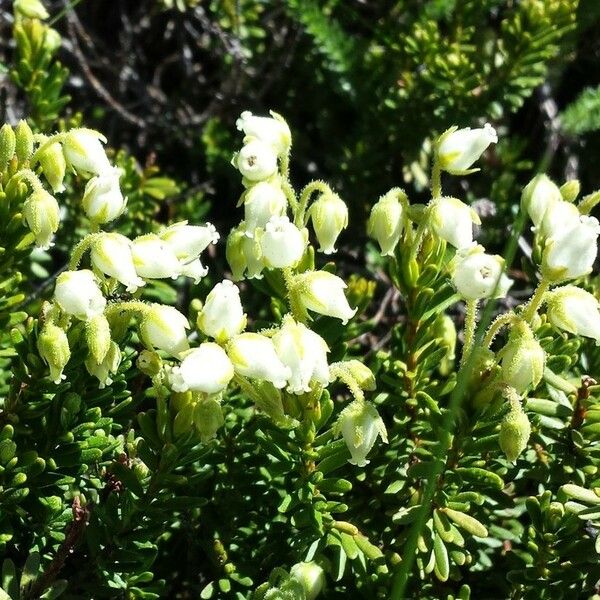
Plant Overview
Often called the Yellow Mountain Heather or Yellow Bell-heather, this rugged little shrub is a true survivor of the high-altitude wilderness. It is a staple of subalpine meadows across Western North America, where it forms dense, evergreen carpets against the backdrop of snowy peaks. Its scientific name, glanduliflora, refers to the tiny, sticky glands that cover its flowers—a secret weapon for surviving the harsh, drying winds of the alpine tundra.
🔍 How to Identify
- 🔔 The Flowers: Its signature feature is the drooping, urn-shaped flowers that range from cream to a pale sulfur-yellow. Unlike many heathers, these bells are narrow and slightly "pinched" at the opening.
- 🍯 Sticky Glands: If you look closely, the flower stalks and the base of the blooms are covered in fine, sticky hairs. These glandular hairs give the plant a slightly tacky feel and help deter crawling insects that might steal nectar without pollinating.
- 🌲 Needle-like Leaves: The leaves are dark green, thick, and resemble miniature pine needles. They are leathery to the touch and arranged spirally along the woody stems, allowing the plant to retain moisture during freezing winters.
🏡 In Your Garden
- 🏔️ Alpine Aspirations: This is a specialist plant. In a garden setting, it demands "alpine" conditions—specifically, gritty, highly acidic soil that mimics the rocky slopes of the Cascades or Rockies. It thrives in rock gardens where its roots can stay cool under stones.
- 💧 Drainage is Key: While it loves a "misty" environment, it hates stagnant water. It has evolved to live where snowmelt drains away quickly, so heavy clay soil is a death sentence for its delicate root system.
⚠️ Safety & Toxicity
- 🌿 Low Risk: Yellow Mountain Heather is generally considered non-toxic to humans. Unlike some of its cousins in the Ericaceae (Heath) family, it does not have a reputation for high toxicity.
- 🐾 Pet Watch: While not listed as a major hazard, the leathery, evergreen leaves of mountain shrubs can be difficult for dogs or cats to digest, potentially causing mild stomach upset if ingested in large quantities.
✨ Fun Fact
This plant is a master of "natural mixing." When the Yellow Mountain Heather grows near its cousin, the Pink Mountain Heather (Phyllodoce empetriformis), they frequently cross-pollinate to create a beautiful hybrid with intermediate purple-pink flowers known as Phyllodoce × intermedia.

Detailed Care Instructions
To grow Phyllodoce Glanduliflora (Mountain Heather), follow these steps:
- Climate: This plant thrives in cool, mountainous regions with moist, acidic soil. Ensure you have the right climate and soil conditions before planting.
- Soil Preparation: Phyllodoce Glanduliflora prefers acidic soil with a pH range of 4.5-5.5. If your soil is not naturally acidic, you can amend it with organic matter like peat moss or compost to lower the pH. Ensure good drainage as this plant does not tolerate waterlogged soil.
- Planting: Choose an area with partial shade to full sun exposure. Dig a hole twice as wide and deep as the nursery pot. Gently remove the plant from its container, place it in the hole, and backfill with soil, firming it gently around the base. Leave a slight depression around the stem to hold water during watering.
- Watering: Keep the soil consistently moist but not waterlogged. Phyllodoce Glanduliflora enjoys a moist environment, so water regularly, especially during dry spells. However, avoid over-watering, as excessive moisture can lead to root rot.
- Mulching: Apply a layer of organic mulch, such as wood chips or pine straw, around the base of the plant. This helps to retain moisture, moderate soil temperature, and suppress weeds.
- Fertilization: If your soil lacks essential nutrients, you can use a slow-release acidic fertilizer specifically formulated for acid-loving plants in early spring. Follow the manufacturer's instructions for application rates.
- Pruning: Prune the plant after it finishes blooming to remove any dead or damaged branches. This will help maintain its shape and encourage new growth.
- Pests and Diseases: Phyllodoce Glanduliflora is generally resistant to pests and diseases. However, keep an eye out for common issues like aphids or powdery mildew. If detected, treat them with appropriate organic insecticides or fungicides.
- Winter Care: Provide some winter protection for Phyllodoce Glanduliflora, as it is not fully hardy and might not withstand extremely cold temperatures. You can use mulch or cover the plant with a frost cloth during winter months.
By following these guidelines and providing proper care and maintenance, you should be able to successfully grow Phyllodoce Glanduliflora.

When watering this plant, it is important to avoid getting water on the foliage or flowers. Instead, focus on watering the soil around the base of the plant. Allow the soil to dry out slightly between waterings, as this plant prefers well-draining soil and can become susceptible to root rot if overwatered. Consider using a watering can or hose with a gentle spray nozzle to avoid disturbing the soil or causing soil erosion. Additionally, avoid watering during periods of high humidity or when the plant is in direct sunlight, as this can increase the risk of fungal diseases.
To fertilize this plant, prepare a solution of balanced fertilizer and mix with water according to the manufacturer's instructions. Apply the fertilizer solution to the soil around the base of the plant, being careful not to get any on the foliage. Repeat every 4-6 weeks during the growing season. Avoid over-fertilizing as this can cause damage to the plant.
For Phyllodoce Glanduliflora, it is recommended to use well-draining and slightly acidic soil. The pH level of the soil should be between 5.0 to 6.5. A mixture of peat moss, sand, and perlite can be used to create such soil. The plant prefers soil that is moist but not waterlogged, so be careful not to overwater it. It is also essential to fertilize the soil with a balanced fertilizer in the growing season, to provide the necessary nutrients. Additionally, a layer of mulch can be added to the soil to retain moisture and keep weeds at bay.
The propagation of this plant can be accomplished through several methods, including division, cuttings, and seed propagation. Division involves separating the plant into smaller sections, each with roots and stems, and replanting them in individual pots or in another location in the garden. Cuttings involve taking a stem or leaf cutting from the plant and rooting it in soil or water until it develops its own roots and can be transplanted to a new location. Seed propagation involves collecting seeds from the plant and planting them in soil, providing them with proper growing conditions until they sprout and can be transplanted to a new location. Regardless of the method used, ensuring proper growing conditions and care for the plant throughout the propagation process will increase the success of the project.








