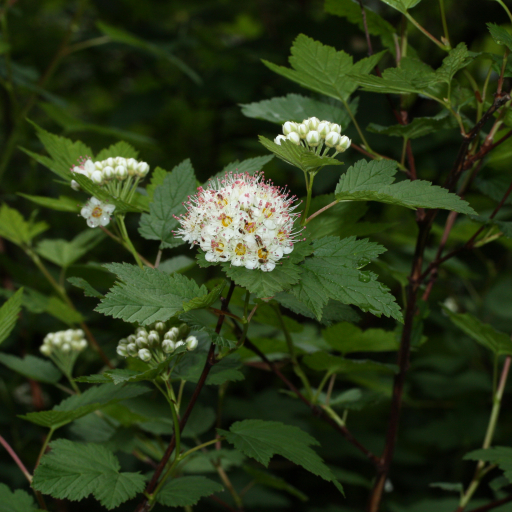
Plant Overview
Known as the Pacific Ninebark, this hardy shrub is a storyteller of the Pacific Northwest. Its common name comes from the belief that its bark possesses nine distinct layers, each peeling away to reveal a new texture beneath. Often found hugging the banks of streams, it is a resilient beauty that bridges the gap between wild woodland and refined garden.
🔍 How to Identify
- 🍂 The Bark: The most iconic trait is the reddish-brown bark that peels away in thin, papery strips. This "shredded" look provides excellent visual interest, especially during the winter months.
- 🍃 Maple-like Leaves: The leaves are deciduous and deeply lobed, resembling a small maple leaf. They transition from a lush green in summer to warm tones of yellow and bronze in the autumn.
- 🌸 Pom-pom Blooms: In late spring, the plant produces dense, rounded clusters of tiny white flowers with prominent pink-tipped stamens, making the shrub look like it is covered in miniature snowy pom-poms.
🏡 In Your Garden
- 💧 Thirst for Life: Because it naturally grows near water, the Pacific Ninebark loves "wet feet." It is a champion for rain gardens or those low-lying spots in your yard where water tends to settle.
- 🛡️ Natural Protector: Its dense, twiggy growth habit makes it a favorite for homeowners looking to create a natural privacy screen or a windbreak. It is also exceptionally "tough," resisting many common pests and diseases that plague other ornamental shrubs.
- 🦋 Wildlife Magnet: It serves as a vital resource for local ecology. The flowers are a buffet for pollinators, while the peeling bark provides cozy overwintering nooks for beneficial insects.
⚠️ Safety & Toxicity
- ✅ Low Risk: The Pacific Ninebark is generally considered non-toxic to humans and common household pets like cats and dogs.
- 🐾 Wildlife Forage: While not a primary food source for humans, the seeds are a snack for songbirds, and the foliage is occasionally browsed by deer, though it is usually not their first choice.
✨ Fun Fact
Indigenous peoples of the Pacific Northwest traditionally used the straight, sturdy stems of the Ninebark to create tools and hunting implements, while the inner bark was sometimes used to create a medicinal tea for various ailments.

Detailed Care Instructions
To grow Physocarpus capitatus (Pacific ninebark) plants, you can follow these steps:
- Planting: Choose a location with well-drained soil and full to partial sun exposure. The soil should be slightly acidic to neutral pH. Dig a hole that is twice as wide and slightly deeper than the plant's root ball. Place the plant in the hole, fill it with soil, and gently firm it around the roots.
- Watering: Water the plant thoroughly after planting and keep the soil consistently moist during the first growing season. Once established, Pacific ninebark is quite drought-tolerant, but regular watering during extended dry periods can promote healthier growth.
- Mulching: Apply a layer of organic mulch, such as wood chips or bark, around the base of the plant. This will help conserve moisture, suppress weeds, and insulate the roots from temperature extremes.
- Pruning: Although not necessary, pruning can help maintain a more compact and attractive shape. Prune after the plant has finished flowering in late spring or early summer. Remove any dead, damaged, or crossing branches, and thin out overcrowded areas.
- Fertilizing: Pacific ninebark generally does not require regular fertilization. However, if the plant exhibits poor growth or a lack of vigor, you can apply a slow-release balanced fertilizer in early spring.
- Pest and Disease Control: Physocarpus capitatus is generally resistant to pests and diseases. However, they may occasionally face issues like powdery mildew or aphid infestations. Regular inspection of the leaves and stems can help identify any problems early on. If necessary, treat with organic pest control methods or consult with a local garden center for appropriate remedies.
- Division and Propagation: Pacific ninebark can be propagated through seed or by division. The plant naturally produces suckers or shoots from the base, which can be transplanted to create new plants. Division is best done in early spring or fall.
Remember to check your local climate and specific soil conditions to ensure optimal growth conditions for Physocarpus capitatus.

Place in a window with dappled sun or a spot in the middle of a room. Or directly in a window facing west or east.

To water this plant, the soil should be checked regularly to make sure it is moist but not waterlogged. A general rule for watering is to water deeply and infrequently rather than frequently with small amounts of water. Water should be applied slowly and evenly to the base of the plant, avoiding getting water on the leaves or foliage. The frequency of watering will depend on factors such as the temperature, humidity, and soil type. During times of drought or high temperatures, extra water may be necessary. It is also important to note that overwatering can be detrimental to the health of the plant, so it is important to allow the soil to dry out slightly between waterings.
To fertilize this plant, apply a balanced, slow-release fertilizer in the spring. Follow the package instructions for the appropriate amount to apply based on the size of the plant. Avoid over-fertilizing, as this can promote weak growth and reduce the plant's overall health. Water the plant well before and after fertilizing to help distribute the nutrients.
To grow Physocarpus Capitatus plants, it is recommended to use well-draining, fertile soil that is rich in organic matter. The soil pH should be slightly acidic to neutral, between 5.5 and 7.5.
It is important to choose soil that has good drainage, as the plant likes to be in moist but not waterlogged soil. This can be achieved by adding coarse sand or perlite and ensuring that the soil is not compacted.
One should also avoid using heavy or clayey soil as it may not drain well and can lead to root rot. Instead, a mixture of loamy soil, garden soil, and some sphagnum peat moss can be used for potting or filling up garden beds.
Before planting, it is recommended to amend the soil with compost or well-rotted manure to provide the plant with essential nutrients.
Regularly fertilizing the soil with a balanced fertilizer can also help maintain healthy plant growth and development.
To propagate this plant, take a softwood cutting in the spring or early summer. Cut a stem that is about 4-6 inches long and remove the bottom leaves. Dip the cut end in rooting hormone and plant it in a pot filled with well-draining soil. Keep the soil moist and place the pot in a warm, bright spot, but out of direct sunlight. It should root in 4-6 weeks. After it has rooted, you can transplant it into a larger pot or into the ground.








