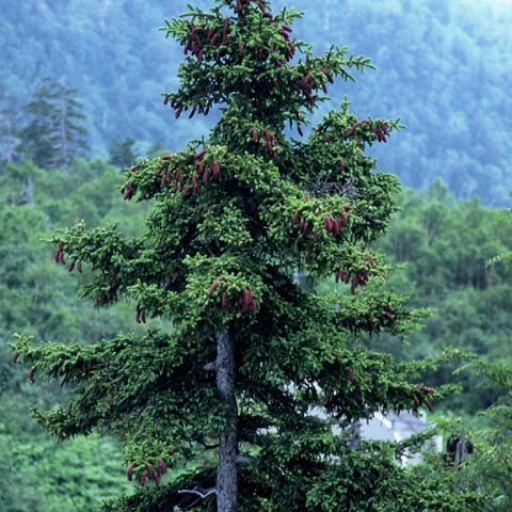
Plant Overview
Often called the "Dark-bark Spruce," Picea jezoensis is a majestic conifer that hails from the chilly, mist-shrouded regions of Northeast Asia and Japan. It is a cornerstone of northern forests and a legendary favorite among bonsai masters, who prize it for its tiny needles and the way its rugged bark makes even a young sapling look like an ancient mountain sentinel.
🔍 How to Identify
- 🌲 Dual-Toned Needles: The needles are short and flat, featuring a striking "two-faced" look—dark glossy green on the top and two brilliant silvery-white bands on the underside.
- 🪵 Craggy Bark: As the tree matures, the bark becomes deeply fissured and scaly, turning a dark, charcoal gray that contrasts beautifully with its bright spring growth.
- 🏮 Pendulous Cones: It produces slender, cylindrical cones that hang downward from the branches. They start with a purplish tint before ripening into a pale, papery brown.
🏡 In Your Garden
- 🏔️ Cool Climate Specialist: This spruce is a child of the mountains. It thrives in regions with cool summers and high humidity; it may struggle or lose its luster in hot, arid lowland gardens.
- 💧 Shallow Roots: Because it has a relatively shallow root system, it is sensitive to drought. It prefers consistently moist, well-drained soil and appreciates a thick layer of mulch to keep its "feet" cool during the summer months.
⚠️ Safety & Toxicity
- ✅ General Safety: Picea jezoensis is considered non-toxic to humans, dogs, and cats, making it a safe choice for family landscapes.
- 🧤 Sticky Resin: Like most spruces, it produces a thick, aromatic resin. While not poisonous, the sap can be very sticky and may cause mild skin irritation for sensitive individuals or those with allergies to pine products.
✨ Fun Fact
The wood of the Jezo Spruce is highly resonant and is a top choice for traditional Japanese woodworking and the construction of high-quality piano soundboards and violin bellies.

Detailed Care Instructions
To grow Picea jezoensis, also known as Jezo spruce, you can follow these steps:
- Obtain seeds or saplings: Purchase Picea jezoensis seeds or saplings from a reputable nursery or online store. Make sure that they are fresh and viable.
- Select a suitable location: Picea jezoensis requires full sun to partial shade and well-draining soil. Choose a spot in your garden that meets these requirements and has enough space for the tree to grow.
- Prepare the soil: Before planting, prepare the soil by removing any weeds, rocks, or debris. Work in organic matter, such as compost or aged manure, to improve soil fertility and drainage.
- Plant the seeds or saplings: If you have seeds, sow them in a seed tray or small pots filled with potting soil. Water lightly and place the tray or pots in a warm, well-lit area. Once the seedlings emerge and grow a few inches, transplant them into individual pots.
If using saplings, dig a hole slightly larger than the root ball and gently place the sapling into the hole. Backfill the hole with soil, firming it gently around the base of the plant.
- Watering: Picea jezoensis prefers consistently moist but not waterlogged soil. Water the plant deeply once or twice a week, especially during dry periods. Ensure that the soil does not become overly saturated, as it can lead to root rot.
- Mulching: Apply a layer of organic mulch, such as wood chips or bark, around the base of the plant. Mulch helps to conserve soil moisture, control weeds, and maintain a consistent soil temperature.
- Fertilization: Picea jezoensis generally does not require heavy fertilization. However, you can apply a slow-release balanced fertilizer in early spring to promote healthy growth.
- Pruning: Minimal pruning is required for Picea jezoensis. Remove any dead, damaged, or diseased branches as needed to maintain the tree's overall shape and health.
- Protection from pests and diseases: Monitor your Picea jezoensis regularly for any signs of pest infestation or disease. Common issues include aphids, spider mites, and needle cast. If pests or diseases are detected, take appropriate measures, such as applying organic insecticides or fungicides, to control the problem.
- Winter care: Picea jezoensis is cold-hardy and can tolerate harsh winter conditions. However, young plants may benefit from some protection during their first winter. Apply a layer of mulch around the base and consider wrapping the tree with burlap to shield it from heavy snow or extreme temperatures.
Remember to check specific care requirements for your specific location, as environmental conditions can vary. Regular monitoring, proper care, and attention to the plant's needs will help ensure healthy growth of your Picea jezoensis plant.

Place in a bright room that is sun drenched almost all day. Or directly in a south-facing window.

To water this particular plant, it is important to keep in mind that it prefers well-draining soil and does not like to have its roots sitting in standing water. It is recommended to water deeply but infrequently, allowing the soil to dry out slightly between waterings. Care should be taken to avoid getting water on the foliage, as this can lead to fungal diseases. If the plant is in a container, make sure there is a drainage hole and allow excess water to drain out completely.
For proper fertilizing of Picea Jezoensis, use a slow-release fertilizer with a balanced N-P-K ratio. Apply the fertilizer in the spring before new growth begins. Spread the fertilizer evenly around the tree, avoiding the trunk area. Water the tree thoroughly after fertilizing to help distribute the nutrients. Avoid over-fertilizing, as this could lead to excessive growth that could weaken the branches.
For optimal growth, Picea Jezoensis prefers a well-draining soil that is rich in organic matter. A mixture of sand, loam, and peat moss is ideal. The soil should have a neutral to slightly acidic pH level of around 6.0 to 7.0. The plant requires soil that is moist but not waterlogged, so ensure proper drainage to prevent water accumulation. It is also important to avoid using heavy clay soil as it can lead to root rot. To maintain soil fertility, it is recommended to add a slow-release fertilizer formulated for evergreen trees to the soil every spring.
Propagation of this plant can be done through both sexual and asexual means. The seeds can be collected from mature cones and sown in a well-draining soil mix in a cool, shaded area. The seedlings should be transplanted to individual pots when they are large enough to handle.
Asexual propagation can be done through various methods such as cuttings, layering, and grafting. Cuttings can be taken from the parent plant and rooted in a rooting hormone and soil mix. Layering involves bending a low branch or stem down to the soil and allowing it to root before severing it from the parent plant. Grafting involves joining a scion of the desired plant onto the rootstock of a related plant.
Regardless of the propagation method used, it is important to provide proper care to the young plants, including watering, fertilizing, and protecting them from extreme temperatures and pests.








