Plant Overview
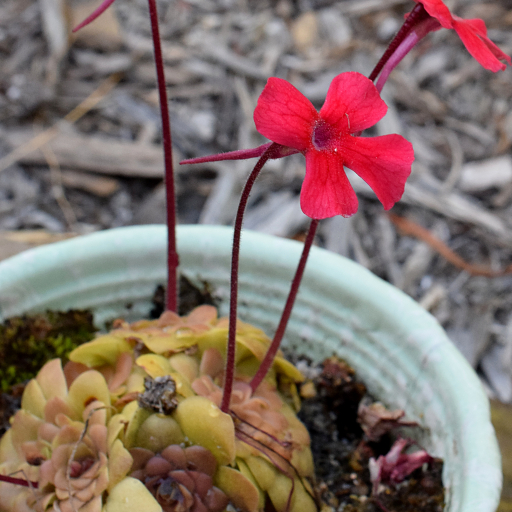
Known as the "Crimson Butterwort," Pinguicula laueana is a true jewel of the carnivorous plant world, native to the misty, high-altitude mountains of Oaxaca, Mexico. While most butterworts produce purple or white blossoms, this species is famous for its breathtaking, orchid-like flowers in shades of brilliant scarlet and deep red. It acts as a living piece of flypaper, blending the beauty of a succulent with the calculated precision of a predator.
🔍 How to Identify
- 🍃 The Rosette: It grows in a compact, star-shaped arrangement of fleshy, teardrop-shaped leaves that hug the ground.
- ✨ The "Dew": The leaf surfaces are coated in thousands of microscopic, glandular hairs that secrete a sticky mucilage, making the plant shimmer as if covered in morning frost.
- 🌺 The Flower: Its most distinctive feature is the long-spurred, five-petaled flower that rises on a tall stalk, usually displaying a vibrant, saturated red color rarely seen in other Pinguicula species.
🏡 In Your Garden
- 🔄 The Seasonal Shift: This plant is "heterophyllous," meaning it changes its look based on the season. In summer, it grows larger, sticky leaves to catch bugs; in winter, it transforms into a tight, non-carnivorous succulent rosette. It is crucial to reduce watering during this winter "rest" phase to prevent the roots from rotting.
- 🪰 Natural Pest Control: It is a favorite among indoor gardeners because it excels at catching fungus gnats and fruit flies, making it a functional companion for your other houseplants.
- ☀️ Light & Color: To achieve the most intense leaf coloration, it requires bright, indirect light. Under high-quality LED grow lights or dappled sunlight, the leaves may "blush" with a lovely bronze or reddish tint.
⚠️ Safety & Toxicity
- ✅ Non-Toxic Status: Pinguicula laueana is generally considered safe and non-toxic to cats, dogs, and humans.
- 🧪 Delicate Surface: While it won't hurt your pets, the plant itself is fragile. The digestive enzymes on the leaves can be easily neutralized by the oils on human skin, so avoid touching the foliage to keep the plant healthy and "sticky."
✨ Fun Fact
In its native Mexican habitat, Pinguicula laueana is often found growing vertically on mossy limestone cliffs. It has evolved to cling to rock faces where very few other plants can survive, literal "cliff-hangers" that survive on a diet of mist and small flying insects.

Detailed Care Instructions

Place in a window with dappled sun or a spot in the middle of a room. Or directly in a window facing west or east.

Some plants require more regular watering than others, which should be done every few days. It's critical to maintain the soil moist all of the time. The water requirements of the same plant placed in pots with varying sizes will differ. Because the water in the smaller pot evaporates faster than the water in the larger pot, it will require more watering. Regardless of pot size, the surface should constantly be maintained moist.
These plants can thrive without taking help from any fertilizer. However, if the medium of growth is something other than soil for instance sand then you may need to add little fertilizer. The best way to know if your plants need fertilizer or not is to check for yellowing of leaves. If the leaves start to turn yellow it’s fertilizing time.
You may use Carnivore Fertilizer for your Pinguicula Laueana
Common pests of the pinguicula laueana include Aphids. Make a habit of checking your pinguicula laueana frequently for pests so that any infestations can be caught and managed early.








