Plant Overview
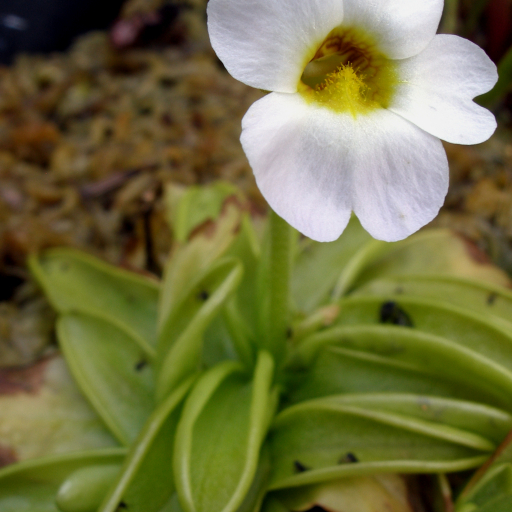
Known affectionately as the "Primrose Butterwort," this charming little carnivore is a master of disguise. While it looks like a delicate, pale-green succulent, it is actually a highly efficient "living flypaper" trap native to the boggy wetlands of the Southeastern United States. Its name comes from its stunning blossoms, which closely resemble the flowers of a wild primrose.
🔍 How to Identify
- 🧈 The "Buttery" Leaves: The leaves are arranged in a flat, star-shaped rosette. They have a distinctively greasy or "buttery" feel due to thousands of microscopic glands that secrete sticky digestive enzymes.
- 🌸 Primrose-Like Blooms: It produces elegant, five-petaled flowers that range from pale violet to white, often featuring a white or yellow center. Unlike many other butterworts, these flowers appear quite "ruffled" and delicate.
- 🌱 Tip Propagators: A unique visual giveaway is its ability to grow miniature "baby" plants directly on the tips of its older leaves, a trait known as being viviparous.
🏡 In Your Garden
- 💧 The "Pure Water" Rule: Like most carnivorous plants, the Primrose Butterwort is extremely sensitive to minerals. It thrives only when given distilled water, reverse osmosis water, or clean rainwater. Tap water will quickly cause "mineral burn" and kill the plant.
- 🌫️ Boggy Foundations: This species loves to keep its feet wet. In a home setting, it is best grown in a "tray method" where the pot sits in a shallow dish of water constantly. It prefers a nutrient-poor soil mix, such as a blend of peat moss and perlite or silica sand.
- ☀️ Gentle Light: While it loves brightness, the Primrose Butterwort can scorch in intense, direct afternoon sun. It prefers the dappled light of a bog or a bright windowsill with some protection from the harshest rays.
⚠️ Safety & Toxicity
- ✅ Safe for Pets: Pinguicula primuliflora is non-toxic to cats, dogs, and humans. It is a "passive" hunter, posing a threat only to gnats, fruit flies, and other small winged insects.
- 🧤 Delicate Handling: While safe to touch, try to avoid handling the leaves. The oils from human skin can disrupt the sticky mucilage on the leaves, and the plant spends a lot of energy producing those digestive "dewdrops."
✨ Fun Fact
The Primrose Butterwort is one of the few plants in the world that exhibits "leaf-tip vivipary." This means when a leaf touches the wet ground, it can spontaneously grow a fully formed clone of itself from the tip, eventually creating dense mats of butterworts in its natural habitat.

Detailed Care Instructions

Place in a window with dappled sun or a spot in the middle of a room. Or directly in a window facing west or east.

Some plants require more regular watering than others, which should be done every few days. It's critical to maintain the soil moist all of the time. The water requirements of the same plant placed in pots with varying sizes will differ. Because the water in the smaller pot evaporates faster than the water in the larger pot, it will require more watering. Regardless of pot size, the surface should constantly be maintained moist.
These plants can thrive without taking help from any fertilizer. However, if the medium of growth is something other than soil for instance sand then you may need to add little fertilizer. The best way to know if your plants need fertilizer or not is to check for yellowing of leaves. If the leaves start to turn yellow it’s fertilizing time.
You may use Carnivore Fertilizer for your Southern Butterwort








