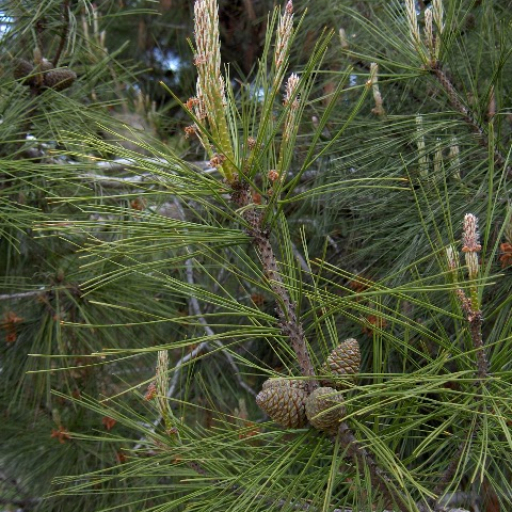
Plant Overview
The Pinus brutia, widely known as the Turkish Pine or Calabrian Pine, is the rugged survivor of the Eastern Mediterranean. Native to the rocky coasts and sun-drenched hillsides of Turkey and Greece, this tree is a symbol of endurance. Often confused with its cousin, the Aleppo Pine, it stands out with its straighter trunk and reddish-hued bark, making it a favorite for both forestry and coastal landscaping.
🔍 How to Identify
- 🌲 The Needles: Look for bright green to yellowish-green needles that almost always grow in pairs. They are quite long (usually 10–16 cm) and feel slender but sturdy to the touch.
- 🍎 The Cones: The cones are distinctively stout and heavy. Unlike many pines, these cones often point backwards toward the trunk or grow straight out from the branch without a drooping stalk.
- 🪵 The Bark: On young trees, the bark is smooth and silver-grey. As it matures, it develops deep, vertical cracks, revealing a rich, orange-red inner layer that glows in the sunset.
🏡 In Your Garden
- ☀️ Sun Worshipper: This pine is biologically programmed for intense light. It rarely thrives in shade and will "stretch" or become sparse if it doesn't get a full day of direct sun.
- 🏜️ Drought Warrior: Because it evolved in dry, rocky soils, it has a deep taproot. This makes it incredibly hard to transplant once established, so choose its "forever home" carefully. It actually prefers poor, well-draining soil over rich, soggy garden beds.
- 🌬️ Coastal Shield: Due to its thick needles and flexible branches, it is exceptionally resistant to salty sea winds, making it an ideal windbreak for coastal properties.
⚠️ Safety & Toxicity
- ✅ Generally Safe: The Turkish Pine is non-toxic to humans, dogs, and cats. It is a safe choice for family backyards.
- 🌵 Physical Hazards: The needles are quite sharp, and the cones are heavy; keep this in mind if planting near walkways. The tree also produces a very sticky resin (sap) that can be difficult to remove from clothing or pet fur.
✨ Fun Fact
If you’ve ever enjoyed "Pine Honey" from the Mediterranean, you have this tree to thank! Most Turkish pine honey isn't made from flower nectar, but from the "honeydew" secreted by a tiny scale insect (Marchalina hellenica) that lives exclusively in the bark of Pinus brutia. Bees collect this sweet substance to create a world-famous, dark, mineral-rich honey.

Detailed Care Instructions
To grow Pinus brutia plants, also known as Turkish pine, you can follow these steps:
- Choose the planting location: Pinus brutia prefers well-draining soil with a pH between 5.5 and 7.5. It grows best in full sun or partial shade. Ensure the location has enough space for the tree to reach its mature size, as they can grow up to 100 feet tall and spread up to 40 feet wide.
- Prepare the soil: Before planting, loosen the soil and remove any weeds, rocks, or debris. If your soil is heavy clay, consider improving its drainage by adding organic matter like compost or aged manure.
- Select healthy seedlings: Purchase or collect healthy Pinus brutia seedlings. Look for ones with green, plump needles and a well-developed root system.
- Dig the planting hole: Make sure the hole is two to three times wider and as deep as the root ball. This will help the seedling establish itself more easily. Make a mound of soil at the bottom of the hole to place the roots on.
- Plant the seedling: Carefully place the seedling on the mound, ensuring its roots are spread out and not cramped. Backfill the hole with soil, firmly pressing it around the roots. Avoid burying the trunk, and leave a slight depression around the base to hold water.
- Water thoroughly: Water the newly planted tree deeply, saturating the soil around the roots. This will help settle the soil and remove any air pockets. Continue to water the tree regularly, especially during dry periods, to ensure it receives enough moisture.
- Mulch and weed: Apply a layer of organic mulch, such as wood chips or pine straw, around the base of the tree. This will help retain moisture, regulate soil temperature, and suppress weeds. Keep the mulch a few inches away from the trunk to prevent rotting.
- Prune if necessary: Pinus brutia generally doesn't require heavy pruning. However, you may need to remove any dead, damaged, or diseased branches periodically. Pruning should be done in late winter or early spring while the tree is still dormant.
- Monitor for pests and diseases: Keep an eye out for common pine pests like pine beetles, adelgids, or scales. Additionally, watch for diseases like pine wilt or needle blight. If you notice any issues, consult a local nursery or arborist for appropriate treatment options.
- Provide ongoing care: Regularly monitor the tree's moisture levels and adjust watering as needed. If your area experiences dry spells, provide supplemental irrigation. Fertilize the tree with a slow-release, balanced fertilizer in early spring if necessary, following the manufacturer's instructions.
Remember, growing Pinus brutia trees requires patience, as they are slow-growing. However, with proper care, they can add beauty and shade to your landscape.

Place in a bright room that is sun drenched almost all day. Or directly in a south-facing window.

Pinus Brutia is a type of coniferous plant that requires a moderate amount of water to grow properly. To water this plant, it is important to keep the soil moist but not waterlogged. One way to achieve this is by watering deeply once or twice a week, depending on the climate and the soil's moisture level.
Before watering, it is essential to check the soil's moisture level by touching the top inch of soil. If it feels dry, it is time to water the plant. Another indicator of water needs is to observe the plant's foliage. If the needles start to turn brown or droop, it is a sign that it needs water.
When watering Pinus Brutia, it is best to water at the base of the tree, avoiding the foliage. This helps prevent fungal diseases and also ensures that the water reaches the roots. Using a garden hose or a watering can with a gentle stream is preferable to avoid soil erosion.
It is also important to note that Pinus Brutia grows well in well-draining soils. Overwatering can lead to waterlogged soils and root rot, which can harm the plant's health. Therefore, it is always recommended to allow the soil to dry out slightly before the next watering.
In summary, watering Pinus Brutia requires keeping the soil moist but not waterlogged, checking the soil's moisture level regularly, avoiding watering the foliage, and using well-draining soils to grow the plant effectively.
To fertilize this plant, first ensure that the soil is moist. Use a balanced fertilizer with equal parts nitrogen, phosphorus, and potassium. Apply the fertilizer to the soil around the base of the plant, avoiding direct contact with the trunk. Use a rake or your hands to lightly work the fertilizer into the soil to a depth of around 2-3 inches. Water the plant thoroughly after fertilizing. It is recommended to fertilize once every year in the spring.
Pinus Brutia is a type of plant that requires a specific type of soil in order to thrive. It is best to use a soil that is well-draining and has a neutral pH level, meaning it falls between 6.0 and 7.5 on the pH scale. The soil should be able to hold moisture, but not become waterlogged, as too much water can cause the plant to become stressed and potentially die. In addition, the soil should be rich in nutrients and organic matter to help promote healthy growth. It is recommended to mix in compost or other organic materials into the soil before planting. Overall, using a high-quality, well-drained soil with a neutral pH level and plenty of nutrients will help promote the health and growth of the Pinus Brutia plant.
Pinus Brutia can be propagated by collecting and sowing its seeds. The seeds should be collected from mature cones in the fall when they are fully ripe. The cones should be dried, and the seeds should be removed from the cones. The seeds should be soaked in water for a few days to remove their outer coating.
After soaking, the seeds should be sown in trays filled with a mixture of sand and peat moss. The trays should be kept in a cool and moist environment, and the seeds should be watered regularly. The seedlings should be transplanted to individual pots when they are big enough to handle.
Alternatively, Pinus Brutia can be propagated by taking cuttings from the new growth of the mature tree. The cuttings should be taken in early spring and should be treated with a rooting hormone. The cuttings should be placed in a mixture of sand and peat moss and kept moist. The cuttings should be transplanted to individual pots when they have rooted, and they should be kept in a cool and shaded environment until they have established.
Common pests of the turkish pine include Scale insect, spider mites, aphids. Make a habit of checking your turkish pine frequently for pests so that any infestations can be caught and managed early.








