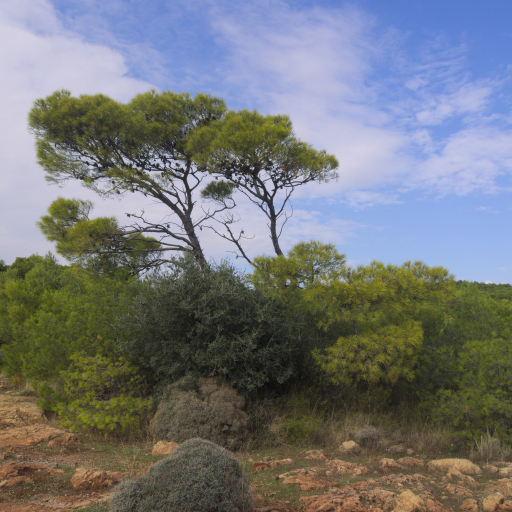
Plant Overview
Known as the Aleppo Pine or the "Mediterranean Pine," this resilient evergreen is the quintessential tree of the coastal Mediterranean landscape. Often seen leaning gracefully over turquoise waters, it has been a symbol of endurance and survival for centuries. In ancient times, its resin was so prized that it became the secret ingredient in traditional Greek wines, a practice that continues to this day.
🔍 How to Identify
- 🌲 Slender Needles: The needles grow in pairs (fascicles), are exceptionally thin, and have a distinct yellowish-green hue that gives the tree a "soft" appearance from a distance.
- 🍦 Conical Cones: Its cones are smooth, reddish-brown, and shaped like narrow teardrops; they often persist on the branches for several years, even after releasing their seeds.
- 🎨 Changing Bark: Young trees boast smooth, silvery-grey bark that matures into a rugged, deeply fissured texture with warm orange-red tones visible in the cracks.
🏡 In Your Garden
- 🌊 Coastal Warrior: This pine is uniquely adapted to salt spray and harsh winds, making it the perfect choice for seaside gardens where other trees might wither.
- 🧱 Alkaline Specialist: Unlike many conifers that crave acidic soil, the Aleppo Pine thrives in limestone-heavy, alkaline earth and can survive in the poorest, rockiest terrains with very little water.
- ☀️ Light Seeker: It is a "pioneer species," meaning it loves being the first to colonize open, sunny spaces; ensure it has plenty of room to stretch, as it hates being shaded by taller neighbors.
⚠️ Safety & Toxicity
- ✅ Low Risk: Pinus halepensis is generally considered non-toxic to humans and common household pets like dogs and cats.
- 🤧 Allergy Alert: Like most pines, it produces significant amounts of fine yellow pollen in the spring, which can be a nuisance for those with seasonal allergies.
- 🐾 Sticky Situation: The tree produces a very thick, sticky resin (sap). While not poisonous, it can be difficult to remove from pet fur or children's clothing and may cause mild skin irritation in sensitive individuals.
✨ Fun Fact
The Aleppo Pine is a "fire-chaser." It produces serotinous cones, which are glued shut with resin. These cones often wait for the intense heat of a forest fire to melt the resin and open up, ensuring its seeds are the first to hit the nutrient-rich ash and restart the forest!

Detailed Care Instructions
It is not a particularly long-lived pine, surviving an average of 100 years. However, in the right conditions, these trees can live up to 150 years or more.
What plants are similar to Aleppo pine?
There are numerous other pine species that share many of the same characteristics as the Aleppo (although none are quite as drought-tolerant). This includes the Turkish pine (Pinus brutia), Canary Island pine (Pinus canariensis), and the maritime pine (Pinus pinaster). The Turkish pine is sometimes referred to as a subspecies of the Aleppo pine, but most experts regard it as a separate species.
How fast does Aleppo pine grow?
An Aleppo pine can grow about 10 inches per year and perhaps a bit more if the conditions are ideal.
| Humidity | Normal |
| Lighting | Part Sun |
| Toxicity | Poisonous |
| Soil Type | Tolerates A Wide Range |
| Difficulty | Medium |
| Plant Type | Evergreen Conifer |
| Mature Size | 30 To 60 Feet Tall, 20 To 40 Feet Wide |
| Native Area | Coastal Areas Of The Mediterranean Basin |
| Temperature | Min 15°C |
| Sun Exposure | Loamy, Sandy Loam |
| Hardiness Zones | 8-10 |
To grow Pinus halepensis, also known as Aleppo pine, you can follow these steps:
- Climate and soil: Choose a location with a Mediterranean climate, featuring mild winters and long, hot summers. The soil should be well-draining, sandy, and slightly acidic.
- Collect seeds: Obtain seeds from a reputable nursery or collect them from mature cones. Aleppo pine cones typically mature in the fall and release their seeds. Make sure to collect healthy, viable seeds.
- Seed preparation: Soak the seeds in water for 24 hours to soften the hard seed coat. This process, called stratification, can increase the germination rate.
- Planting: Fill small pots or trays with a well-draining seed-starting mix. Plant the soaked seeds at a depth of about 1/4 inch (0.6 cm). Place the pots in a warm and sunny location, such as a greenhouse or a sunny windowsill.
- Watering: Keep the soil evenly moist but not waterlogged. Water the seedlings whenever the top inch of the soil feels dry. Avoid overwatering, as excessive moisture can lead to root rot.
- Transplanting: When the seedlings are about 6-8 inches (15-20 cm) tall, usually after 6-12 months, they can be transplanted into larger pots or directly into the ground. Select a well-drained, sunny spot in the garden with enough space for the mature tree.
- Maintenance: Water the young trees regularly during dry periods to establish a strong root system. Once established, Aleppo pines are relatively drought-tolerant. Mulch around the base of the tree with organic matter to conserve moisture and suppress weed growth.
- Pruning: Prune any dead, damaged, or weak branches to maintain the overall health and shape of the tree. However, avoid excessive pruning, as Aleppo pines have a naturally symmetrical growth habit.
- Pest and disease control: Monitor the trees for common pests like bark beetles or aphids. If detected, treat with appropriate organic or chemical methods. Regularly inspect the trees for signs of diseases like pine pitch canker or pine wilt disease and take necessary action if needed.
- Enjoying the tree: As the tree grows, it will provide shade, attractive foliage, and potentially produce cones. Be patient, as Pinus halepensis can take several years to reach its full size.
Remember to check with local authorities for any permits or restrictions related to growing this tree, as it may be considered invasive in some regions.

Place in a bright room that is sun drenched almost all day. Or directly in a south-facing window.

To water this plant, you should first check the soil moisture to ensure that it is dry before watering. Then, use a watering can or hose to slowly water the plant at its base, taking care not to soak the foliage. Water until the soil is moist to a depth of about 2-3 inches. Be careful not to overwater, as this can lead to root rot. During periods of drought, it may be necessary to water more frequently. It is also important to use well-draining soil and to avoid allowing the soil to become waterlogged.
To fertilize this plant, use a slow-release fertilizer with a balanced formula and apply it in early spring before new growth appears. Spread the fertilizer evenly around the base of the plant, avoiding contact with the trunk. Water the plant thoroughly after applying the fertilizer. Repeat fertilizer application once or twice a year, depending on the soil quality, growth rate, and plant health. Follow the manufacturer's instructions and adjust the amount and frequency of fertilization based on the plant's response. Avoid over-fertilization, which can damage the roots and foliage and cause nutrient leaching.
The ideal soil to use with this plant is a well-draining, sandy soil with a slightly acidic pH level. It should also contain organic matter and nutrients to support optimal growth. Additionally, it is important to avoid using heavy, clay soils or soils that are prone to waterlogging, as this can cause root rot and other issues. It is recommended to perform a soil test to ensure that the soil’s nutrients and pH level are appropriate for the plant.
To propagate this plant, you will need to start with seeds that have been collected from mature cones. The seeds can be stratified, or stored in a cool, damp environment for several weeks prior to planting. This will help to break dormancy and improve germination rates.
To plant the seeds, you will need to prepare a well-draining soil mix and fill small pots or seed flats with the mix. Scatter the seeds over the surface of the soil and cover lightly with additional soil. Water gently and place the pots in a warm, well-lit area.
Keep the soil moist but not overly wet over the next few weeks as the seeds germinate and grow. Once the seedlings are a few inches tall, they can be transplanted to larger containers or directly into the garden.
Another method of propagating this plant is through cuttings. Take stem cuttings from mature plants in the spring or early summer and dip the cut ends in a rooting hormone. Plant the cuttings in well-draining soil and keep them moist and warm until they root and begin to grow.
Common pests of the aleppo pine include Scale insect, spider mites, aphids. Make a habit of checking your aleppo pine frequently for pests so that any infestations can be caught and managed early.








