Plant Overview
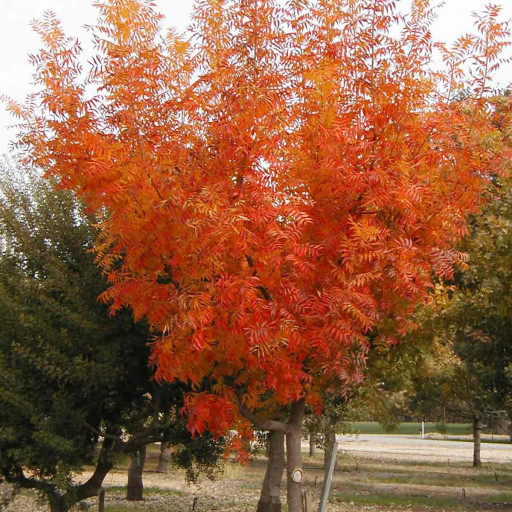
Known as the "Ugly Duckling" of the tree world, the Chinese Pistache is a landscape superstar that transforms from a gangly, awkward sapling into a magnificent, umbrella-shaped shade provider. It is celebrated as the gold standard for fall foliage, especially in warmer climates where traditional maples often struggle to change color.
🔍 How to Identify
- 🌿 Feathery Foliage: Features long, pinnate leaves with 10 to 16 lance-shaped leaflets that create a lush, delicate canopy.
- 🍒 Ornamental Drupes: On female trees, clusters of small berries appear in late summer, transitioning from green to a vivid "Christmas red," then finally to a striking metallic turquoise-blue.
- 🍂 Technicolor Finish: It is one of the few trees that reliably turns brilliant shades of crimson, orange, and neon yellow, often all on the same branch.
- 🪵 Peeling Bark: Mature trees have beautiful grayish-brown bark that develops shallow fissures, occasionally flaking away to reveal glimpses of orange inner bark.
🏡 In Your Garden
- 🏗️ The Taproot Factor: This tree invests heavily in a deep taproot early in life. This makes it incredibly resistant to drought and high winds, but it also means it hates being transplanted. Choose its "forever home" carefully!
- 🏙️ Urban Warrior: It is highly tolerant of poor soil, heat, and urban pollution, making it a favorite for city sidewalks and parking lots where other trees might wither.
- ✂️ Pruning Patience: When young, the branches can grow in somewhat erratic directions. A little structural pruning in the first few years is essential to help it achieve its classic rounded shape.
⚠️ Safety & Toxicity
- ✅ Status: Generally safe and non-toxic to humans and pets.
- 🐾 Details: While the berries are a favorite for birds, they are not intended for human consumption. Ingesting large quantities may cause mild stomach upset in curious pets or toddlers, but it is not considered a poisonous plant.
✨ Fun Fact
Despite its name and lineage, you won't get a snack from this tree! While it is a cousin to the nut-producing pistachio (Pistacia vera), the Chinese Pistache is strictly ornamental. However, it is so hardy that commercial pistachio growers often use its roots as a sturdy base (rootstock) to graft their nut-bearing trees onto.

Detailed Care Instructions
| Color | Yellow, Orange, Or Red |
| Soil Ph | Adaptable |
| Humidity | Normal |
| Lighting | Full Sun |
| Soil Type | Moist, Rich, Well-Drained Soil |
| Bloom Time | April |
| Difficulty | Medium |
| Plant Type | Deciduous Tree |
| Hibernation | Cold Period |
| Mature Size | 30 - 35 Ft. Tall, 20 - 30 Ft. Wide |
| Native Area | China To Phillipines |
| Sun Exposure | Full Sun |
| Hardiness Zones | 6-9 |
To grow a Pistacia Chinensis plant, also known as Chinese pistache, follow these steps:
- Climate and soil requirements: Pistacia Chinensis plants thrive in full sun and well-drained soil. They are adaptable to various soil types, but prefer fertile and slightly acidic soil. This plant is generally hardy in USDA zones 6-9.
- Propagation: You can grow a Pistacia Chinensis plant from seeds or by grafting. If using seeds, scarify them by gently scraping the outer shell to allow easier water absorption. Soak the seeds in water for 24 hours before planting. If grafting, obtain a scion from a healthy Pistacia Chinensis plant and graft it onto a Pistacia integerrima rootstock.
- Planting: Choose a sunny location and dig a hole slightly larger than the rootball of the plant. Place the plant in the hole, ensuring that the top of the rootball is level with or slightly above the soil surface. Fill the hole with soil and firm it gently around the plant. Water thoroughly after planting.
- Watering: Initially, keep the soil consistently moist but not waterlogged. Once the plant establishes itself after a few months, water moderately, allowing the top inch of soil to dry out between waterings. Avoid overwatering as this plant is somewhat drought-tolerant.
- Fertilization: Apply a balanced slow-release fertilizer in early spring, following the manufacturer's instructions. Avoid overfertilization, which can result in excessive foliage growth and decreased resistance to pests and diseases.
- Pruning: Prune Pistacia Chinensis plants in late winter or early spring to remove dead, damaged, or crossing branches. This helps maintain good airflow and overall plant health.
- Pest and disease control: Chinese pistache plants are generally resistant to most pests and diseases. However, keep an eye out for aphids, scale insects, and leaf spot diseases. Regularly inspect the plant and take appropriate measures if infestations or diseases occur.
- Harvesting: Chinese pistache plants produce small berries in autumn. These berries are edible but are not as tasty as those of Pistacia vera. They can be harvested when they turn red and can be used in cooking or as bird feed.
By following these steps, you can successfully grow a Pistacia Chinensis plant and enjoy its beautiful foliage and potential harvest.

Place in a bright room that is sun drenched almost all day. Or directly in a south-facing window.

To water the plant, first check the soil moisture level by sticking your finger about an inch into the soil. If it feels dry, it's time to water. Use room-temperature water and pour it slowly and evenly around the base of the plant, avoiding getting water on the leaves. Give it enough water so that it starts to run out of the drainage holes at the bottom of the pot. Allow the excess water to drain away completely before returning the plant to its saucer. During the growing season, water the plant thoroughly once a week or as needed based on the soil moisture level. In colder months, water less frequently, approximately once every two weeks. It's important not to overwater as this can lead to root rot.
To maximize the growth and overall health of the plant, fertilize it once every two months using a balanced, slow-release fertilizer. Apply the fertilizer around the drip line of the plant, keeping it approximately six inches away from the trunk. Water the plant deeply after fertilizing. Be sure not to over-fertilize, as this may damage the plant and cause excessive growth.
Pistacia chinensis is a plant species that requires well-draining soil with a slightly acidic to neutral pH level. The ideal soil for this plant should be loamy, containing a good mix of sand, silt, and clay particles. It should also be rich in organic matter to provide the necessary nutrients for healthy growth. A soil mix with equal parts of peat moss, perlite, and vermiculite can create the ideal growing medium for this plant. It is important that the soil is not too heavy or compacted, as this can impact root growth and water absorption. In addition, it is important to ensure proper drainage to prevent waterlogging, which can lead to root rot. Adding coarse sand or gravel to the soil mix can improve drainage. Overall, the soil used for Pistacia chinensis should support the plant's structural stability, nutrient uptake, and water retention needs, while also allowing for proper drainage.
Propagation of this plant can be easily done through seed germination or cuttings. For seed germination, the seeds should be soaked overnight in warm water before planting them in well-drained soil. It is important to keep the soil moist and warm throughout the germination process.
For propagation through cuttings, select a healthy branch and cut it at an angle just below a leaf node. Remove any leaves from the bottom half of the cutting and dip the cut end into rooting hormone. Plant the cutting in well-drained soil and keep it moist. It is recommended to cover the cutting with a plastic bag to create a greenhouse effect and promote growth.
Both seed and cutting propagation can be done in the spring or early summer when the plant is actively growing. It is important to note that this plant can take several years to mature and produce fruit.








