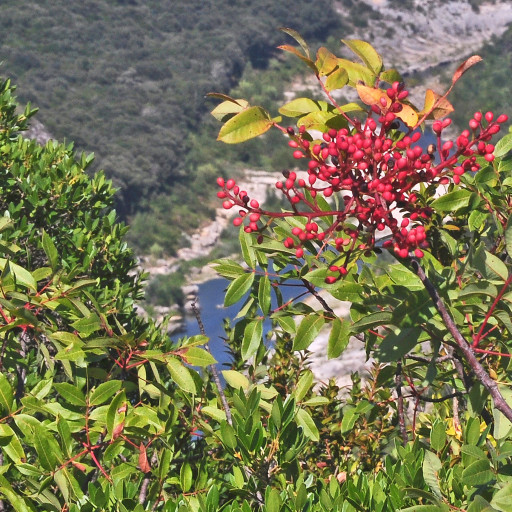
Plant Overview
Known as the Turpentine Tree or Terebinth, this hardy Mediterranean native has been a witness to history for millennia, frequently appearing in ancient texts and even the Bible. It is a resilient deciduous shrub or small tree that characterizes the rocky landscapes of the Middle East and Southern Europe. Celebrated for its aromatic resin and its ability to thrive in scorching heat, it remains a symbol of endurance and natural fragrance.
🔍 How to Identify
- 🌿 The Foliage: Look for leathery, glossy green leaves that are "odd-pinnate," typically featuring 3 to 9 leaflets with a single leaf at the very tip.
- 🎨 Spring Colors: In early spring, the new growth and flower clusters emerge in a striking, vibrant reddish-purple hue before maturing to deep green.
- 🍒 The Berries: Small, round fruits grow in dense clusters, transitioning from a bright, showy crimson to a dark, metallic blue-black as they ripen.
🏡 In Your Garden
- 🪨 Terrain Tolerance: This plant is a master of "lean" living; it actually prefers rocky, limestone-rich soils and can grow in cracks where other plants would struggle.
- 💧 Drought Strategy: Because it possesses a deep taproot, it is exceptionally drought-tolerant once established. It hates "wet feet," so ensure your soil drains quickly to prevent root rot.
- ✂️ Growth Habit: It grows slowly and takes well to pruning, making it an excellent candidate for a sturdy, aromatic hedge or even a large-scale bonsai project.
⚠️ Safety & Toxicity
- ✅ Status: Generally considered non-toxic to humans, cats, and dogs.
- 🍯 Resin Caution: The tree produces a thick, sticky resin (the source of original turpentine). While not poisonous, this sap can be messy and may cause mild skin irritation or "sticky fingers" for curious children or gardeners.
- 🍴 Edibility: The small fruits are technically edible and are sometimes used in traditional baking or to flavor oils, though they are quite tart and resinous when raw.
✨ Fun Fact
The word "Turpentine" actually derives from the name of this tree! Long before pine trees became the primary source for the solvent, the resin of the Terebinth was harvested on the Greek island of Chios to create "Cyprian Turpentine," a substance highly prized by ancient physicians and perfumers.

Detailed Care Instructions
| Humidity | Normal |
| Lighting | Part Sun |
| Difficulty | Medium |
| Temperature | Min 18°C |
| Hardiness Zones | 8 - 11 |
- Choose the right location: Pistacia terebinthus plants thrive in full sun to partial shade. Select a spot that receives at least 6-8 hours of sunlight per day. Ensure the soil is well-draining, as this plant does not tolerate waterlogged conditions.
- Prepare the soil: Pistacia terebinthus plants prefer slightly alkaline soil with a pH level of 7.5-8.5. If your soil is acidic, you can amend it with lime or bone meal to raise the pH. Additionally, ensure the soil is loose and rich in organic matter to improve drainage and provide nutrients.
- Planting: Dig a hole twice the size of the plant's root ball, and place the plant in the hole. Backfill with soil, gently firming it around the root ball. Water thoroughly after planting.
- Watering: Pistacia terebinthus plants require regular watering, especially during the first few years of establishment. However, be cautious not to overwater, as this plant prefers slightly drier conditions once established. Water deeply but infrequently to encourage a deep root system.
- Pruning: Pruning is not strictly necessary for Pistacia terebinthus plants, but you can remove any dead or damaged branches as needed. However, avoid excessive pruning, as this can weaken the plant.
- Fertilizing: Apply a balanced, slow-release fertilizer in early spring to provide the plant with necessary nutrients. Follow the manufacturer's instructions for application rates.
- Mulching: Apply a layer of organic mulch around the base of the plant to conserve moisture, suppress weed growth, and maintain a more stable soil temperature.
- Pest and disease management: Pistacia terebinthus plants are generally resistant to pests and diseases. However, occasional aphid or scale insect infestations may occur. Monitor the plant regularly and promptly treat any pest or disease issues that arise.
- Propagation: Pistacia terebinthus plants can be propagated from seeds or by taking semi-hardwood cuttings in summer. Seeds require stratification (a period of cold temperatures) before sowing for better germination results.
- Winter care: While Pistacia terebinthus plants are hardy, they may benefit from protection in colder regions, especially during their early years. Mulching the base of the plant and covering it with a protective layer can provide insulation against frost and extreme cold.
By following these steps, you can successfully grow and care for Pistacia terebinthus plants.

Place in a window with dappled sun or a spot in the middle of a room. Or directly in a window facing west or east.

1. Assess the soil: Before watering Pistacia Terebinthus plant, it's important to assess the soil around it. This can involve checking the texture and moisture levels.
2. Consider the climate: The amount and frequency of watering required may vary based on the climate. If the weather is hot and dry, the plant may require more frequent watering.
3. Use the right method: To water Pistacia Terebinthus plant, it's best to use a watering can or hose. Avoid using a sprinkler as it may not provide enough moisture to the roots.
4. Water deeply: It's important to water deeply to encourage root growth and prevent surface runoff. Watering at the base of the plant will ensure that the roots receive adequate moisture.
5. Avoid overwatering: Pistacia Terebinthus plant should not be overwatered as it may promote fungal growth and damage the roots. Ensure that the soil drains well and allow the top few inches of soil to dry out before watering again.
6. Water at the right time: Pistacia Terebinthus plant should be watered in the morning or evening when the temperature is cooler. This will reduce the risk of evaporation and help the plants retain moisture for longer.
To fertilize this plant, apply a balanced, slow-release fertilizer in early spring before new growth emerges. Avoid applying fertilizer during the dormant season. Follow the manufacturer's instructions for application rate. Water the plant thoroughly after applying the fertilizer to help it absorb the nutrients. Depending on the quality of the soil, you may only need to fertilize once a year, but monitor the plant's growth and adjust fertilizer applications as needed.
Pistacia Terebinthus plant grows well in well-draining soil that is moderately fertile and slightly acidic or neutral. The soil should have good water retention capacity but must be well-draining to prevent waterlogging. To ensure proper drainage, the soil should be mixed with a good amount of sand and organic matter such as compost. Clay soils should be avoided as they can become compact and prevent proper root growth. Additionally, the plant requires full sun exposure and protection from cold winds. Soil should be maintained moist but not soggy. Fertilization is not necessary but it can benefit from a slow-release fertilizer during the growing season to encourage healthy growth and fruit development.
Propagation of this plant can be done through the method of seed sowing. Collect ripe seeds in the autumn or early winter when they are enclosed in their hard shells. The seeds need to be soaked in water for 24 hours before sowing. After soaking, plant the seeds at a depth of 1.5 cm in a well-draining, sandy soil mix. The soil should be kept moist and the seeds can take up to 3 months to germinate.
Another method of propagation is through stem cuttings. Take 10-15 cm long stem cuttings from the current season's growth in spring or early summer. Remove the leaves from the lower half of the stem and dip the cut end in rooting hormone powder. Plant the cuttings in a well-draining soil mix and keep them moist under high humidity. After 4-6 weeks, the cuttings should root and start to grow.
Grafting is also a popular method of propagation for this plant. It involves grafting a stem cutting of Pistacia Terebinthus onto a rootstock of a closely related species of Pistacia. This method is often used to propagate plants that are difficult to root from cuttings.








