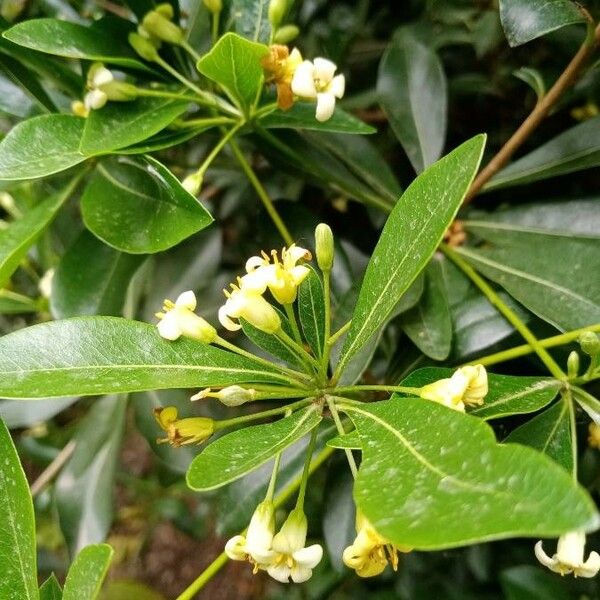
Plant Overview
Often referred to as the "Chinese Mock Orange," Pittosporum heterophyllum is a versatile evergreen shrub that bridges the gap between a hardy hedge and a sensory delight. Its botanical name, heterophyllum, literally translates to "different leaves," hinting at the plant's unique ability to produce foliage in various shapes and sizes on the same branch. Originating from the rocky slopes of China, it is beloved by gardeners for its intoxicating, jasmine-like scent that can perfume an entire yard during the spring.
🔍 How to Identify
- 🍃 Variable Foliage: Look for leathery, lance-shaped leaves that vary in width; some are narrow and willow-like, while others appear more oval and blunt.
- 🌼 Creamy Clusters: In late spring and early summer, the plant is covered in small, bell-shaped flowers that transition from pale yellow to a soft ivory white.
- 🌿 Arching Habit: Unlike the more rigid Pittosporum tobira, this species has a more graceful, fountain-like growth habit with branches that arch slightly toward the ground.
🏡 In Your Garden
- ☀️ Sun Adaptability: While it thrives in full sun, it is one of the more shade-tolerant Pittosporums, making it perfect for those tricky "half-day sun" spots in the yard.
- 💧 Drought Resilience: Once its root system is established, this plant is remarkably water-wise. It is an excellent choice for xeriscaping or Mediterranean-style gardens where water conservation is key.
- ✂️ Hedging Potential: It responds exceptionally well to pruning. It can be sheared into a formal, boxed hedge or left to grow naturally as a dense, evergreen privacy screen.
⚠️ Safety & Toxicity
- 🐾 Pet Sensitivity: This plant contains saponins in its leaves and seeds. While very bitter (which usually discourages chewing), ingestion can cause drooling, vomiting, or diarrhea in dogs and cats.
- 👶 Child Safety: The small, sticky seeds can be a choking hazard or cause mild stomach upset if swallowed by curious toddlers.
- 🧤 Sap Irritation: The sticky sap released during heavy pruning may cause minor skin irritation for those with sensitive skin; wearing gloves is recommended.
✨ Fun Fact
The genus name Pittosporum comes from the Greek words pitta (pitch) and spora (seed), referring to the sticky, resinous substance that coats the seeds inside their woody capsules!

Detailed Care Instructions
To grow Pittosporum Heterophyllum (also known as Japanese Mock Orange or Pittosporum tobira), you can follow these steps:
- Choose a suitable location: Select an area that receives full to partial sunlight. Pittosporum Heterophyllum can tolerate a variety of soil conditions but prefers well-draining soil.
- Prepare the soil: If the soil is clay-like or heavy, amend it with organic matter such as compost to improve drainage and fertility. Ensure the soil pH is slightly acidic to neutral (pH 6-7).
- Planting: Dig a hole that is wider and deeper than the plant's root ball. Place the plant in the hole, making sure it is planted at the same level as it was in the nursery container. Backfill the hole with soil, firming it gently around the base of the plant.
- Watering: After planting, water the plant deeply to settle the soil and help the roots establish. Keep the soil consistently moist but not waterlogged during the first months of growth. Once established, Pittosporum Heterophyllum is moderately drought-tolerant but will benefit from regular watering in dry periods.
- Mulching: Apply a layer of organic mulch around the base of the plant to help conserve moisture, suppress weeds, and regulate soil temperature. Ensure the mulch is not too close to the stem to prevent stem rot.
- Pruning: Pittosporum Heterophyllum generally requires minimal pruning to maintain its shape. However, you can prune it after flowering to remove any dead, damaged, or overgrown branches. Always use clean and sharp pruning tools to make precise cuts.
- Fertilizing: Apply a balanced slow-release fertilizer in early spring, following the manufacturer's instructions. This will provide the necessary nutrients for healthy growth. Avoid excessive fertilization, as it can cause foliage burn.
- Pests and diseases: Pittosporum Heterophyllum is generally quite resistant to pests and diseases. However, it can occasionally be affected by scale insects or aphids. Monitoring your plant regularly and applying insecticidal soap or neem oil as needed can help control these pests.
By following these guidelines, you can successfully grow Pittosporum Heterophyllum and enjoy its beautiful foliage and fragrant flowers.

Place in a window with dappled sun or a spot in the middle of a room. Or directly in a window facing west or east.

Watering instructions for the plant with the scientific name Pittosporum Heterophyllum involve ensuring that the soil is consistently moist but not waterlogged. This can be achieved by watering the plant deeply but infrequently, allowing the top few inches of soil to dry out before watering again. Care should be taken not to let the plant remain in standing water, as this can cause root rot. Additionally, the plant should be kept in well-draining soil to prevent waterlogging. During the winter months, the plant may require less frequent watering.
To fertilize this plant, use a balanced fertilizer with an N-P-K ratio of 10-10-10. Apply the fertilizer in the early spring and again in the mid-summer. Water the plant thoroughly before and after fertilizing. Avoid getting fertilizer on the leaves or stems, as it can cause burns. Follow the recommended dosage on the fertilizer package, as over-fertilizing can damage the plant.
The Pittosporum Heterophyllum plant requires well-draining soil that is slightly acidic with a pH level between 5.5 and 6.5. It should be rich in organic matter and nutrients with a good balance of sand, silt, and clay. The soil should be moist but not waterlogged, and should never be allowed to completely dry out. A mixture of peat moss and perlite or vermiculite is suitable for growing Pittosporum Heterophyllum. Regular fertilization with a balanced fertilizer is also recommended to keep the plant healthy and thriving.
To propagate this plant, one can start by taking cuttings from the parent plant in the spring or early summer. It's recommended to take 4-6 inch cuttings with a clean, sharp pair of pruning shears.
Once the cuttings have been taken, it's important to remove all leaves from the bottom two-thirds of the stem, leaving just a few leaves at the top. Dip the cut end of the stem in rooting hormone powder, tapping off any excess.
Prepare a pot with a well-draining potting mix and make a hole in the center. Insert the cutting into the hole and gently press the soil around the stem.
Water the cutting thoroughly and cover the pot with a clear plastic bag to create a humid environment. Place the pot in a bright, indirect light location, but avoid placing it in direct sunlight.
Keep the soil moist and monitor growth regularly. Once roots begin to form, the cutting can be transplanted into a larger pot or in the garden.








