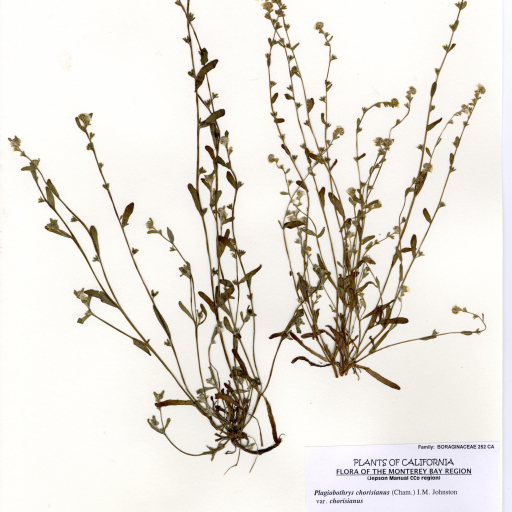
Plant Overview
Often called the Artist's Popcornflower, this charming California native looks as though someone sprinkled tiny kernels of buttered popcorn across a coastal meadow. A member of the Borage family, it is a close relative of the Forget-Me-Not, sharing that family’s signature "sculpted" look. It is a rare gem often found clinging to the misty edges of the Pacific coast.
🔍 How to Identify
- 🌼 The "Popcorn" Blooms: Tiny, five-lobed white flowers with a bright yellow "eye" or crest in the center that fades to white as the flower ages.
- 🌀 Scorpion-Tail Clusters: The flowers grow along a stem that curls at the tip, slowly unfurling as each bud opens—a growth pattern botanists call a "scorpioid cyme."
- 🌱 Hairy Texture: Look closely at the stems and narrow leaves; they are covered in fine, stiff hairs (strigose) that give the plant a slightly fuzzy, grayish-green appearance.
🏡 In Your Garden
- 🌊 Coastal Cravings: This plant is a specialist of coastal bluffs and moist meadows. In a garden setting, it requires "cool feet" and consistent moisture, making it a perfect candidate for a native rain garden or a damp rockery.
- ⏳ Short but Sweet: As an annual, its life cycle is fast. It blooms beautifully in the spring and then focuses all its energy on seed production. To see it again next year, avoid heavy mulching, which can prevent its tiny seeds from reaching the soil.
⚠️ Safety & Toxicity
- ✅ Non-Toxic Status: There are no known reports of high toxicity for this specific species, making it a relatively "safe" neighbor for backyard explorations.
- 🐾 Mild Irritant: Like many plants in the Boraginaceae family, the stiff hairs on the stems can cause very mild skin irritation for people with sensitive skin or curious pets who might try to nibble on the foliage.
✨ Fun Fact
The "Chorisianus" in its name honors Louis Choris, a famous Russian-German painter and explorer. He was the official artist on a 19th-century expedition to California, where he spent his days painting the landscapes and plants that many Europeans had never seen before!

Detailed Care Instructions
To grow Plagiobothrys chorisianus, also known as popcornflower, follow these steps:
- Seed Preparation: Popcornflower seeds are small and can be difficult to handle. To improve their germination rate, you can cold-stratify them. Place the seeds in a plastic bag with some moist soil or sand and refrigerate for 4-6 weeks before sowing.
- Choose a Location: Popcornflowers prefer full sun to partial shade. They can be grown both indoors and outdoors. If growing indoors, make sure they receive at least 6-8 hours of sunlight per day.
- Soil Preparation: The soil should be well-draining and fertile. Work in some compost or organic matter to improve the soil texture and fertility. This will ensure healthy growth and blooming.
- Sowing Seeds: Sow the cold-stratified seeds directly into the soil after the last frost date in your area. Scatter the seeds on the prepared soil surface and lightly press them into the ground. Avoid covering the seeds with too much soil, as they need light to germinate.
- Watering: Keep the soil consistently moist but not waterlogged. Water the plants regularly, especially during dry periods. Avoid overwatering, as excessive moisture may cause root rot.
- Maintenance: Popcornflowers are relatively low-maintenance plants. Remove any weeds that compete for resources and space with the plants. Mulching around the base of the plants can help retain moisture and suppress weed growth.
- Propagation: If you want to increase your popcornflower population, you can collect the seeds once the flowers have dried and replant them in the following season.
- Blooming and Harvesting: Popcornflowers typically bloom from late spring to early summer. The flowers are small, white, and resemble popcorn, hence the common name. Enjoy the flowers and consider leaving some on the plant to develop seeds for future propagation.
With proper care, your Plagiobothrys chorisianus plants should thrive and provide beautiful blooms throughout the growing season.
When watering this particular plant, it is important to first check the moisture level of the soil. The best way to do this is to insert your finger about an inch into the soil and feel for dampness. If the soil feels dry, it is time to water the plant.
It is recommended to water this plant thoroughly, ensuring that the water reaches the roots. This can be done by pouring water slowly and evenly over the soil until it begins to drain from the bottom of the pot. It is important to avoid getting water on the leaves of the plant or letting the water sit in the saucer beneath the pot, as this can lead to root rot.
The frequency of watering will depend on various factors such as the temperature, humidity levels, and amount of sunlight the plant is receiving. Generally, it is best to water this plant when the top inch of the soil feels dry to the touch. Overwatering should be avoided, as this can also lead to root rot and other plant health issues.
To fertilize this plant, use a balanced fertilizer with equal amounts of nitrogen, phosphorus, and potassium. Apply the fertilizer once a month during the growing season, diluting the fertilizer in water according to the package instructions. Be sure to water the plant thoroughly after fertilizing. Avoid over-fertilizing, as this can lead to leaf burn and other problems.
The ideal soil for this plant is well-draining and loose, with a sandy or gravelly texture. It should have a slightly alkaline pH level and be fairly nutrient-poor. A mix of sand, perlite, and peat moss may be suitable for growing this plant. It is important to avoid soil that is too heavy or clay-like, as this can lead to poor drainage and root rot. Additionally, the soil should be kept moist but not overly wet, as this can also cause damage to the roots.
Plagiobothrys Chorisianus can be propagated through seed germination or vegetative propagation. To propagate through seed germination, collect mature seeds from the plant and store them in a dry and cool place. In the following spring, sow the seeds in well-draining soil, lightly cover them with soil and water them regularly until they start to germinate.
For vegetative propagation, take stem cuttings from the plant in the spring or summer and ensure each cutting has a few nodes. Trim off any leaves from the lower half of the cutting and dip the cut end in rooting hormone. Plant the cutting in well-draining soil and keep it consistently moist until roots develop.
Another way to propagate this plant is by layering. Choose a healthy parent plant and bend a lower branch towards the ground. Make a small cut in the bark of the branch, and then gently press it into the soil. Ensure that the cut area is in contact with the soil. Once roots develop from the cut area, cut the branch from the parent plant and transplant it into its own pot or location in the garden.








