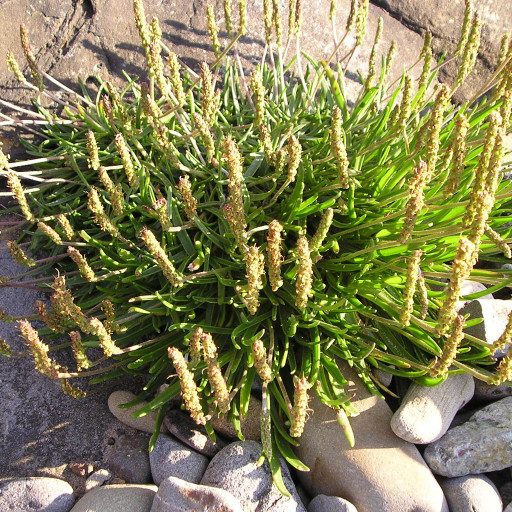
Plant Overview
Known as the Sea Plantain or Goose-tongue, this resilient little specialist is a master of the shoreline. While its inland cousins are often dismissed as common sidewalk weeds, Plantago maritima is a coastal survivor that thrives where most plants wither—right in the path of salty ocean spray, shifting tides, and rocky crevices.
🔍 How to Identify
- 🍃 Fleshy Leaves: The leaves are narrow, linear, and surprisingly thick (almost succulent-like), which helps the plant store water in salty environments.
- 🌾 Flower Spikes: It sends up long, leafless stalks topped with dense, cylindrical brownish-green flower spikes that bob gracefully in the sea breeze.
- 📐 Growth Habit: It forms a low-growing, star-shaped rosette that hugs the ground tightly to avoid being uprooted by harsh coastal winds.
🏡 In Your Garden
- 🌊 Coastal Specialist: This is the ultimate plant for "salt-spray" zones. If you live near the ocean where other plants struggle with the air quality, the Sea Plantain will feel right at home.
- 🪨 Drainage is Key: Because it naturally grows in rocky outcrops and sandy marshes, it has a deep taproot that hates being waterlogged in heavy clay. It requires "sharp" drainage—think gravelly or sandy soil mixes.
⚠️ Safety & Toxicity
- ✅ Status: Generally considered non-toxic and has a long history as a wild edible.
- 🐾 Details: It is safe for pets and children. However, if you are foraging, be cautious: because it grows in marshes and near coastlines, it can absorb heavy metals or pollutants from contaminated seawater. Only harvest from "clean" wild areas.
✨ Fun Fact
In some coastal regions, Sea Plantain is known as "Goose-tongue" and was historically used as a "famine food." Today, foragers prize it for its salty, nutty flavor, often tossing the young, crunchy leaves into summer salads or steaming them like asparagus.

Detailed Care Instructions
To grow Plantago Maritima, also known as sea plantain, you can follow these steps:
- Choose the right location: Sea plantain prefers coastal areas with sandy or well-draining soil. It can tolerate full sun to partial shade. Ensure that the location has good air circulation.
- Obtain seeds: You can find Plantago Maritima seeds online, or you may consider collecting seeds from existing plants. Seeds are typically available in the spring.
- Prepare the soil: Before sowing the seeds, prepare the soil by removing any weeds or grass. Loosen the soil and incorporate organic matter, such as compost or well-rotted manure, to improve its fertility and drainage.
- Sow the seeds: Sprinkle the seeds evenly over the prepared soil. Lightly press them into the soil without burying them too deeply. It is preferable to sow the seeds in spring or early summer.
- Watering: Keep the soil consistently moist but not waterlogged. Water the plants regularly, especially during hot and dry weather conditions.
- Maintenance: Remove any weeds that compete with the sea plantain for resources. Mulching around the plants can help suppress weed growth and retain soil moisture.
- Pruning: If the plant becomes leggy or starts to produce seed heads, you can prune it back to promote bushier growth. Regularly deadhead the spent flowers to prevent self-seeding.
- Harvesting and propagation: You can harvest the leaves of Plantago Maritima for culinary or medicinal purposes. To propagate new plants, collect the seeds from mature seed heads and sow them according to the steps mentioned above.
Remember that patience is important when growing plants, so provide adequate care and attention, and it should thrive over time.

Place in a window with dappled sun or a spot in the middle of a room. Or directly in a window facing west or east.

To water this plant, make sure the soil is dry to the touch before watering. Use a watering can or hose with a gentle flow to moisten the soil evenly. Avoid overwatering, as this can cause root rot. Water the soil rather than the leaves to prevent moisture buildup and to minimize the risk of disease. Water the plant once a week or as needed based on the plant's environment and growth rate.
To fertilize this plant, scatter a low-nitrogen fertilizer that's high in phosphorus and potassium around the base of the plant in early spring before new growth emerges. Repeat this process every six to eight weeks throughout the growing season, taking care not to apply too much fertilizer at once to avoid burning the roots. Water the plant thoroughly after fertilizing to ensure the nutrients are fully absorbed.
Plantago Maritima prefers sandy soils that are well-drained and have a good water-holding capacity. The soil pH should be slightly acidic to neutral, with a range of 6.0 to 7.5 being ideal. The soil should be rich in organic matter, with good fertility levels, particularly nitrogen. It is important to maintain adequate moisture levels, as the plant prefers consistently moist soil. However, excessive watering can cause root rot. Compost or other organic soil amendments can be added to improve soil structure and fertility. The use of heavy, clay soils should be avoided, as they can restrict root growth and cause poor drainage.
Plantago Maritima is a perennial plant that can be propagated by collecting and planting its seeds. The seeds can be collected after the flowers have finished blooming and the plant has matured. To propagate the plant, the seeds should be planted in well-draining soil and watered regularly until they germinate. The seedlings should be transplanted to a larger pot once they have grown a few inches. Alternatively, the plant can be propagated through stem cuttings by taking cuttings from the plant in early spring or late summer and rooting them in soil. The cuttings should be taken from healthy, mature stems and dipped in rooting hormone before planting in soil. Regular watering and misting will help the cuttings to root and establish themselves. With proper care and attention, Plantago Maritima can be easily propagated and grown into a healthy and vibrant plant.
Common pests of the sea plantain include Aphids, larvae, snails. Make a habit of checking your sea plantain frequently for pests so that any infestations can be caught and managed early.








