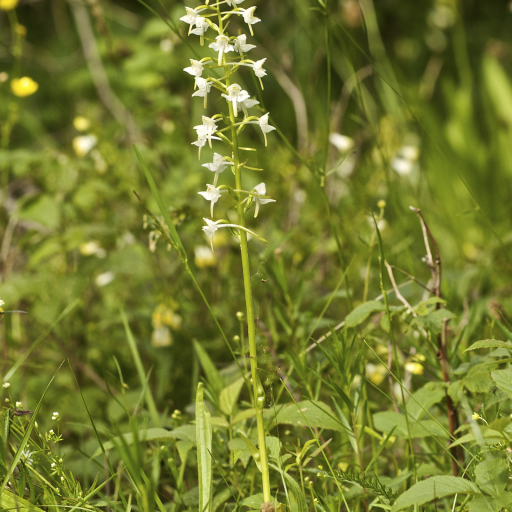
Plant Overview
Often referred to as the Greater Butterfly-orchid, this elegant perennial is one of Europe’s most enchanting wild orchids. While its name suggests a flutter of wings, the plant is actually a master of the night, releasing a heavy, sweet fragrance at dusk to lure in nocturnal navigators. In folklore, finding one in a clearing was often seen as a sign of a healthy, "ancient" forest.
🔍 How to Identify
- 🍃 Twin Leaves: At the very base of the plant, you will find two large, shiny, oval-shaped leaves that hug the ground, often looking slightly "floppy" compared to other orchid species.
- 🍦 The Flowers: The flowering spike holds a loose cluster of greenish-white blossoms. Each flower has a long, slender "spur" (a nectar tube) trailing behind it like a delicate tail.
- 📐 The "V" Sign: To tell it apart from its cousin (the Lesser Butterfly-orchid), look at the pollinia (the yellow pollen sacs) inside the center; in this species, they are tilted away from each other in a distinct "V" shape.
🏡 In Your Garden & Wild Habitat
- 🌳 The Mycorrhizal Bond: This orchid isn't a typical "plug and play" garden plant. It relies on a complex relationship with underground fungi to survive. Because of this, it is notoriously difficult to transplant and should never be dug up from the wild.
- ⛅ Shadow Play: In its natural habitat, it thrives in dappled shade or the "edge" zones where woodland meets meadow. It prefers lime-rich (alkaline) soils that stay moist but never waterlogged, mimicking the cool, damp floor of a deciduous forest.
⚠️ Safety & Toxicity
- ✅ Status: Generally non-toxic.
- 🚫 Hands Off: While it isn't poisonous to touch, this plant is highly sensitive. Oils from human skin can sometimes damage the delicate petals, and in many regions, it is a protected species. It is best enjoyed with a camera rather than your hands.
- 🐾 Pets & Kids: There are no recorded toxic effects for cats or dogs, but like most wild orchids, its rarity makes it a "look but don't touch" treasure of the plant world.
✨ Fun Fact
The Greater Butterfly-orchid is a specialist in "long-distance" dating. Its nectar spur is so deep (up to 4cm) that only certain hawk-moths with incredibly long tongues can reach the reward, getting a face full of pollen in the process!

Detailed Care Instructions
To grow Platanthera chlorantha, also known as the greater butterfly orchid or fragrant orchid, you can follow the steps below:
- Climate and Location:
- Determine if your local climate is suitable for growing Platanthera chlorantha. It typically prefers temperate to cool climates.
- Find a suitable outdoor location for your plant. It needs partial shade to full sun.
- Determine if your local climate is suitable for growing Platanthera chlorantha. It typically prefers temperate to cool climates.
- Soil Preparation:
- Prepare a well-draining soil mixture that is rich in organic matter.
- If your soil is heavy, you can add perlite or sand to improve drainage.
- Prepare a well-draining soil mixture that is rich in organic matter.
- Planting:
- Plant the Platanthera chlorantha tubers in early autumn.
- Dig a hole large enough to accommodate the tubers, usually around 6 inches deep (15 cm).
- Place the tubers in the hole and cover them with soil.
- Plant the Platanthera chlorantha tubers in early autumn.
- Watering:
- Water the tubers thoroughly after planting to encourage good root establishment.
- During the growing season, maintain soil moisture by watering regularly. The soil should be evenly moist but not waterlogged.
- Water the tubers thoroughly after planting to encourage good root establishment.
- Fertilization:
- Platanthera chlorantha doesn't require frequent fertilization.
- Applying a balanced orchid fertilizer or a slow-release fertilizer once or twice a year should be sufficient.
- Platanthera chlorantha doesn't require frequent fertilization.
- Mulching:
- Apply a layer of organic mulch, like compost or bark chips, around the base of the plant to help retain moisture and suppress weeds.
- Apply a layer of organic mulch, like compost or bark chips, around the base of the plant to help retain moisture and suppress weeds.
- Maintenance:
- Remove any competing weeds carefully to avoid damaging the Platanthera chlorantha's delicate roots.
- Protect the plant from slugs and snails, which can eat the foliage.
- Avoid overwatering, as excessive moisture can lead to root rot.
- Remove any competing weeds carefully to avoid damaging the Platanthera chlorantha's delicate roots.
- Dormancy:
- Platanthera chlorantha goes dormant during the winter months.
- Allow the plant to die back naturally, and avoid removing or disturbing the tubers during this period.
By following these guidelines, you should be able to successfully grow Platanthera chlorantha. Remember to monitor the plant regularly, provide proper care, and be patient, as these orchids may take a few years to bloom.
- Platanthera chlorantha goes dormant during the winter months.

Place in a bright room that is sun drenched almost all day. Or directly in a south-facing window.

To ensure optimal growth and health of Platanthera Chlorantha plant, you must provide it with adequate hydration. Follow these steps to properly water this plant:
1. Assess the soil moisture: Check the soil moisture level by inserting your finger about an inch deep into the soil. If it feels dry at this depth, it is an indication that watering is required.
2. Watering frequency: Platanthera Chlorantha plants generally require consistent moisture but avoid overwatering. Watering frequency may vary depending on factors such as climate, temperature, and humidity. As a general guideline, water the plant once every 7-10 days or when the top inch of soil feels dry.
3. Watering method: Slowly pour water into the potting container or onto the soil surrounding the plant. Ensure that you do not allow water to accumulate in the saucer or container bottom, as this may lead to root rot.
4. Water quantity: Provide enough water to moisten the soil thoroughly. Allow water to penetrate the entire rootball by ensuring that water reaches the bottom of the pot. However, avoid excessive water that causes waterlogging.
5. Time of watering: Water plants early in the morning or late in the evening. This prevents evaporation and allows the plant sufficient time to absorb water before the heat of the day.
6. Monitor the drainage: Platanthera Chlorantha plants require well-draining soil to prevent root rot. After watering, ensure that excess water drains freely from the bottom of the pot. If the plant is sitting in a saucer, empty it after the water has drained.
7. Environmental considerations: Adjust your watering schedule based on environmental conditions. High temperatures, low humidity, and increased airflow may cause increased water loss, requiring more frequent watering.
8. Use filtered or distilled water: If possible, use filtered or distilled water to water your Platanthera Chlorantha plant. Tap water often contains minerals and chemicals, which can accumulate in the soil and adversely affect the plant's growth.
Remember, each plant's watering requirements can vary, so it's essential to monitor your Platanthera Chlorantha plant closely and adapt the watering routine based on its specific needs.
To fertilize Platanthera Chlorantha, follow these instructions:
- Choose a well-balanced fertilizer with equal proportions of nitrogen (N), phosphorus (P), and potassium (K). Look for a fertilizer with a ratio of 10-10-10 or similar.
- Start fertilizing in the early spring, once the plant begins to show signs of growth. Avoid applying fertilizer when the plant is dormant or during extreme weather conditions.
- Dilute the fertilizer according to the package instructions. Generally, mix 1 tablespoon of fertilizer with 1 gallon of water.
- Apply the diluted fertilizer evenly around the base of the plant, avoiding direct contact with the leaves or flowers.
- Water the plant thoroughly after fertilizing to ensure proper absorption of nutrients into the soil.
- Repeat the fertilization process every four to six weeks throughout the growing season. However, always check the fertilizer package for specific instructions regarding frequency and dosage.
- Monitor the plant's response to the fertilizer. If you notice any signs of over-fertilization, such as yellowing leaves or stunted growth, reduce the amount of fertilizer or dilute it further.
Remember to always read and follow the specific instructions provided by the fertilizer manufacturer, as different products may have slight variations in application methods.
Platanthera chlorantha, or the specific species without mentioning any common names, thrives best in a specific type of soil that offers the ideal conditions for its growth. This plant prefers moist, well-draining soil that allows excess water to flow away, preventing root rot and other water-related issues.
The soil used for Platanthera chlorantha should have a slightly acidic to neutral pH level, ranging from 6.0 to 7.0. This pH range suits the plant's nutritional needs and aids in better nutrient absorption.
Moreover, the soil should be rich in organic matter, such as compost or well-rotted manure, as it enhances soil fertility, improves moisture retention, and promotes aeration. Organic matter also helps create a favorable environment for beneficial microorganisms that contribute to the overall health of the plant.
Platanthera chlorantha requires loose and crumbly soil texture, which allows for proper root development and prevents compaction. This helps the plant's roots to penetrate easily into the soil, ensuring efficient absorption of water and nutrients.
Additionally, the soil chosen should be able to hold adequate moisture without becoming waterlogged. This is essential as Platanthera chlorantha prefers consistently moist soil to support its growth. However, the soil should also allow excess water to drain to prevent waterlogging, which can lead to root rot and other fungal diseases.
Lastly, the soil should be free of any contaminants, heavy metals, or chemical residues that could potentially harm the plant. Platanthera chlorantha, like many other plant species, is sensitive to toxic substances, so it is important to ensure that the soil is clean and uncontaminated.
Overall, choosing a high-quality soil that is well-draining, slightly acidic to neutral, rich in organic matter, loose in texture, able to retain moisture but not waterlogged, and free of contaminants is essential for the healthy growth and development of Platanthera chlorantha.
To propagate Platanthera chlorantha plants, follow the steps below:
- Choose a healthy and mature Platanthera chlorantha plant. Look for a plant that is producing multiple healthy shoots and has an overall robust appearance.
- Find a suitable location for propagation. Platanthera chlorantha plants require partial to full shade in a moist environment. Ideally, choose an area with dappled sunlight and slightly acidic, well-draining soil.
- Prepare the growing medium. Mix equal parts of peat moss, perlite, and vermiculite to create a well-draining and moisture-retaining medium for the Platanthera chlorantha cuttings.
- Take stem cuttings. Using clean and sharp pruning shears, cut a healthy, non-flowering stem from the parent plant. Make sure the cutting is around 4-6 inches in length and includes 2-3 leaf nodes.
- Remove the lower leaves. Carefully strip off the leaves from the lower half of the cutting. This will prevent excess moisture loss and help promote root formation.
- Apply rooting hormone (optional). Dip the lower end of the cutting into a rooting hormone powder or gel to stimulate root growth.
- Plant the cutting. Make a small hole in the prepared growing medium and gently insert the cutting, ensuring the leaf nodes are buried in the soil. Firmly press the soil around the base of the cutting to ensure good contact.
- Water the cutting. Moisten the growing medium thoroughly but avoid saturating it. Platanthera chlorantha prefers moist conditions but can rot if overwatered. Place the cutting in a tray or container with drainage holes to avoid waterlogging.
- Provide proper environmental conditions. Platanthera chlorantha cuttings prefer high humidity while they establish roots. You can cover the cutting with a clear plastic bag or place it in a propagator to create a humid environment. Keep the cutting away from direct sunlight.
- Monitor and maintain the cutting. Check the moisture level of the growing medium regularly and water as needed to keep it consistently moist but not waterlogged. Remove any mold or rotting material promptly to avoid fungal diseases.
- Wait for root growth. Depending on the conditions, Platanthera chlorantha cuttings may take several weeks to months to develop roots. Be patient and avoid disturbing the cutting during this period.
- Transplant the rooted cutting. Once the cutting has developed a healthy root system, gently remove it from the rooting medium and plant it in a suitable pot or desired planting location with similar growing conditions.
By following these steps, you can successfully propagate Platanthera chlorantha plants and expand your collection.








