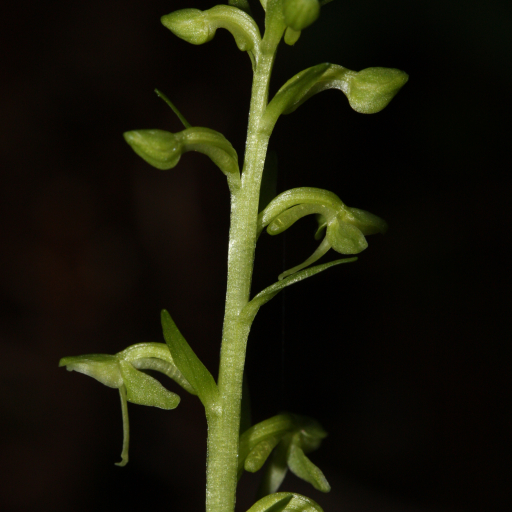
Plant Overview
Known commonly as the Slender Bog Orchid, this understated beauty is a master of camouflage in the misty wetlands of Western North America. While it doesn't boast the flashy colors of its tropical cousins, its elegant green spikes are a hallmark of a healthy, pristine ecosystem. Finding one along a mountain stream feels like discovering a hidden, living emerald tucked away in the reeds.
🔍 How to Identify
- 📏 Towering Spikes: It features a tall, slender stem that can reach up to three feet in height, topped with a dense arrangement of small, translucent green or yellowish flowers.
- 👤 The "Hooded" Bloom: The upper sepals and petals curve together to form a tiny, protective "hood" over the center of the flower.
- 💧 Blunt Nectar Spur: If you look closely at the back of the flower, you’ll see a short, blunt, sac-like spur that holds nectar for thirsty pollinators.
🏡 In Your Garden
- 🌊 The Wetland Specialist: This orchid is a true "hydrophile," meaning it thrives in saturated, boggy soils where most other plants would suffer from root rot. It loves cold, moving water and high-elevation air.
- 🍄 A Delicate Symbiosis: Like many wild orchids, it relies on a complex relationship with underground mycorrhizal fungi to absorb nutrients. Because this fungal network is nearly impossible to replicate at home, this plant rarely survives being transplanted and is best left to flourish in the wild.
⚠️ Safety & Toxicity
- ✅ Safe for All: The Slender Bog Orchid is generally considered non-toxic to humans, cats, and dogs.
- 🛑 Conservation Warning: The primary "danger" involves the plant's survival. It is highly sensitive to soil compaction and water pollution. In many regions, it is a protected species; picking or moving it can damage local populations and may be illegal in national parks.
✨ Fun Fact
- 🦋 Spicy Secrets: While the flowers appear plain to our eyes, they emit a faint, spicy fragrance—often compared to cloves or musk—that becomes more intense in the evening to attract specific nocturnal moths.

Detailed Care Instructions
To grow Platanthera stricta (the green wood orchid or green fringed orchid), follow these steps:
- Climate and location: Ensure that you live in a suitable climate for this plant, which is typically found in eastern North America and prefers cool, moist environments. Provide it with a shaded location that receives filtered light.
- Soil requirements: The plant prefers slightly acidic soil with good drainage. Add organic matter like compost to improve soil quality and drainage. Avoid heavy clay or waterlogged soil.
- Propagation: Platanthera stricta can be propagated through seeds or division. Seeds can be purchased from a reliable source. After collecting seeds, store them in a cool, dry place until planting. Division is usually done in early spring when the plant starts to show new growth. Divide the rhizomes carefully and replant them in suitable locations.
- Planting: When planting seeds, sow them in a pot or container filled with moist, well-draining soil. Surface sow the seeds and keep the container in a cool location, ideally between 65-70°F (18-21°C). Once the seeds have germinated and developed a few leaves, they can be transplanted into larger pots or directly into the ground.
- Watering: Platanthera stricta requires consistent moisture, but it should not be waterlogged. Water the plant regularly, ensuring the soil stays evenly moist. Avoid letting the soil dry out completely or become too wet.
- Mulching: Apply a layer of organic mulch, such as leaf compost or wood chips, around the base of the plant. This will help maintain moisture levels in the soil, suppress weeds, and keep the roots cooler.
- Fertilization: Orchids generally don't require much fertilization, and Platanthera stricta is no exception. Use a balanced, slow-release orchid fertilizer or a diluted general-purpose fertilizer once or twice a year during its active growing season.
- Maintenance: Remove any weeds or competing plants near the Platanthera stricta to prevent nutrient competition. Monitor for pests, diseases, or signs of stress. Prune away any dead or yellowed leaves or flowers.
Remember that Platanthera stricta is a native plant that prefers natural conditions rather than cultivated environments. It may take time to establish, so be patient and provide suitable conditions for its growth.

The Platanthera Stricta plant should be watered regularly, but not too much as this can lead to root rot. It is important to allow the soil to dry out slightly before watering again. When watering, avoid getting water on the leaves as this can cause damage. It is best to water at the base of the plant and allow the water to soak into the soil. This plant prefers slightly acidic soil, so be sure to use water with a pH level between 5.5 and 6.5. Avoid using hard water or water with high levels of minerals or chlorine. Water the plant more frequently during the summer months when the air is dry.
To fertilize this plant, apply a slow-release fertilizer in early spring, just as new growth begins. Use a fertilizer with a balanced ratio of nitrogen, phosphorus, and potassium, such as 10-10-10 or 20-20-20. Apply according to package instructions, being careful not to over-fertilize, which can damage the plant. Water the plant thoroughly after fertilizing to help distribute the nutrients. Repeat fertilizer application once or twice more during the growing season, spacing applications several weeks apart. In late summer, stop fertilizing to allow the plant to prepare for dormancy in the winter.
The Platanthera Stricta plant prefers to grow in well-draining soils that are rich in organic matter. It is important to avoid heavy clay soils as they can hold too much moisture and cause root rot. The ideal soil pH for this plant is slightly acidic to neutral, with a range of 5.0-7.0. A good soil mix for this plant would include equal parts of peat moss, perlite, and vermiculite, with a small addition of coarse sand. It is important to water the plant regularly, but not excessively, and to allow the top layer of soil to dry out slightly between watering. A high-quality, slow-release fertilizer can be applied in the spring and summer to promote healthy growth.
To propagate this plant, the first step is to collect a mature seed pod once it has dried out. Carefully remove the seeds from the pod and soak them in water for 24 hours. Next, prepare a potting mix of equal parts sphagnum peat moss, perlite, and vermiculite. Fill a small container with the potting mix and then scatter the seeds evenly over the surface, gently pressing them into the mix.
Cover the container with a clear plastic lid to create a mini greenhouse, ensuring that the lid is slightly ajar to allow for air circulation. Place the container in a shaded area with indirect light, and keep the soil consistently moist but not waterlogged.
After a few weeks, the seeds should start to germinate, and tiny seedlings will emerge from the potting mix. At this stage, carefully remove the plastic lid and continue to care for the seedlings as they mature.
Once the seedlings have established a strong root system and have grown to a size that can be handled, they can be transplanted into individual containers with a similar potting mix. Keep the plants in a shaded area with indirect light, and continue to water them thoroughly as the soil begins to dry out.
Over time, as the plants grow, they can be gradually acclimated to brighter light and eventually transplanted into their final location in a garden or container. With proper care and attention, the propagated Platanthera Stricta plants should thrive and produce beautiful flowers year after year.








