Plant Overview
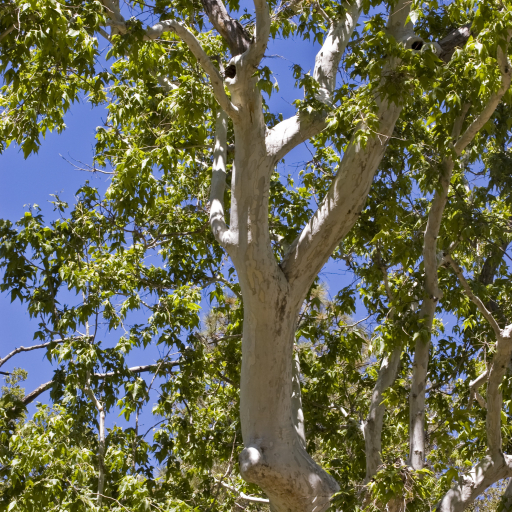
Often called the "Ghost of the Canyon," the Arizona Sycamore is a striking native giant that defines the rugged beauty of Southwestern stream banks. Its massive, twisting branches and peeling white bark make it look like a piece of living sculpture standing against the desert heat. Historically, these trees have been vital landmarks for travelers in arid regions, signaling that life-sustaining water is nearby.
🔍 How to Identify
- ⚪ The Bark: The most iconic feature is the smooth, bone-white bark on the upper branches, which peels away in thin, papery scales to reveal mottled patches of gray and tan.
- 🍁 Leaf Shape: Unlike the Eastern Sycamore, this variety has very deeply lobed leaves—often 5 to 7 distinct "fingers"—that resemble giant, oversized maple leaves.
- 🧶 Buttonball Fruit: In the fall and winter, the tree drops distinctive, fuzzy seed balls that hang from long stems like natural Christmas ornaments.
🏡 In Your Garden
- 💧 The Riparian Rule: While it lives in the desert, it is a "riparian" species, meaning it naturally grows near water. If planting one at home, it needs deep, regular watering to mimic a canyon floor; it will not thrive in high-and-dry desert landscaping without help.
- 🏘️ Space Requirements: This is a massive, fast-growing tree that can reach 80 feet tall. Because of its expansive root system and brittle wood that can drop branches in high winds, it should be planted far away from houses, power lines, or underground pipes.
⚠️ Safety & Toxicity
- 🛡️ Safe Assessment: The Arizona Sycamore is non-toxic to humans, dogs, cats, and horses.
- 🤧 Respiratory Irritant: Be careful when handling the leaves or seed balls in the autumn. They are covered in tiny, stiff hairs (trichomes) that can shed and cause significant irritation to the eyes, nose, and throat if inhaled or rubbed into the skin.
✨ Fun Fact
The Arizona Sycamore is the preferred "apartment complex" of the Southwest; its tendency to form hollow cavities in its old age provides essential nesting sites for the rare and beautiful Elegant Trogon and many species of owls.

Detailed Care Instructions
To grow a Platanus Wrightii plant, also known as Arizona sycamore, you can follow these steps:
- Select a suitable location: Choose a spot in your garden or landscape that receives full sun or partial shade. Ensure the soil is well-draining and has good fertility.
- Prepare the soil: Before planting, loosen the soil by tilling or digging it up to a depth of 12-18 inches. Remove any weeds or grass from the area.
- Dig a hole: Dig a hole twice as wide and just as deep as the root ball of the sapling. Ensure there is enough space for the root system to spread out comfortably.
- Plant the sapling: Gently place the sapling into the hole, making sure the top of the root ball is level with the surrounding soil. Backfill the hole with soil, firming it gently around the roots.
- Water thoroughly: Water the newly planted sapling deeply to settle the soil and promote root establishment. Provide water regularly during the first few weeks to help the plant establish itself.
- Mulch: Apply a layer of organic mulch around the base of the plant, leaving a small gap near the trunk. This will help retain soil moisture, suppress weeds, and regulate soil temperature.
- Prune if necessary: Once the tree has become established, you can prune it if desired. Pruning can help shape the plant and remove any dead, damaged, or crossing branches. It is best to prune the tree during the dormant season, usually in late winter or early spring.
- Provide regular care: Continue to provide regular water during dry spells, especially in the first year. Fertilize the tree in early spring with a balanced slow-release fertilizer according to package instructions. Monitor for pests and diseases and take appropriate action if needed.
By following these steps, you can successfully grow a Platanus Wrightii plant. Remember that patience is key, as it may take several years for the plant to reach its full potential.

Place in a bright room that is sun drenched almost all day. Or directly in a south-facing window.

To ensure proper watering for the Platanus wrightii plant, it is important to consider the following factors:
1. Soil Moisture: Prioritize a soil moisture level that is conducive to the plant's health. Ideally, the soil should be kept consistently moist but not overly saturated or waterlogged.
2. Check the Soil: Regularly inspect the soil's moisture level by inserting your finger a few inches into the soil. If it feels dry, it is an indication that the plant requires watering.
3. Watering Method: Prefer a thorough yet gentle watering approach. Avoid splashing or pouring water directly onto the foliage, as this could lead to fungal diseases. Instead, focus on directing the water at the root zone.
4. Water Quantity: Provide an adequate amount of water to ensure deep penetration into the root system. This ensures that the roots of the Platanus wrightii plant receive the necessary hydration and nutrients. However, be cautious not to over-water, as it can lead to root rot or other water-related issues.
5. Watering Frequency: The frequency of watering largely depends on factors such as climate, temperature, and the moisture retention capacity of the soil. Generally, a watering schedule of once or twice a week should suffice. Adjust the frequency based on the plant's response, ensuring the soil does not dry out completely between watering sessions.
6. Drought Tolerance: Platanus wrightii plants are known to be relatively drought-tolerant, so it is preferable to slightly underwater rather than overwater. This allows the plant to develop a stronger root system, making it more resilient during prolonged dry spells.
7. Mulching: Applying a layer of organic mulch around the base of the plant can help retain soil moisture and regulate soil temperature. This, in turn, reduces the frequency and amount of water needed for the Platanus wrightii plant.
Remember that the above guidelines provide general watering recommendations. Observing the plant's individual needs, monitoring environmental conditions, and adapting the watering regimen accordingly is crucial for the optimal health and growth of Platanus wrightii.
To fertilize the Platanus Wrightii plant, follow these instructions:
- Choose a balanced, slow-release fertilizer specifically formulated for trees and shrubs. Avoid using high-nitrogen fertilizers as they can promote excessive foliage growth.
- Apply the fertilizer in early spring before the new growth starts. This allows the plant to utilize the nutrients during the growing season.
- Read the fertilizer's label for specific application rates. Generally, for established Platanus Wrightii plants, use 1 pound of fertilizer per inch of trunk diameter. Sprinkle the fertilizer evenly in a ring around the base of the plant, starting a foot away from the trunk and extending to the drip line.
- Gently work the fertilizer into the top few inches of soil using a garden fork or a small cultivator. Avoid damaging the plant's roots while doing so.
- After fertilizing, thoroughly water the area to facilitate nutrient absorption. Apply enough water to moisten the soil to a depth of 6-8 inches.
- Repeat the fertilization process once a year, preferably in early spring. Adjust the amount of fertilizer based on the plant's growth and response to previous applications.
Remember to always follow the fertilizer manufacturer's instructions for the best results and to protect the environment.
Platanus Wrightii, a plant commonly found in North America, thrives best in a specific type of soil that provides it with the necessary nutrients and conditions for healthy growth. Ideal soil for Platanus Wrightii is typically well-draining, allowing water to pass through it easily. This ensures that the plant's roots do not become saturated, reducing the risk of root rot.
The preferred soil for Platanus Wrightii is loamy or sandy, which enhances drainage. Loam soil is a blend of sand, silt, and clay, providing a balanced mixture of nutrients and adequate water retention. Sandy soil, on the other hand, is composed of larger particles, allowing water to flow freely. A sandy loam combination would be highly suitable for this plant.
In terms of pH level, Platanus Wrightii prefers slightly acidic to neutral soil, with a pH range of around 5.5 to 7.0. Maintaining the appropriate pH level helps the plant to absorb nutrients effectively, supporting its overall growth and health.
Additionally, incorporating organic matter into the soil enriches it with essential nutrients and improves its overall structure. Organic matter can be added in the form of compost or well-rotted manure, which provides a slow-release source of nutrients over time.
To summarize, Platanus Wrightii thrives in well-draining soil that is preferably loamy or sandy in texture. The pH level should be kept slightly acidic to neutral, and the inclusion of organic matter can greatly benefit the plant's growth and development.
To propagate Platanus wrightii, you can follow the method of vegetative propagation through softwood cuttings. Here's a detailed step-by-step process:
- Preparation: Begin by collecting all the necessary materials, including a clean pair of pruning shears or gardening scissors, a clean plastic nursery pot, a well-draining potting mix, a rooting hormone (optional), a clear plastic bag, and a spray bottle filled with water.
- Selecting cuttings: Choose a healthy, pest-free, and disease-free Platanus wrightii plant. Look for young, green stems that are not too woody. Softwood cuttings, taken in spring or early summer, provide the best chances for successful root development.
- Cutting the stems: Use the pruning shears to make a clean cut, around 4 to 6 inches long, just below a leaf node. Remove any leaves from the lower half of the cutting, leaving a few at the top.
- Preparing the cuttings: If desired, dip the cut end of each stem into a rooting hormone powder to increase rooting success. Gently tap off any excess powder. Not using rooting hormone is also an option, but it may take longer for the cuttings to root.
- Potting the cuttings: Fill the plastic nursery pot with a well-draining potting mix. Moisten the mix slightly, so it is damp but not soaking wet. Make a hole in the potting mix, using a pencil or your finger, and insert the bottom half of the cutting into the hole. Firmly press the soil around the base of the cutting to ensure good contact.
- Watering and humidity: Mist the cutting and the soil around it with the spray bottle to provide moisture. Cover the pot with a clear plastic bag to create a mini greenhouse effect and maintain humidity. Make sure the plastic does not touch the cutting, as it may cause rotting.
- Providing suitable conditions: Place the potted cutting in a warm and bright location, but avoid direct sunlight that can scorch the cutting. Maintain a consistent temperature between 70-75°F (21-24°C). Check the moisture level of the soil regularly and mist if it feels dry.
- Root development: Within a few weeks, roots should begin to develop. You can gently tug on the cutting, and if you feel resistance, it means roots have started to grow.
- Acclimatizing: Once the roots are well-developed, remove the plastic bag and gradually expose the cutting to normal room conditions over the course of a week or two. This helps the cutting adjust to the change in humidity and reduces the risk of transplant shock.
- Transplanting: After about 8-12 weeks, the new plant should have an established root system. Carefully lift the young Platanus wrightii plant from the nursery pot and transplant it into a larger container, or directly into the ground if the weather and soil conditions are suitable.
By following these steps, you can successfully propagate Platanus wrightii through softwood cuttings, allowing you to grow new plants from the parent plant without mentioning its common name.








