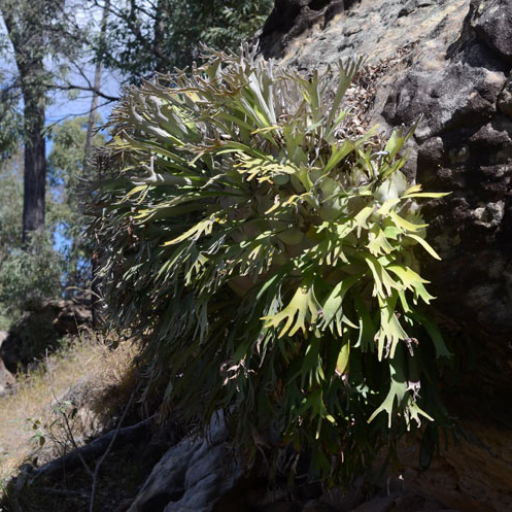
Plant Overview
Known as the "Silver Staghorn Fern," Platycerium veitchii is the rugged, sun-loving cousin of the common houseplant fern. Hailing from the semi-arid regions of Australia, it looks less like a delicate woodland plant and more like a piece of living sculpture crafted from velvet and silver. Its ability to thrive in harsher conditions than most ferns makes it a prized possession for plant collectors seeking architectural flair.
🔍 How to Identify
- 🌿 Silver Sheen: The fronds are covered in a dense layer of white, star-shaped hairs called trichomes. This gives the plant a distinct dusty, metallic silver appearance rather than a traditional forest green.
- 🦌 Upright Antlers: Unlike other Staghorns that have drooping leaves, the "fertile fronds" of this species grow remarkably upright and stiff, mimicking the narrow antlers of a young buck.
- 🛡️ Deeply Lobed Shields: At the base, you’ll find "shield fronds" (nest leaves) that are often deeply finger-like or "fringed" at the top, creating a dramatic, wavy crown around the root ball.
🏡 In Your Garden
- ☀️ Sun-Kissed Resilience: Because it evolved on open rock faces, this fern craves much more light than its relatives. Those silver hairs act like tiny mirrors, reflecting harsh sunlight and helping the plant retain moisture in dry air.
- 💨 Drought Endurance: This fern is a master of the "soak and dry" cycle. It hates "wet feet," so it is best grown mounted on a cedar board or in a slatted orchid basket where the roots can breathe.
- 🧗 The Rock Climber: In the wild, it is often "lithophytic," meaning it grows directly on rocks. At home, this means it appreciates excellent airflow and a substrate that doesn't stay soggy, such as coarse sphagnum moss or bark.
⚠️ Safety & Toxicity
- ✅ Pet & Human Friendly: Platycerium veitchii is generally considered non-toxic to dogs, cats, and humans, making it a safe choice for high-traffic areas of the home.
- 🧤 Handle with Care: While not poisonous, the silver "fuzz" on the leaves is functional and fragile. Avoid rubbing or cleaning the leaves with water; your finger oils can strip away the protective trichomes, leaving the plant susceptible to sunburn.
✨ Fun Fact
In its native Australian habitat, the shield fronds of the Silver Staghorn act as a "living trash can." They are designed to catch falling leaves and debris from the canopy above. As this organic matter decays within the shield, the fern creates its own personal compost to feed its roots!

Detailed Care Instructions
To grow a Platycerium Veitchii (Staghorn Fern) plant, follow these steps:
- Lighting: Staghorn ferns prefer bright, indirect light. Place the plant near a window with filtered light or use artificial grow lights.
- Temperature and Humidity: Staghorns thrive in temperatures between 60-75°F (15-24°C). They prefer high humidity, so consider placing a humidifier nearby or misting the leaves regularly.
- Potting: Staghorns are epiphytic plants and can be mounted on cork or wooden plaques or placed in a hanging basket filled with well-draining orchid or fern potting mix. Ensure the potting mix doesn't retain excess moisture.
- Watering: Staghorn ferns need watering regularly to keep the medium slightly moist. Mist the entire plant, including the shield fronds, to mimic natural rainfall. Avoid using tap water; filtered or distilled water is preferred.
- Fertilizing: Feed the plant with a balanced liquid fertilizer diluted to half strength every 4-6 weeks during the growing season (spring and summer). Avoid fertilizing during the dormant winter months.
- Mount Maintenance: If mounted, occasionally soak the entire mount in a basin of water for an hour to provide hydration. Ensure it drains thoroughly afterward.
- Pruning: Remove brown or yellow fronds to promote new growth and maintain the plant's health and appearance.
- Propagation: Propagate Staghorn ferns by dividing the plants during repotting or by removing offsets (new plants growing alongside the parent plant). Attach the divided plants or offsets onto separate mounts or suitable containers.
- Pest Control: Check the plant regularly for pests such as scale insects or mealybugs. Use a mild insecticidal soap or manually remove them with a cotton swab dipped in rubbing alcohol.
Remember, Staghorn ferns are slow-growing plants, so be patient and provide consistent care to help them thrive.

Place in a window with dappled sun or a spot in the middle of a room. Or directly in a window facing west or east.

Platycerium Veitchii is a type of plant that belongs to the family Polypodiaceae. This plant requires moist soil to survive, but it also needs good drainage to prevent the roots from becoming waterlogged.
When watering Platycerium Veitchii, it is important to make sure that the soil remains moist but not waterlogged. This means that you should water it thoroughly, but then allow the soil to dry out slightly before watering it again. To test the soil moisture, stick your finger about an inch into the soil. If it feels dry, it’s time to water.
You should also avoid getting water on the leaves of Platycerium Veitchii, as it can lead to the growth of fungus and rot. Instead, water the soil around the base of the plant, making sure that the water gets deep into the soil.
In terms of frequency, Platycerium Veitchii generally needs to be watered about once a week, but this may vary depending on the environment it is in. During periods of high heat or low humidity, it may need to be watered more frequently.
Overall, the key to watering Platycerium Veitchii is to keep the soil moist but not waterlogged, and to avoid getting water on the leaves. With proper watering, this plant can thrive and add a unique touch to your indoor or outdoor space.
To fertilize this plant, make sure to dilute the fertilizer to half the recommended strength and apply it once a month during the growing season. Apply the fertilizer around the base of the plant, avoiding the leaves. Do not fertilize the plant during the dormant season.
Platycerium Veitchii is a type of epiphytic plant that requires a well-draining soil mix with good aeration for proper growth. It is recommended to use a soil mix made up of organic materials such as sphagnum moss, peat, or coconut coir, with added perlite or vermiculite to improve drainage. The soil mix should be slightly acidic with a pH range between 5.5 to 6.5. This plant also requires good air circulation, so it is essential to use a porous soil mix that allows air to flow through the roots. The soil should be kept lightly moist but never saturated, as excess water can lead to root rot. Fertilizing the plant every two to three weeks during the growing season with a balanced, water-soluble fertilizer will promote healthy growth.
To propagate this plant, use a sterile razor blade to cut a healthy frond off the mother plant close to the base, making sure there is a small portion of the rhizome attached. Then, cut the frond into several smaller pieces, making sure each piece has a portion of the rhizome and at least one healthy frond. Dip the cut ends of each piece in a rooting hormone and plant them in a well-draining mix of sphagnum moss and perlite. Keep the soil moist and the plant in a shaded area until new growth appears, then gradually increase light exposure.
Common pests of the silver staghorn include Scale insect, mealybugs. Make a habit of checking your silver staghorn frequently for pests so that any infestations can be caught and managed early.








