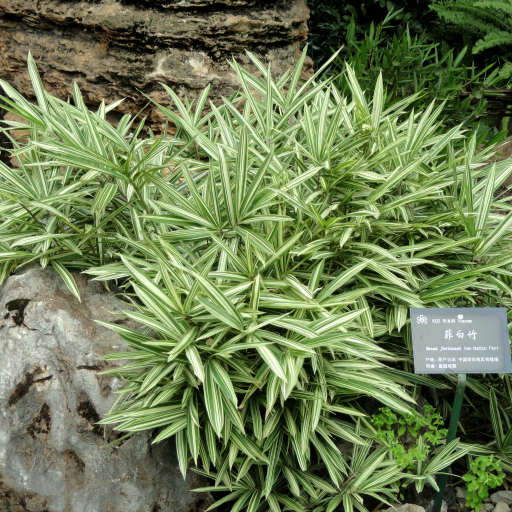
Plant Overview
Often called the Dwarf Whitestripe Bamboo, this elegant ornamental is the "tuxedo" of the groundcover world. Its striking white-and-green variegated foliage brings a splash of light to the darker, shaded corners of a garden. Native to Japan, it has been a staple in Zen-style landscapes for centuries, prized for its ability to mimic a miniature, wind-swept forest in a small space.
🔍 How to Identify
- 🍃 Foliage: Linear, lance-shaped leaves roughly 3 to 5 inches long. They are famously decorated with bold, creamy-white longitudinal stripes against a deep forest-green base.
- 🎋 Culms (Stems): Very slender, green, and wiry stems that remain upright. Unlike its giant cousins, these "canes" stay thin and flexible.
- 🌱 Growth Habit: A low-growing, spreading bamboo that rarely exceeds 2 or 3 feet in height, forming a dense, lush carpet that feels soft from a distance.
🏡 In Your Garden
- ✂️ The Annual Refresh: To keep those white stripes looking crisp and prevent the plant from becoming "twiggy," you should shear it almost to the ground in late winter. This "mowing" forces the plant to send up a flush of vibrant, fresh new growth in the spring.
- 🧱 The Runaway Root: This species is a "running" bamboo, meaning its underground rhizomes are ambitious explorers. To keep it from taking over your lawn, it is best grown in large containers or within a garden bed lined with a professional-grade root barrier.
- ⛅ Sun & Scorching: While it needs light to maintain its variegation, the white parts of the leaves are delicate. In scorching climates, give it dappled afternoon shade to prevent the white edges from "burning" and turning brown.
⚠️ Safety & Toxicity
- ✅ Status: Non-Toxic.
- 🐾 Details: This bamboo is generally safe for cats, dogs, and children. However, like many grasses, the leaf edges contain silica and can be slightly sharp. Handling the plant without gloves might occasionally cause tiny, "paper-cut" style irritations on sensitive skin.
✨ Fun Fact
🎋 Living Landscapes: In traditional Japanese gardening, Pleioblastus fortunei is frequently used as a "living prop." It is often pruned into different heights and shapes to represent rolling hills or ocean waves in miniature "tsubo-niwa" (courtyard gardens).

Detailed Care Instructions
| Humidity | High |
| Lighting | Part Sun |
| Difficulty | Easy |
| Hibernation | Cold Period |
| Temperature | 20°C - 27°C |
| Hardiness Zones | 7 - 8 |
To grow Pleioblastus Fortunei (also known as a bamboo plant), follow these steps:
- Choose a suitable location: Pleioblastus Fortunei prefers full sun to partial shade. Look for a spot in your garden that receives 4-6 hours of direct sunlight per day. The soil should be well-draining.
- Prepare the soil: Bamboo plants prefer slightly acidic soil with a pH between 5.5 and 6.5. Incorporate well-rotted organic matter, such as compost or aged manure, into the soil to improve its texture and fertility.
- Planting: Dig a hole that is wide and deep enough to accommodate the bamboo rhizome. Place the plant in the hole, making sure the rhizome is covered with soil, and firm the soil gently around the plant.
- Watering: Water the newly planted bamboo thoroughly and keep the soil evenly moist. The plant requires regular watering, especially during dry periods. However, avoid overwatering, as excess moisture can lead to root rot.
- Mulching: Apply a layer of organic mulch, such as wood chips or straw, around the base of the plant to help retain moisture and suppress weed growth. Keep the mulch about 2 inches away from the bamboo stem to prevent rotting.
- Fertilizing: Bamboo plants can benefit from regular fertilization. Use a balanced, slow-release fertilizer or apply organic fertilizers, such as bone meal or fish emulsion, according to the package instructions. Fertilize the plant in early spring and again in mid-summer.
- Pruning: Prune Pleioblastus Fortunei in late winter or early spring to remove dead or damaged canes and to control its size. Cut the canes close to the ground or at the desired height.
- Controlling spreading: Bamboo can be an aggressive spreader, so you may need to use barriers or rhizome pruning techniques to prevent it from encroaching on neighboring plants. Install a physical barrier at least 18 inches deep around the plant's perimeter to restrict rhizome expansion.
- Pests and diseases: Monitor the plant for pests, such as aphids or spider mites, and treat them promptly. Be on the lookout for signs of root rot, such as wilting or yellowing leaves, and adjust watering practices accordingly.
By following these guidelines, you can successfully grow Pleioblastus Fortunei and enjoy its lush foliage in your garden.

Place in a window with dappled sun or a spot in the middle of a room. Or directly in a window facing west or east.

To water this plant, first check the soil moisture by inserting your finger into the soil about an inch deep. If it feels dry, it is time to water. Use a watering can or hose with a gentle flow to water slowly and evenly around the base of the plant. Water until the soil is thoroughly moist but not waterlogged. Avoid getting water on the foliage or in the crown of the plant to prevent fungal growth. It is important to also make sure that the soil has good drainage and does not become waterlogged, as this can harm the plant's root system. Watering frequency will depend on factors such as temperature and humidity, but as a general rule, water when the soil feels dry to the touch.
To fertilize this bamboo variety, apply a balanced, slow-release fertilizer in the spring and midsummer. Avoid over-fertilizing as it can lead to yellowing and burning of the leaves. Water thoroughly after fertilizing to ensure the nutrients are absorbed properly.
The best type of soil to use for this plant is well-draining and rich in organic matter. It should also have a slightly acidic to neutral pH level. The ideal soil mix should consist of equal parts of loam, sand, and peat moss, with the addition of a small amount of perlite or vermiculite for improved drainage. It is important to ensure that the soil is moist but not waterlogged, as this can lead to root rot. Additionally, adding a slow-release fertilizer to the soil during the growing season can help promote healthy growth and foliage.
- Choose a healthy parent plant to take cuttings from.
- Select stems that are young and flexible. Avoid woody, mature stems.
- Use a sharp, clean pair of scissors to make a clean cut just below a node (a point on the stem where leaves or branches emerge).
- Remove all leaves from the bottom 2/3 of the cutting.
- Dip the cut end into rooting hormone powder, tapping off any excess.
- Prepare a well-draining potting mix and moisten it.
- Make a hole in the soil with a pencil or chopstick and gently insert the cutting, pressing the soil around it to ensure good contact.
- Keep the soil moist and provide bright, indirect light.
- After a few weeks, you should notice new growth. Once the roots are established, the new plant can be transplanted into a larger container or into the ground.








