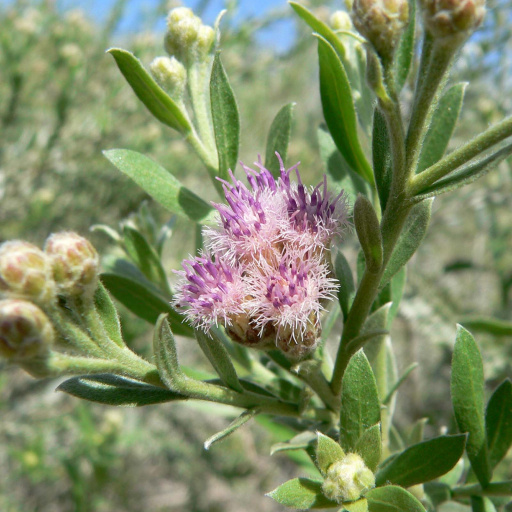
Plant Overview
Known commonly as Arrowweed, this striking desert shrub is a master of survival in the arid landscapes of the Southwestern United States and Northern Mexico. It earned its name from the straight, reed-like stems that were historically harvested by Indigenous peoples to craft arrows and weaving materials. With its shimmering, silvery foliage, it often looks like a cool mist hovering over desert washes.
🔍 How to Identify
- 🌿 Silky Foliage: The leaves are lance-shaped and covered in fine, flattened hairs, giving the entire plant a distinct silvery-grey or "silky" (sericea) sheen.
- 🏹 Straight Stems: It grows in stiff, upright, and very straight woody stalks that can reach up to 10 feet tall, often forming dense, impenetrable thickets.
- 🌸 Cluster Flowers: In late spring and summer, the branch tips produce small, feathery, pink-to-purple flower heads that resemble tiny, frayed tassels.
🏡 In Your Garden
- 💧 Riparian Roots: While it is a desert plant, Arrowweed is a "phreatophyte," meaning it loves to keep its roots near the water table. In a landscape, it excels in low spots or near drainage areas where moisture lingers.
- 🏜️ Salt Tolerance: This plant is incredibly tough in "bad" soil. It thrives in highly alkaline or salty earth where other plants would wither, making it a hero for soil stabilization and erosion control.
⚠️ Safety & Toxicity
- ✅ Safe Status: Pluchea sericea is generally considered non-toxic to humans and common household pets.
- 🌵 Physical Texture: While not "thorny," the dense, woody nature of the thickets can be scratchy. The leaves have a strong, somewhat medicinal resinous scent when crushed which may deter curious nibblers.
✨ Fun Fact
The Cahuilla and Quechan people didn't just use this plant for arrows; they also used the straight branches to construct the framework for "granaries"—large, basket-like structures used to store mesquite beans high off the ground!

Detailed Care Instructions
To grow Pluchea Sericea plant, also known as Saltmarsh Fleabane, consider the following steps:
- Climate and location: Pluchea Sericea plant is native to coastal areas and wetlands, mainly found in warm regions. Ensure that you live in a suitable climate with minimum temperatures above freezing.
- Soil preparation: Pluchea Sericea prefers well-draining soil with high organic matter content. Prepare the soil by adding compost or aged manure to improve fertility and drainage.
- Water requirements: Pluchea Sericea thrives in moist soil and can tolerate periodic flooding. Therefore, it's essential to provide regular irrigation, especially during dry periods, to keep the soil consistently moist.
- Sunlight: Pluchea Sericea requires full sun to part shade to grow optimally. Ensure the plant receives at least 6-8 hours of direct sunlight each day.
- Propagation: Pluchea Sericea can be propagated through seeds or stem cuttings. If using seeds, germinate them indoors before transplanting outside. If using stem cuttings, take cuttings from a mature plant and root them in a moist, well-draining potting mix.
- Planting: Once seeds have sprouted or cuttings have developed roots, transplant them outside in a suitable location. Dig a hole that can accommodate the roots and plant the seedling or cutting at the same depth as it was in the pot. Water thoroughly after planting.
- Maintenance: Pluchea Sericea is relatively low-maintenance. Regularly water the plant to keep the soil moist, but avoid overwatering, as it may lead to root rot. Apply a balanced fertilizer every few months to promote healthy growth.
- Pruning: In late winter or early spring, prune Pluchea Sericea to shape it and remove any dead or damaged branches. Pruning also helps to maintain the desired size of the plant.
- Pest and disease control: Pluchea Sericea is generally resistant to pests and diseases. However, occasionally, it may be affected by aphids or spider mites. Monitor the plant regularly, and if pests are present, use appropriate organic insecticides or neem oil to control them.
- Mulching: Apply a layer of organic mulch around the base of the plant to retain moisture, suppress weed growth, and regulate the soil temperature.
Remember to check if the Pluchea Sericea plant is considered invasive in your region, as it can spread easily in favorable conditions.

Place in a bright room that is sun drenched almost all day. Or directly in a south-facing window.

Pluchea Sericea plant requires proper watering to maintain its healthy growth. When watering this plant, it is important to keep the soil consistently moist. However, it is equally important to avoid overwatering as this can lead to root rot and other issues.
To water Pluchea Sericea plant, start by checking the soil moisture level. Insert your finger into the soil to a depth of about 2 inches. If it feels dry, it is time to water. If it is still moist, wait a few more days before watering.
When watering, use room temperature water and pour it slowly onto the soil. Make sure to water the entire soil surface until it starts to drain out the bottom of the pot. This ensures that water reaches all of the roots and prevents the formation of dry pockets in the soil.
It is also important to avoid getting water on the leaves when watering, as this can lead to fungal diseases. If water gets on the leaves, gently blot them dry with a soft cloth.
Finally, be mindful of the environment in which the plant is growing. If the air is dry or the temperature is warm, the plant may require more frequent watering. Conversely, if the air is humid or the temperature is cooler, the plant may require less frequent watering.
To properly fertilize this plant, it is recommended to use a slow-release, balanced fertilizer with equal amounts of nitrogen, phosphorus, and potassium. Apply the fertilizer around the base of the plant, avoiding direct contact with the leaves or stems. Water the plant thoroughly after fertilizing to allow the nutrients to penetrate the soil. The frequency of fertilization depends on the growth rate and the quality of the soil, but generally, fertilizing once every two to three months is sufficient. Avoid over-fertilizing, as this can lead to leaf burn and other issues.
The Pluchea Sericea plant grows best in well-draining soils that are rich in nutrients and organic matter. It prefers soils that are slightly acidic to neutral in pH.
To create the ideal soil mix for this plant, it is recommended to use a blend of equal parts peat moss, compost, and perlite. This mixture will provide the plant with the necessary nutrients, as well as good drainage and aeration.
It is important to avoid using heavy clay soils or soils that are overly compacted, as this can cause root rot and other issues that may damage the plant. Additionally, avoid using soils that are too sandy, as this can lead to rapid drying out of the soil and cause stress to the plant.
When planting, ensure the soil is evenly moist but not waterlogged, and provide the plant with regular watering and fertilization to promote healthy growth.
- Select a healthy parent plant: Choose a mature Pluchea Sericea plant that is free from any diseases or pests. Ensure that the parent plant is healthy and strong enough for propagation.
- Take stem cuttings: Use a sharp and sterile pair of gardening shears to cut a stem from the parent plant. Cuttings should be around 4 to 6 inches long and taken from the tip of a healthy stem. Ensure that there are at least two leaf nodes on each cutting.
- Prepare the cuttings: Remove the leaves from the lower half of the cutting, leaving only a few leaves at the top. Dip the cut end of the stem into rooting hormone powder.
- Plant the cuttings: Fill a small seed tray or pot with a well-draining potting mix. Make a small hole in the center of the soil and place the stem cutting into the hole. Firm the soil around the cutting to hold it securely.
- Provide the right conditions: Once planted, water the cuttings well and place them in a warm, well-lit location. Keep the soil moist but not waterlogged. Cover the tray or pot with plastic wrap to create a moist environment.
- Wait for roots to grow: After a few weeks, gently tug on the stem cutting to check if roots have formed. If the cutting resists, it has rooted successfully.
- Transplant the propagated plant: Once the cutting has rooted, carefully remove it from the seed tray or pot, and plant it into a larger container or directly into your garden. Water the new plant well and continue to care for it as you would a mature Pluchea Sericea plant.








