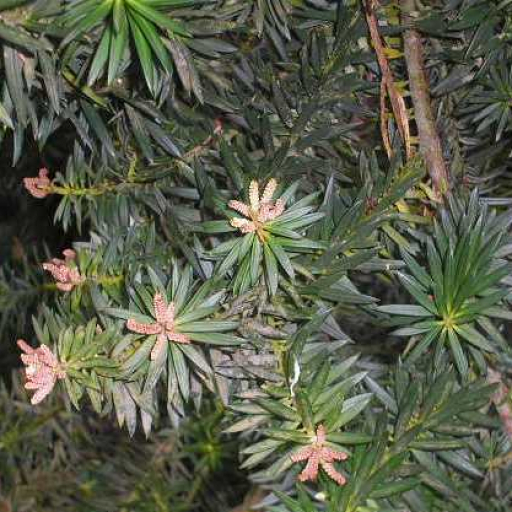
Plant Overview
Known as the Cloud Podocarp or Mountain Totara, this ancient evergreen is a living relic from the temperate rainforests of Chile and Argentina. With its deep emerald needles and rugged, peeling bark, it looks like a tree plucked straight from a prehistoric landscape. In its native habitat, it thrives in the mist-drenched Andes, earning its name nubigenus, which translates to "born from the clouds."
🔍 How to Identify
- 🌲 Lustrous Foliage: The needles are stiff, sharp-pointed, and a rich dark green. They are arranged spirally around the stems, giving the branches a dense, brush-like appearance.
- ⚪ Silvery Undersides: If you flip a needle over, you will see two distinct silvery-white bands (stomata). This is a key way to distinguish it from its close relatives.
- 🍓 Fleshy "Fruits": Unlike traditional pinecones, female trees produce bright red or purplish fleshy structures (receptacles) that hold a single seed, resembling a strange, exotic berry.
🏡 In Your Garden
- ☁️ The "Cloud Forest" Vibe: This plant craves high humidity and cool temperatures. It is not a fan of "wet feet," but it absolutely hates drying out. If you live in a region with hot, dry summers, it will need a sheltered, shadier spot and plenty of mulching to keep its roots cool.
- 🐌 Slow and Steady: The Cloud Podocarp is a very slow grower. While this means you won't need to prune it often, it also means it requires patience. It prefers acidic, well-drained soil and works beautifully as a structural specimen in a woodland-style garden.
⚠️ Safety & Toxicity
- 🟢 Low Risk: The Podocarpus nubigenus is generally considered non-toxic to touch and is not known for causing skin irritation.
- 🐾 Seed Caution: While the fleshy red part of the "fruit" is sometimes eaten by birds, the seeds themselves contain low levels of toxins. It is best to keep curious pets and children away from the fallen seeds to avoid any potential stomach upset if ingested.
✨ Fun Fact
This tree is a member of an ancient family that dates back to the supercontinent Gondwana. Because it evolved in isolated, wet, and cool environments, it is one of the most cold-tolerant species in its genus, capable of surviving in climates where most other tropical-looking conifers would perish!

Detailed Care Instructions
To grow a Podocarpus Nubigenus plant, also known as the Mountain Plum Pine, follow these steps:
- Choose a suitable location: Podocarpus Nubigenus prefers a partially shaded spot with well-draining soil. It can tolerate full sun but may require additional watering in hot climates.
- Prepare the soil: Ensure the soil is fertile and well-draining. If necessary, amend the soil with organic matter, such as compost, to improve its quality.
- Planting: Dig a hole that is slightly larger than the root ball of the plant. Gently place the plant in the hole and backfill with soil, ensuring the top of the root ball is level with the soil surface.
- Watering: Immediately after planting, water the plant thoroughly to help settle the soil and remove air pockets. Afterward, provide regular and consistent watering, especially during dry periods. Avoid overwatering, as it can lead to root rot.
- Mulching: Apply a layer of organic mulch around the base of the plant to help retain soil moisture and suppress weed growth. Leave some space around the stem to prevent moisture-related issues.
- Pruning: Prune Podocarpus Nubigenus regularly to maintain its desired shape and size. It can be trimmed into a formal hedge or left to grow naturally. Pruning can be done in early spring.
- Fertilization: Feed the plant with a balanced, slow-release fertilizer in early spring. Follow the instructions on the fertilizer packaging for appropriate dosage and frequency.
- Pest and disease management: Podocarpus Nubigenus is generally resistant to pests and diseases. However, it's always good practice to monitor for any signs of issues and take appropriate measures if necessary.
- Propagation: The plant can be propagated from seeds or stem cuttings. Seeds require stratification (cold treatment) before sowing, while stem cuttings can be taken from healthy plants in early spring.
- Winter care: In colder climates, provide winter protection by covering the plant with frost cloth or relocating it to a sheltered area. Consult local gardening guides for specific recommendations based on your location.
Remember to always research and consider the specific needs and requirements of the Podocarpus Nubigenus plant to ensure successful growth.
- First, ensure that the soil around the plant is not already moist before watering.
- Choose a watering can or hose with a gentle flow to avoid damaging the plant's leaves or branches.
- Water the plant at ground level, rather than directly on the leaves or branches.
- Slowly pour water around the base of the plant, ensuring that the soil is thoroughly moistened.
- Avoid over-watering, as this can lead to root rot and other plant diseases.
- Monitor the plant's water needs based on environmental factors such as temperature and humidity.
- Water the plant more frequently during hot, dry weather and less frequently during cooler, more humid weather.
- Consider using a moisture meter or testing the soil with your finger to determine when the plant needs watering.
- If the plant is potted, ensure that there are drainage holes in the bottom of the pot to allow excess water to drain away.
To fertilize this plant, you should use a balanced, slow-release fertilizer with an N-P-K ratio of 10-10-10. Apply the fertilizer according to the package instructions, being careful not to over-fertilize, as this can damage the plant. Water the plant thoroughly after fertilizing to help the nutrients penetrate the soil. Fertilize this plant once every two to three months during the growing season (spring and summer) for best results.
The ideal soil for the plant should have good drainage abilities and be well-aerated. It should not be too dense or compacted, which can prevent root growth and lead to issues with the overall health of the plant.
A mixture of coarse sand, perlite or vermiculite, and peat or sphagnum moss can make an ideal soil mix for Podocarpus Nubigenus. The soil should also have a slightly acidic to neutral pH level, ideally around 6.0 to 7.0.
It's important to avoid using soils that are heavy in clay or sand, as these can hold too much moisture and cause drainage issues. Additionally, soils that are too rich in organic matter may also hold onto too much moisture and can lead to root rot.
Overall, the best soil for the plant should be well-draining, well-aerated, and nutrient-rich without being too dense or compacted.
Podocarpus Nubigenus is a species of evergreen coniferous plant that belongs to the Podocarpaceae family. To propagate this plant, you need to follow these steps:
- Take a stem cutting from the plant. Make sure that the cutting is at least 6 inches long and has several nodes.
- Remove all the leaves from the bottom half of the stem.
- Dip the cut end of the stem in rooting hormone powder, which will help the stem form roots more quickly.
- Plant the cutting in a pot filled with a well-draining potting mix.
- Water the cutting thoroughly, making sure that the soil is evenly moist.
- Cover the cutting with a plastic bag or dome to create a humid environment. This will help the cutting to root.
- Place the pot in a warm, bright location, but avoid direct sunlight. A temperature of around 70-75°F is ideal for rooting.
- Check the cutting regularly for signs of new growth and root development.
- Once the cutting has developed roots and new growth, you can transplant it into a larger pot or directly into the ground.








