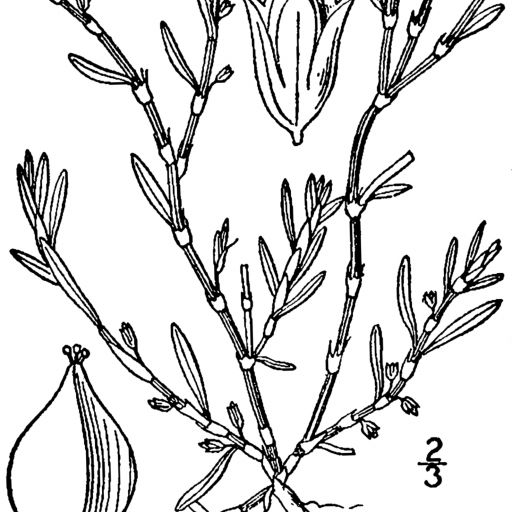
Plant Overview
Often called the Seaside Knotweed, this resilient little survivor is a master of the Atlantic coastlines. It hugs the shifting sands to escape biting sea winds, appearing almost as if it has been dusted with fine silver or sea salt. In the botanical world, it is a "pioneer species," often being one of the first plants to colonize and stabilize the harsh environment of the upper beach.
🔍 How to Identify
- 🌿 The Foliage: The leaves are small, oval, and distinctly "glaucous"—meaning they have a waxy, blue-green or grayish coating that protects the plant from salt and dehydration.
- 🥨 The Stems: It grows "prostrate" (flat against the ground), forming sprawling, wiry mats that can reach about 8 to 20 inches in diameter.
- 👗 The Sheaths: At the base of each leaf, you’ll find the "ocreae"—small, silvery, translucent sheaths that look like tiny, tattered tissue paper wrapped around the stem.
- 🌸 The Flowers: Its blooms are modest; tiny white or pale pink flowers hide in the "axils" (the crotch where the leaf meets the stem) from mid-summer through autumn.
🏖️ Habitat & Ecology
- 🌊 The Wrack Line: You won't find this plant in a typical forest or backyard. It thrives specifically in the "wrack line" of beaches—the area where the high tide leaves behind seaweed and organic debris.
- 🧂 Salt Specialist: It is a halophyte, a plant that actually thrives in salty conditions. It uses its thick, waxy skin like a natural raincoat to prevent the salt from sucking the moisture out of its cells.
- 🛑 Endangered Status: Because it lives on the open beach, it is highly sensitive to human foot traffic and coastal development. In many regions, it is protected as a rare or endangered species.
⚠️ Safety & Toxicity
- 🐾 Low Risk: Like many members of the Buckwheat family (Polygonaceae), it contains oxalic acid. While not considered "poisonous," it can cause mild stomach upset in pets or curious children if consumed in large quantities.
- 🐚 Physical Safety: The plant itself is soft and safe to touch, but because it grows in sandy dunes, be careful of the sharp beach grasses or hidden debris that may be nearby.
✨ Fun Fact
The name glaucum comes from the Greek word glaukos, which was historically used to describe the shimmering, pale-blue color of the sea. It is the perfect name for a plant that spends its entire life watching the waves!

Detailed Care Instructions
To grow Polygonum glaucum, also known as seaside knotweed, you can follow these steps:
- Climate and site selection: Seaside knotweed grows in coastal regions, preferably in full sun to partial shade. It prefers well-draining soil with a pH range of 6.5 to 7.5.
- Propagation: You can propagate Polygonum glaucum using seeds or cuttings. If using seeds, sow them directly into the soil in spring or fall. If propagating from cuttings, take 4-6 inch (10-15 cm) stem cuttings from a healthy plant and place them in a well-draining potting mix.
- Soil preparation: Prepare the planting area by removing any weeds and loosening the soil. Incorporate organic matter, such as compost, to improve the soil's fertility and drainage.
- Planting: If you're using seeds, sow them at a depth of about 1/4 inch (0.6 cm) into the prepared soil. If planting cuttings, make sure to bury about half of the cutting in the soil, keeping the top portion above the surface.
- Watering: Keep the soil evenly moist but avoid overwatering, as Polygonum glaucum prefers slightly drier conditions. Water the plant regularly during its establishment period and during dry periods.
- Mulching and fertilizing: Apply a layer of organic mulch around the plant to help retain moisture and suppress weed growth. Use a balanced organic fertilizer once a month during the growing season to promote healthy growth.
- Pruning: Trim the plant after its flowering period to maintain its shape and remove any dead or damaged stems. You can also prune to control its size and prevent spreading if desired.
- Pests and diseases: Polygonum glaucum is generally resistant to most pests and diseases. However, keep an eye out for aphids or other sap-sucking insects and treat with organic insecticidal soap if necessary.
- Overwintering: Seaside knotweed is hardy in USDA zones 6-9. In colder regions, protect the plant during the winter by providing a layer of mulch around the base.
- Spread control: Polygonum glaucum has a vigorous growth habit, so it's important to monitor its growth and prevent it from spreading beyond desired boundaries. Regularly remove any seedlings that appear in unwanted areas.
Remember to check your local regulations before growing Polygonum glaucum, as it can behave invasively in some areas.

Place in a bright room that is sun drenched almost all day. Or directly in a south-facing window.

To properly water this particular plant, it is important to begin by assessing its specific watering needs. This may involve considering its growth stage, the humidity and temperature of its environment, and any other factors that could impact its moisture requirements.
One important point to keep in mind when watering this plant is that it generally prefers to be kept moist but not overly saturated. This means that it may be beneficial to water it on a consistent basis, but to avoid allowing water to accumulate in the soil or its container.
When watering, it is also important to note that the plant's roots may be relatively shallow, which could impact how much water it can absorb at once. To ensure that the plant receives enough moisture without risking root damage, it may be helpful to water it slowly and carefully, allowing the water to penetrate deeply into the soil or potting mix.
Finally, it is important to monitor the plant closely after watering to ensure that it is responding well. Overwatering or underwatering can both have negative impacts on the plant's health, so keeping a close eye on its leaves, stems, and overall growth can help to identify any issues and ensure that the plant remains healthy and vibrant over time.
To properly fertilize this plant, it's important to use a balanced fertilizer with equal amounts of nitrogen, phosphorus, and potassium. The best time to fertilize is during its growing season, typically spring and summer. Apply the fertilizer every 2-3 weeks, being careful not to over-fertilize as this can cause damage to the plant. Additionally, make sure to water the plant thoroughly before and after fertilizing to ensure that the nutrients are properly absorbed. Prune any dead or damaged branches before fertilizing to allow for optimal nutrient uptake.
Polygonum Glaucum plant prefers to grow in well-draining soil that is rich in organic matter. The soil pH should be slightly acidic to neutral. A mixture of sand, peat moss, and loamy soil may be suitable for growing Polygonum Glaucum. Avoid using heavy clay soil or soil that stays constantly wet. It is best to amend the soil with organic matter to improve the soil texture, water retention, and nutrient content. Soil fertility may also be improved by using a slow-release fertilizer or compost. Overall, a well-draining soil with adequate moisture and nutrient content is ideal for growing Polygonum Glaucum.
Propagation of this plant can be done through stem cuttings. Select a healthy stem with at least two to three nodes. Take a sharp, clean pair of scissors and make a clean cut at an angle just below a node. Remove the leaves from the bottom 1/3 of the stem. Dip the cut end of the stem into rooting hormone and then plant it in well-draining soil. Keep the soil moist and the cutting in a location with bright, indirect light. After a few weeks, roots should develop and new growth should appear.








