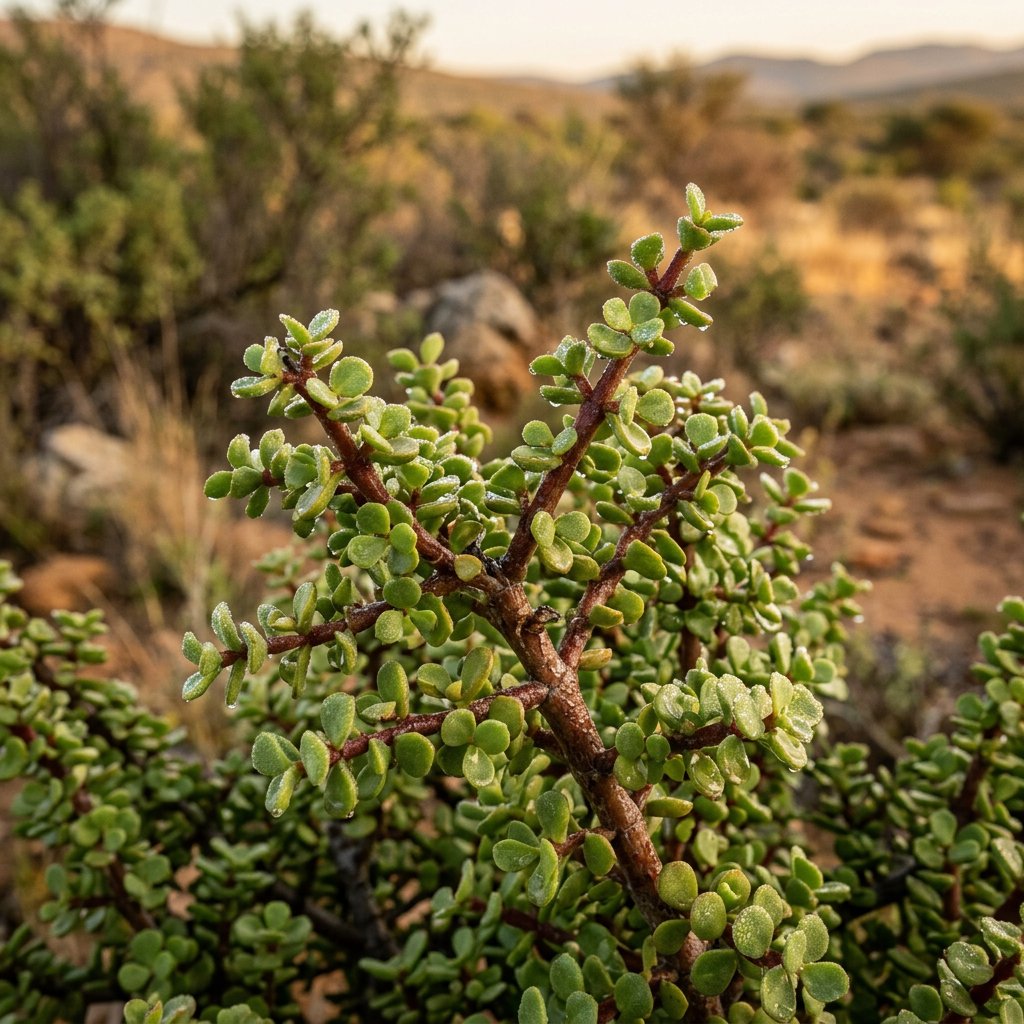
Plant Overview
Meet the "Elephant Bush," a succulent superhero from the semi-arid landscapes of South Africa. Often mistaken for the common Jade plant, this resilient beauty—locally known as Spekboom—is a master of survival. In the wild, it grows into massive thickets that feed roaming elephant herds, while in the home, it offers a lush, bonsai-like charm that even a beginner can maintain.
🔍 How to Identify
- 🍃 The Leaves: Small, rounded, and emerald-green. They are incredibly fleshy and "plump," as they store water to survive droughts.
- 🪵 The Stems: Distinctive reddish-brown or mahogany-colored stems that transition from soft succulent growth to a rugged, woody texture as the plant matures.
- 🪴 Growth Habit: It naturally grows as a sprawling shrub, but its flexible stems make it a favorite for "living sculptures" or cascading hanging baskets.
🏡 In Your Garden
- ☀️ Sun Seeker: This plant thrives on bright light. While it is more tolerant of varied conditions than other succulents, a lack of sun will cause its vibrant red stems to turn dull and its leaves to drop.
- 🏜️ The "Spekboom" Strategy: It is remarkably efficient at using water. It uses a specialized form of photosynthesis (CAM) that allows it to keep its "pores" closed during the hot day and open them at night, making it one of the most drought-hardy plants in existence.
- ✂️ Pruning Potential: Because it handles trimming so well, it is often used for bonsai. You can shape it into a miniature tree with ease, provided you don't overwater the roots.
⚠️ Safety & Toxicity
- ✅ Non-Toxic: This is one of the few succulents that is completely safe for your household.
- 🐾 Pet Friendly: It is non-toxic to cats and dogs. In fact, in its native habitat, it is a primary food source for elephants and tortoises.
- 🥗 Human Consumption: The leaves are actually edible! They have a tart, lemony flavor and are used in traditional South African salads and stews.
✨ Fun Fact
🌍 A Carbon Sponge: The Elephant Bush is a champion of the environment. It has the extraordinary ability to capture more carbon from the atmosphere than many species of trees, making it a critical tool in the fight against climate change. One hectare of Spekboom can capture several tons of carbon per year!

Detailed Care Instructions
With similar succulent leaves and fleshy stems, dwarf jade (Portulacaria afra) and standard jade plant (Crassula ovata and species) are very close in appearance, but the two are botanically unrelated. In contrast to jade plants, dwarf jade has much smaller leaves that grow closer together on thinner stems. In addition, dwarf jade is not poisonous, but jade plants are toxic to animals and humans.
Can dwarf jade be planted directly in the outdoor garden?
Portulacaria afra loves extreme heat, high humidity, and gravelly soil such as found in its native location of South Africa, so if you have these optimal conditions, dwarf jade can be planted in the ground where it will grow easily. In its native environment, dwarf jade can grow up to 15 feet tall and sometimes more, so make sure to give it plenty of space if you use it as a landscape plant.
Are dwarf jade plants used as food?
The dwarf jade (not jade!) is an edible succulent and rich in vitamin C. It can be added to salads, soups, and stews and it's a favorite snack for elephants, rhinos, tortoises, and goats.
| Color | Pink, White |
| Soil Ph | 5.6-7.8 |
| Humidity | Dry |
| Lighting | Part Sun |
| Toxicity | Non-Toxic |
| Soil Type | Cactus Mix |
| Bloom Time | Spring |
| Difficulty | Easy |
| Plant Type | Succulent, Shrub |
| Hibernation | Cold Period |
| Mature Size | Height From 8 To 15 Feet Tall |
| Native Area | Africa |
| Temperature | 15°C - 30°C |
| Sun Exposure | Light Shade To Full Sun |
| Hardiness Zones | 9-11 |
To grow Portulacaria Afra, also known as the "elephant bush" or "jade plant," follow these steps:
- Choose a location: Portulacaria Afra prefers a bright, sunny spot with indirect light. It can also tolerate partial shade but may become leggy if not receiving enough light.
- Select a well-draining pot: Use a pot with drainage holes to prevent waterlogging. The plant can grow well in a pot as long as it has enough space for the roots to spread.
- Soil: Use a well-draining succulent or cactus soil mix. You can also create your own mix by combining equal parts of regular potting soil, sand, and perlite.
- Watering: Allow the soil to dry out between watering as Portulacaria Afra is susceptible to root rot if overwatered. Water thoroughly when the top inch of soil feels dry, and make sure the excess water drains out from the bottom of the pot.
- Humidity and temperature: Portulacaria Afra thrives in average to warm temperatures, around 65-75°F (18-24°C). It can tolerate low humidity levels, making it suitable for indoor environments.
- Fertilizer: During the growing season (spring and summer), apply a balanced, water-soluble fertilizer diluted to half strength. Use the fertilizer every month or according to the package instructions.
- Pruning and shaping: Regularly prune and shape the plant to encourage denser growth. Pinch or trim back the stems to keep the desired shape and size. You can also propagate the pruned stems to start new plants.
- Propagation: Portulacaria Afra can be easily propagated from stem cuttings. Simply cut a healthy stem, remove lower leaves, and let it callus over for a few days. Then, place the cutting in a well-draining soil mix and keep it slightly moist until roots develop.
Remember to keep an eye out for common pests like mealybugs or spider mites. If infested, treat the plant with an appropriate pesticide or use organic methods like rubbing alcohol or insecticidal soap.

Place in a bright room that is sun drenched almost all day. Or directly in a south-facing window.

To water this plant, it is important to wait until the top inch of soil is completely dry before applying water. When watering, be sure to thoroughly saturate the soil to encourage healthy root growth. Avoid getting water on the leaves or stems of the plant, as this can lead to rot and disease. It is also important to use a well-draining soil mix and to avoid over-watering, as this can quickly cause root rot. In general, this plant prefers to be on the drier side and can tolerate periods of drought.
To fertilize this plant, use a balanced fertilizer with equal amounts of nitrogen, phosphorus, and potassium. Feed the plant every two weeks during the growing season, which is typically in the spring and summer. Mix the fertilizer with water and apply it to the soil around the plant, avoiding the leaves and stem. Be sure to follow the instructions on the fertilizer package for dosage and application.
The recommended soil for Portulacaria afra plant should be well-draining and rich in nutrients. A mix of sandy, loamy and gravelly soil with a pH level of 6.0 to 7.5 is ideal for this plant. Organic matter such as compost, peat moss or well-rotted manure should be added to the soil to increase the nutrient content and improve water retention. The soil should not be waterlogged or excessively dry as it can cause root rot or dehydration. Light fertilization with a balanced fertilizer can be done every two to three months during the growing season.
To propagate this plant, you will need a mature and healthy plant that has established roots. Take a stem cutting approximately 10-12 cm long from the parent plant using a sharp and clean scissors or knife. Make sure to cut below a node (the point where leaves attach to the stem).
Remove the leaves from the lower third of the stem cutting. Dip the cut end of the stem in rooting hormone powder (optional) and allow it to dry for a few hours.
Fill a pot with well-draining soil and make a hole in the center of the soil. Insert the stem cutting into the hole, and gently firm the soil around the cutting. Water the plant thoroughly.
Cover the pot with a clear plastic bag or cloche to create a humid environment. Place the pot in a bright area but away from direct sunlight. Mist the cutting regularly to keep the soil moist, but not waterlogged.
After 2-3 weeks, the plant should start to develop roots. To test if roots have grown, gently tug on the plant. If you feel resistance, it means the roots have established. Remove the plastic bag or cloche and gradually expose the plant to more light as it grows.
Once the plant has grown enough, it can be transplanted into a larger pot or planted in the ground.
Common pests of the elephant bush include Mealybugs. Make a habit of checking your elephant bush frequently for pests so that any infestations can be caught and managed early.








