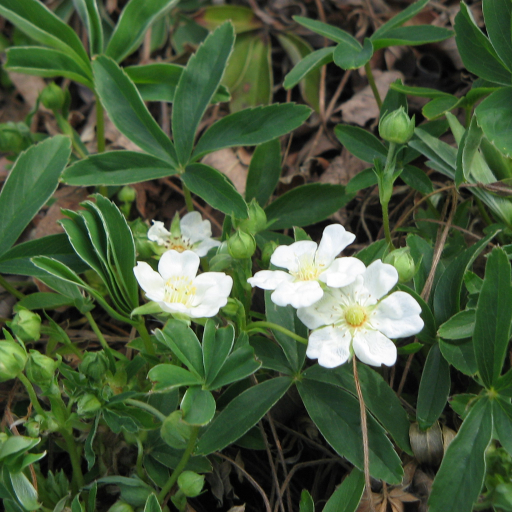
Plant Overview
Often called the "White Cinquefoil," Potentilla alba is a low-growing mountain beauty that brings a touch of the European Alps to your doorstep. This hardy perennial is a master of survival, forming dense, elegant mats of silver-green foliage that look like a shimmering carpet even when the flowers aren't in bloom. It is a favorite for those who want a "set it and forget it" plant that still delivers delicate, star-like beauty.
🔍 How to Identify
- 🌸 The Bloom: Pure white flowers with five rounded petals and a cluster of bright yellow stamens at the center. They look remarkably like tiny strawberry blossoms.
- 🖐️ Palmate Leaves: The name "Cinquefoil" comes from the French for "five leaves." Each leaf is divided into five distinct leaflets that spread out like the fingers of a hand.
- 🥈 Silky Undersides: If you flip a leaf over, you’ll find a dense layer of silky, silver-white hairs. This "silver lining" helps the plant retain moisture and gives the foliage a metallic sheen.
🏡 In Your Garden
- 🪨 The Rock Star: This plant is an absolute specialist for rock gardens, stone walls, and dry slopes. Because it grows via a deep taproot, it is exceptionally drought-tolerant once established but very difficult to transplant—so pick its forever home carefully!
- 🥣 Lean Living: Unlike many garden favorites, White Cinquefoil thrives in "poor" soil. If you give it too much fertilizer or rich organic matter, it may grow leggy and lose its compact, tidy shape. It prefers well-drained, sandy, or gravelly spots.
⚠️ Safety & Toxicity
- 🛡️ Safe Status: Potentilla alba is generally considered non-toxic and is safe to plant in gardens frequented by curious pets or adventurous toddlers.
- 🌿 Tannin Content: Historically, members of this genus were used in folk medicine due to high tannin content. While not "poisonous," ingesting large amounts of the leaves could cause a mild stomach upset or a bitter taste.
✨ Fun Fact
The genus name Potentilla is derived from the Latin word potens, meaning "powerful." This refers to the plant's long history in ancient medicine, where it was believed that these small, unassuming herbs held potent powers to heal everything from fevers to snakebites.

Detailed Care Instructions
To grow a Potentilla Alba plant, you can follow these steps:
- Select a suitable location: Potentilla Alba requires full sun to grow well. Choose a spot in your garden that receives at least 6-8 hours of direct sunlight per day.
- Prepare the soil: Potentilla Alba prefers well-draining soil. Amend the soil by adding organic matter, such as compost or aged manure, to improve its fertility and drainage. Ensure the pH of the soil is between 5.5 and 7.
- Planting: Dig a hole in the prepared soil that is slightly larger than the root ball of the Potentilla Alba plant. Place the plant in the hole, ensuring the top of the root ball is level with the soil surface. Backfill the hole with soil and gently firm it around the plant.
- Watering: Water the newly planted Potentilla Alba thoroughly after planting. In the first year, keep the soil consistently moist but avoid overwatering. Once established, the plant is moderately drought-tolerant and requires watering only during prolonged dry spells.
- Mulching: Apply a layer of organic mulch around the base of the plant to help retain moisture, suppress weeds, and regulate soil temperature. Ensure that the mulch does not touch the stem directly.
- Pruning: Potentilla Alba benefits from pruning in late winter or early spring before new growth appears. Prune back any dead or damaged branches and shape the plant as desired. This helps maintain a neat and compact form.
- Fertilizing: Apply a balanced, slow-release fertilizer in early spring to provide essential nutrients to the Potentilla Alba plant. Follow the package instructions for the appropriate dosage.
- Pests and diseases: Potentilla Alba is generally pest and disease resistant. However, keep an eye out for common garden pests such as aphids or spider mites. If detected, treat the infestation promptly using organic insecticides or by introducing beneficial insects.
Remember to check the specific care requirements for Potentilla Alba in your region, as the conditions may vary. Regular monitoring and maintenance, along with proper care, will help ensure healthy growth and abundant blooms.

Place in a bright room that is sun drenched almost all day. Or directly in a south-facing window.

To water this plant, make sure to water it deeply and consistently, allowing the soil to dry out slightly between watering sessions. However, avoid letting the soil become completely dry for prolonged periods of time. Use a watering can or hose to water directly at the base of the plant, avoiding getting water on the leaves. Water in the morning or early evening to avoid evaporation during the heat of the day. It's important to make sure the water penetrates the soil deeply to encourage the plant's roots to grow down and establish a strong, healthy root system.
To fertilize this plant, first make sure the soil is moist. Then, apply a balanced fertilizer with equal amounts of nitrogen, phosphorus, and potassium. Use a slow-release fertilizer and apply according to package instructions. Fertilize once in the spring and again in the summer for best results. Avoid over-fertilizing, as it can lead to excess growth and weak stems.
Potentilla Alba is a type of plant that is typically grown in garden settings and requires specific types of soil to thrive. Ideally, this plant does best when planted in well-drained soil that is rich in organic material. The soil should also be moderately acidic, with a pH range of 5.5 to 7.5.
It is recommended to use a high-quality potting soil mix that is specifically formulated to provide the ideal growing conditions for this type of plant. Additionally, adding organic matter, such as compost or well-rotted manure, to the soil can help improve soil health and nutrient availability.
When planting, it is important to ensure that the soil is evenly moist, but not saturated or waterlogged, as this can lead to root rot and other problems. Additionally, regular watering and fertilization are necessary to promote healthy growth and flowering.
Overall, by using the right soil and providing proper care, Potentilla Alba can thrive and provide a beautiful addition to any garden setting.
To propagate this plant, take cuttings from the stem that are approximately 5-7 inches in length. Remove the lower leaves and dip the cut end into rooting hormone. Plant the cutting in well-draining soil and water thoroughly. Keep in a warm, bright location and mist regularly to maintain humidity. After several weeks, new growth should appear, indicating successful propagation.








