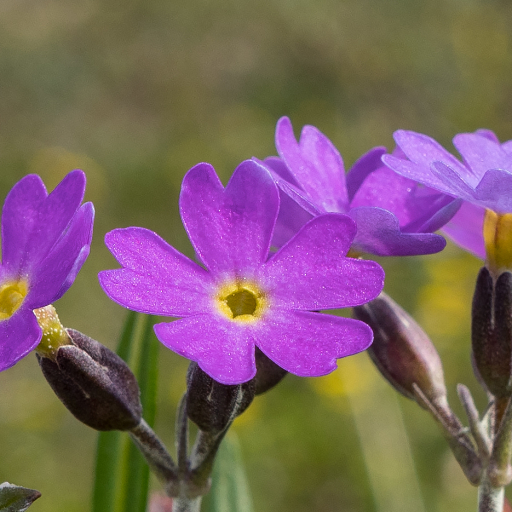
Plant Overview
The Scandinavian Primrose, often called the "Jewel of the Fjords," is a resilient little pioneer that thrives where most plants fear to tread. Endemic to the rugged mountain ranges of Norway and Sweden, this petite perennial is a master of survival in harsh, limestone-rich alpine terrains. Its vibrant purple blooms are a celebrated signal to hikers that spring has finally reached the high altitudes.
🔍 How to Identify
- 🌸 The Violet Eye: Look for small, five-petaled flowers in shades of deep violet or magenta, each featuring a distinct, bright yellow "eye" at the center.
- ❄️ Silver Dust: The undersides of the leaves and the flower stalks are often coated in a white, flour-like powder called farina. This "mealy" texture is a natural sunscreen and moisture-barrier.
- 🍃 Ground-Hugging Rosettes: It grows in a tight, low-lying cluster of spoon-shaped leaves with slightly toothed edges, a shape designed to stay protected from biting mountain winds.
🏔️ Habitat & Ecology
- 🦴 The Lime Lover: This primrose is a "calciphile," meaning it specifically seeks out soil rich in lime or calcium. In the wild, you will almost always find it tucked into limestone crevices or gravelly alpine meadows.
- 🧊 Snowmelt Specialist: It relies on the predictable cycle of the Nordic seasons. It prefers to spend its winter buried under a deep blanket of snow and wakes up just as the meltwater begins to soak the earth.
⚠️ Safety & Toxicity
- 🧤 Skin Sensitivity: Many Primula species produce a substance called primin. While the Scandinavian variety is less aggressive than garden primroses, it can still cause mild skin irritation or a "prickly" rash if handled excessively without gloves.
- 🐾 Pet Warning: The plant is considered mildly toxic to cats, dogs, and horses. Ingestion usually leads to minor stomach upset or vomiting, so it is best kept as a "look-but-don't-eat" specimen.
✨ Fun Fact
- 🌍 A True Local: Primula scandinavica is one of the few plants that is strictly endemic to the Scandinavian Peninsula—meaning if you find it growing wild anywhere else in the world, it’s likely a long-lost cousin!

Detailed Care Instructions

Place in a bright room that is sun drenched almost all day. Or directly in a south-facing window.

Some plants require more regular watering than others, which should be done every few days. It's critical to maintain the soil moist all of the time. The water requirements of the same plant placed in pots with varying sizes will differ. Because the water in the smaller pot evaporates faster than the water in the larger pot, it will require more watering. Regardless of pot size, the surface should constantly be maintained moist.








