Plant Overview
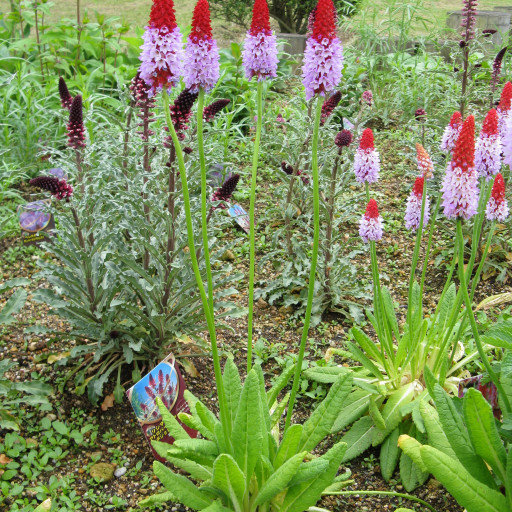
Often called the "Orchid Primrose" or "Red Hot Poker Primrose," Primula vialii is one of the most striking and unusual members of the primrose family. Unlike the common flat-faced primroses of early spring, this Chinese native produces tall, conical flower spikes that look more like tropical rockets than traditional woodland blooms. It’s a show-stopper that bridges the gap between late spring and early summer gardens.
🔍 How to Identify
- 🗼 The Flower Spikes: The most iconic feature is the dense, cone-shaped flower head. The unopened buds at the top are a brilliant, waxy crimson, while the flowers at the base open into a soft, contrasting lavender-pink.
- 🍃 The Foliage: It forms a basal rosette of long, lance-shaped leaves. They are light green, slightly hairy (pubescent), and have a textured, crinkled surface similar to a Romaine lettuce leaf.
- 📏 Growth Habit: This plant is a "sleeper." It emerges much later in the spring than other perennials, eventually sending up leafless, silvery-green stalks that can reach 12 to 18 inches in height.
🏡 In Your Garden
- 💧 Thirsty Roots: This species thrives in "damp but not drowned" conditions. It is perfect for the edges of a garden pond or a bog garden. If the soil dries out completely, the plant will likely go dormant or perish.
- 💤 The Late Emergence: Gardeners often accidentally dig up Primula vialii because it stays dormant underground long after other plants have sprouted. Mark its spot clearly in the fall so you don't mistake it for a bare patch in May!
- 🌥️ Cooler Climates: It prefers partial shade and cool summers. In blistering heat, the "pokers" will wilt quickly. It’s a short-lived perennial, so it’s best to let it go to seed to ensure new plants appear in future seasons.
⚠️ Safety & Toxicity
- 🌿 Status: Generally non-toxic to humans and pets, but should be handled with a bit of care.
- 🧤 Skin Sensitivity: Like many members of the Primula genus, this plant contains primulin, a mild allergen. Sensitive individuals may experience a slight itchy rash (contact dermatitis) after handling the leaves or stems, so wearing gloves is a smart precaution.
✨ Fun Fact
Primula vialii was first discovered in the high-altitude mountain meadows of Yunnan, China, by the famous French missionary and botanist Père Jean-Marie Delavay in 1888. It was named in honor of his colleague, Père Paul Vial. Despite its delicate, "hot" appearance, it is remarkably hardy and can survive freezing mountain temperatures!

Detailed Care Instructions
| Humidity | Normal |
| Lighting | Part Sun |
| Difficulty | Medium |
| Hibernation | Cold Period |
| Hardiness Zones | 5 - 8 |
To successfully grow Primula vialii (also known as the orchid primrose), follow these steps:
- Choose the right location: Primula vialii prefers partial shade, with morning sunlight and afternoon shade being ideal. It can also tolerate full sun in cooler climates. Ensure the soil is well-draining.
- Prepare the soil: Primula vialii prefers slightly acidic soil (pH 6.0-7.0). Add organic matter such as compost or well-rotted manure to improve soil structure and fertility. Work the organic matter into the top few inches of soil.
- Planting: Plant Primula vialii in spring or early fall. Dig a hole slightly larger than the root ball and place the plant in the hole, making sure the crown is level with the soil surface. Gently backfill the hole and firm the soil around the plant.
- Watering: Keep the soil consistently moist but not waterlogged. Water the plant regularly, especially during dry spells. Avoid overhead watering to prevent foliage diseases; instead, water at the base of the plant.
- Mulching: Apply a layer of organic mulch around the base of the plant to help retain soil moisture and suppress weed growth. Avoid covering the crown of the plant.
- Fertilizing: Primula vialii doesn't require heavy feeding. Apply a balanced, slow-release fertilizer in spring and again in mid-summer, following the manufacturer's instructions.
- Deadheading: To encourage continuous blooming, remove faded flowers by snipping off the spent flower stalks.
- Division: Primula vialii can become crowded over time. Divide the plants every 2-3 years in early spring to maintain their vigor. Lift the clump out of the ground and carefully separate it into smaller sections, ensuring each section has roots attached. Replant the divisions, making sure they are at the same depth as before.
- Pests and diseases: Watch out for pests like aphids and slugs, which may feed on Primula vialii. Treat infestations promptly using organic pest control methods. Provide good air circulation around the plants to prevent fungal diseases.
By following these guidelines, you should be able to successfully grow Primula vialii and enjoy their unique and beautiful flowers.

Place in a window with dappled sun or a spot in the middle of a room. Or directly in a window facing west or east.

To water this plant, fill a watering can with room temperature water and pour water around the base of the plant until the soil appears moist but not waterlogged. Allow excess water to drain out of the bottom of the pot. You should avoid getting water on the leaves of the plant as this can cause damage or lead to fungal diseases. Water this plant once a week during the growing season, but reduce frequency during the dormant season. Check the soil moisture level regularly and adjust watering as necessary to maintain a consistently moist but well-draining soil.
To fertilize this plant, apply a balanced fertilizer once a month during the growing season. Be sure to dilute the fertilizer to half strength before applying it to the soil. Apply the fertilizer to moist soil and avoid getting any on the leaves or flowers. Water the plant thoroughly after fertilization to ensure the nutrients are absorbed by the roots. Do not fertilize during the plant's dormant period.
Primula Vialii is a herbaceous perennial plant that prefers a well-drained soil that is rich in organic matter. It requires a slightly acidic to neutral soil pH, between 6.0 and 7.0. The soil should be kept moist but not waterlogged, as the plant does not tolerate drought or waterlogging. A good soil mix for Primula Vialii would include a blend of garden soil, compost, and peat moss or leaf mold. The plant also benefits from the addition of a slow-release fertilizer in the spring. It is important to avoid compacting the soil around the plant's roots or planting it too deeply, as this can lead to root rot and other problems.
To propagate this particular plant, it is best to take stem cuttings. Select a healthy stem with several leaves and use a clean, sharp pair of secateurs to cut the stem just below a node (where a leaf attaches).
Remove any lower leaves from the stem and dip the cut end into rooting hormone powder. Plant the stem cutting into a pot filled with moist, well-draining soil, ensuring that the node is buried. Place the pot in a warm, bright location and keep the soil consistently moist.
After several weeks, roots should develop from the node and the cutting will begin to grow new leaves. Once the cutting has established a strong root system, it can be transplanted into a larger pot or directly into the garden.
It is important to monitor the cutting closely and watch for any signs of wilting or disease. Keep the plant away from drafts and protect it from pests such as aphids or spider mites.
Common pests of the poker primrose include Aphids, snails. Make a habit of checking your poker primrose frequently for pests so that any infestations can be caught and managed early.








