Plant Overview
Known as the Martius' Loulu, this palm is a living piece of Hawaiian history. Found naturally only on the windswept ridges of the Koʻolau Mountains on Oʻahu, it carries an air of tropical royalty with its stiff, architectural fronds. It is a slow-growing beauty that brings an instant prehistoric feel to any garden or conservatory.
🔍 How to Identify
- 🍃 The Fronds: Massive, rigid, fan-shaped leaves (palmate) that are deeply divided into stiff segments that don't "droop" at the ends like other palms.
- 🥈 Silver Undersides: If you flip a leaf over, you’ll find a beautiful coating of fine, silvery or yellowish-brown "fuzz" (known as tomentum) that helps protect the plant from high-altitude winds.
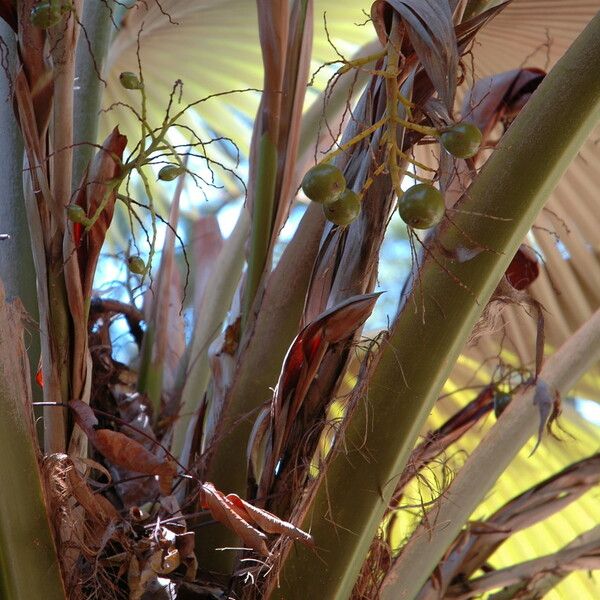
- 🥥 Fruit & Flowers: It produces thick, hanging clusters of small flowers that eventually turn into large, rounded, blackish fruits about the size of a marble.
🏡 In Your Garden
- ⛰️ The Taproot Rule: This palm is notoriously sensitive to root disturbance. Because it develops a deep taproot to anchor itself on Hawaiian cliffs, it hates being moved. Once you plant it, try to make that its "forever home."
- ☁️ Humidity & Drainage: Coming from a cloud forest environment, it craves high humidity and constant air movement. However, it cannot tolerate "wet feet"—it requires highly porous, volcanic-style soil to thrive without rotting.
⚠️ Safety & Toxicity
- ✅ Status: Generally non-toxic and safe for homes.
- 🧤 Details: While it is non-toxic to pets and children, the edges of the mature, dried fronds can be quite sharp and stiff. Use gloves when pruning old growth to avoid "paper cuts" from the foliage.
✨ Fun Fact
In ancient Hawaii, the large leaves of the Loulu were used as natural umbrellas to protect royalty from the rain, and the young, green seeds (called hāwane) were actually eaten as a delicacy, tasting similar to a coconut!

Detailed Care Instructions
To successfully grow a Pritchardia martii plant, also known as the Martinique palm, you can follow these steps:
- Location: Choose a location that provides the plant with partial shade to full sun. Pritchardia martii prefers bright and indirect sunlight. Ensure the area has well-draining soil.
- Climate: This palm is native to tropical regions and thrives in warm climates. It is best suited for USDA hardiness zones 10-11. If you live in a colder climate, you can grow it indoors.
- Soil: Use well-draining soil enriched with organic matter. Pritchardia martii prefers slightly acidic to neutral soil pH levels.
- Watering: Water the plant regularly and keep the soil evenly moist. Avoid overwatering, as it can lead to root rot. Allow the top inch of soil to dry out between watering sessions.
- Fertilization: Fertilize the plant with a balanced palm fertilizer or slow-release granules designed for palms. Follow the instructions on the fertilizer packaging and apply it during the growing season.
- Pruning: Remove any dead, damaged, or yellowing fronds regularly. Be careful not to remove too many healthy fronds as they are essential for the plant's health and growth.
- Repotting: When the plant outgrows its container, you can repot it in a slightly larger pot with fresh potting mix. Repotting every 2-3 years may be necessary.
- Pest control: Monitor the plant for pests such as palm aphids, scale insects, or mealybugs. Treat any infestations promptly with neem oil or an appropriate insecticidal soap.
- Protection from cold: If you live in a colder climate, protect the plant from freezing temperatures by moving it indoors during winter or wrapping it in frost blankets.
- Patience: Palm trees, including Pritchardia martii, grow relatively slowly. It may take several years for the plant to reach its full height and maturity.
By following these guidelines, you should be able to grow a healthy and beautiful Pritchardia martii plant.

Place in a bright room that is sun drenched almost all day. Or directly in a south-facing window.

To water this plant, it is important to ensure that the soil is completely dry before watering again. This can be determined by sticking your finger into the soil up to your second knuckle - if it feels dry to the touch, it is time to water. When watering, make sure to saturate the soil completely, allowing the water to drain out of the bottom of the pot. It is important to never let the plant sit in standing water, as this can lead to root rot. During the winter months, the plant may require less frequent watering than during the summer months.
To fertilize this plant, use a slow-release fertilizer with balanced NPK ratios. Apply in the spring and summer months, following the manufacturer's recommended application rate. Water the plant thoroughly after fertilizing to ensure proper absorption. Avoid over-fertilizing as this can lead to nutrient burn and damage to the roots.
Pritchardia Martii is a tropical plant that grows best in well-draining soil that is rich in nutrients. The ideal soil pH range for this plant is between 6.0 and 7.5. This plant is sensitive to water-logged soil, so it is important to use a soil mix that allows for good drainage. A mix of organic compost, perlite, and sand is an excellent choice for Pritchardia Martii. This type of soil will provide the plant with the nutrients it needs while also promoting good drainage, which is essential to prevent root rot and other water-related problems. It is recommended that you avoid using heavy garden soils, as these can become compacted and prevent good drainage. A light, well-draining soil mix with good nutrient content will give your Pritchardia Martii the best chance to thrive and grow.
Propagation of this plant can be done through the collection of seeds or by dividing the offsets from the mother plant. When collecting seeds, it is important to ensure that they are ripe and have fallen off the plant naturally. The seeds should be soaked in warm water for 48 hours before planting, as this helps to soften the outer layer and increase germination rates. The seeds should then be planted in well-draining soil in a warm location with bright, indirect light.
Offsets can be removed from the mother plant and planted in their own containers once they have developed their own roots. This is done by gently pulling the offset away from the main plant and planting it in a container with well-draining soil. The new plant should be kept in indirect light and watered regularly until it has established its own roots and begins to grow. With proper care, this plant can be propagated effectively and easily.








