Plant Overview
Often called the Ram’s Horn or Devil’s Claw, Proboscidea louisianica is a botanical drama queen native to the southern United States and Mexico. While it starts the season with elegant, orchid-like blossoms that smell surprisingly sweet, it ends the year by producing some of the most intimidating seed pods in the plant kingdom. Its name "Proboscidea" is a nod to the long, trunk-like "horn" of its fruit.
🔍 How to Identify
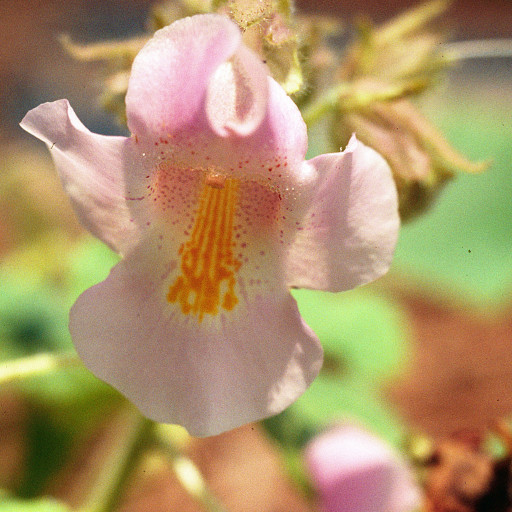
- 🌸 The Flowers: Large, trumpet-shaped blooms that are creamy white or pale lavender, often featuring striking purple splotches and yellow nectar guides inside the throat to attract pollinators.
- 🍃 Sticky Foliage: The entire plant is covered in dense, glandular hairs that secrete a sticky, oily substance. This makes the large, heart-shaped leaves feel tacky to the touch and often traps small dust particles or tiny gnats.
- 🪝 The "Claw": The fruit begins as a fleshy, curved green pod with a long "beak." As it matures and dries, the outer skin falls away to reveal a woody, two-pronged hook that looks like a wicked claw or a set of ram's horns.
🏡 In Your Garden
- ☀️ Heat and Space: This plant is a sun-worshipper that thrives in the intense heat of summer. It has a sprawling growth habit, so it needs plenty of room to spread its velvety leaves. Because it develops a deep taproot to find water, it hates being transplanted; it’s best to sow seeds exactly where you want them to grow.
- 🦟 Natural Defense: The "stickiness" of the plant isn't just for show. It acts as a mechanical defense against crawling insects. While it isn't a true carnivorous plant that "eats" its prey, the trapped insects often die on the leaves, leading some scientists to call it "protocarnivorous."
⚠️ Safety & Toxicity
- 🐾 Physical Hazard: Proboscidea louisianica is not known to be chemically toxic to humans or pets. However, the dried seed pods are a significant physical hazard. The hooks are incredibly strong and sharp, designed to latch onto the hooves or fur of livestock and can cause painful injuries or entanglement.
- 🧺 Culinary Use: Interestingly, the very young, tender green pods are edible and are sometimes used as a substitute for okra or are pickled. Once the "horn" starts to harden, however, it becomes far too woody to consume.
✨ Fun Fact
The split, jet-black woody pods were historically a vital resource for Indigenous peoples in the Southwest. The fibers from the "claws" are exceptionally tough and were used to create the striking black geometric patterns seen in traditional Pima and Papago basketry.

Detailed Care Instructions
To grow Proboscidea louisianica, also known as Deer's potato or Devil's claw, you can follow these steps:
- Choose a suitable location: Select a spot in your garden or a container with well-draining soil. Proboscidea louisianica prefers full sun but can tolerate partial shade.
- Prepare the soil: Loosen the soil and amend it with compost or organic matter to improve drainage and fertility. This plant can adapt to a wide range of soils, including sandy or loamy types.
- Plant the seeds: Sow the seeds directly into the soil after the last frost date in your area. Space the seeds around 6-8 inches apart and plant them about ½ inch deep. Gently cover the seeds with soil.
- Watering: Keep the soil consistently moist but not waterlogged. Watering once or twice a week, depending on the local climate and rainfall, should be sufficient. Avoid overwatering to prevent root rot.
- Maintenance: Weed regularly to prevent competition for nutrients and water. You can also mulch around the plants to aid in weed suppression and moisture retention.
- Fertilization: Proboscidea louisianica typically doesn't require much additional fertilization since it can cope with nutrient-poor soils. However, if you notice slow growth or poor color, you can fertilize with a balanced, slow-release fertilizer according to the package instructions.
- Pruning: Pruning is not necessary for Proboscidea louisianica, but you can trim back any damaged or dead stems if needed.
- Pest and disease control: This plant is generally not bothered by many pests or diseases. However, keep an eye out for common garden pests like aphids or caterpillars. If necessary, use appropriate insecticides or organic pest control methods to manage any infestations.
- Harvesting: Proboscidea louisianica produces interesting seed pods that resemble claws or curved horns. The pods can be harvested after they turn brown and start to split open. Allow them to dry on the plant for a few days and then collect the ripe seed pods. Open the pods, remove the seeds, and store them for future planting or culinary use.
By following these steps, you should be able to successfully grow Proboscidea louisianica and enjoy its unique appearance in your garden.

Place in a bright room that is sun drenched almost all day. Or directly in a south-facing window.

To water this plant, it is important to wait until the top layer of soil feels dry to the touch. Then, slowly pour water into the soil around the base of the plant, being careful not to splash water onto the leaves. Water until the soil is moistened thoroughly, but not water-logged. It is best to water this plant deeply and infrequently, allowing the soil to dry out slightly between waterings. In hot, dry conditions, it may need to be watered more frequently. It is important to avoid allowing this plant to sit in standing water, as this can lead to root rot.
For optimal growth and performance, it is recommended to fertilize this plant with a balanced fertilizer that has equal amounts of nitrogen, phosphorus, and potassium. Fertilize once a month during the growing season, which typically spans from early spring to late summer.
Before fertilizing, make sure the soil is moist to prevent fertilizer burn. Apply the fertilizer around the base of the plant, and water it in immediately afterward. Avoid getting the fertilizer on the leaves, as it can cause damage.
If the plant is grown in a container, use a slow-release fertilizer that will gradually release nutrients over time.
It's important not to over-fertilize, as this can cause excessive growth and potentially harm the plant. If the plant appears healthy and has good growth, it may not need as much fertilization. Always follow the manufacturer's instructions for the specific fertilizer being used.
Proboscidea Louisianica is a type of plant that requires well-draining soil to thrive. The ideal soil for this plant should be loamy or sandy, with good drainage properties that allow excess water to drain away quickly. It is also important that the soil is fertile and nutrient-rich, providing the plant with the necessary nutrients for healthy growth and development. The pH level of the soil should be in the range of 6 to 7, which is slightly acidic to neutral. Soil that is too acidic or alkaline can negatively affect the growth of this plant. Organic matter such as compost or manure can be added to the soil to improve its fertility and structure. It is important to avoid using soil with high clay content, as this can lead to waterlogging and reduced oxygen availability. Regular watering and fertilization are also key to maintaining healthy growth of this plant.
- Choose a mature and healthy plant: To propagate Proboscidea Louisianica, you need a mature and healthy plant. Look for a plant that has no signs of disease, pests, or damage.
- Take a cutting: Take a cutting from the plant using a sharp and sterilized tool. Choose a stem that has at least two nodes. The cutting should be about 4 to 6 inches long.
- Remove the lower leaves: Remove the lower leaves from the cutting. This will help the plant focus on root growth instead of supporting leaves.
- Dip in rooting hormone: Dip the bottom of the cutting in rooting hormone to encourage root growth.
- Plant the cutting: Plant the cutting in a pot with well-draining soil. The pot should be small enough to fit the cutting snugly. Water the plant immediately after planting.
- Provide proper care: Place the potted cutting in a warm and bright location with indirect sunlight. Water the plant regularly, but do not overwater. The soil should be moist but not soggy.
- Wait for roots to grow: Roots should begin to grow in a few weeks. Check for roots by gently tugging on the plant. If there is resistance, the plant has roots.
- Transplant: Once the plant has established roots, it's time to transplant it into a larger pot or into the ground. Ensure the plant gets plenty of sunlight and water as needed.








