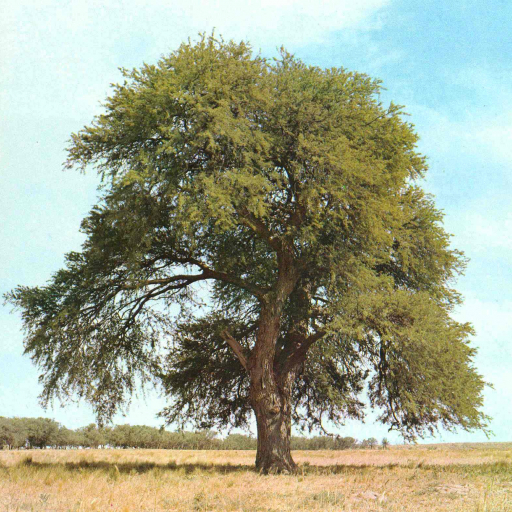
Plant Overview
The Caldén is the stoic sentinel of the Argentine Pampa, a tree so iconic that it gave its name to an entire region. Known scientifically as Prosopis caldenia, this rugged deciduous tree thrives where others fail, twisting its branches into dramatic, wind-swept silhouettes. Deeply rooted in the history of the gauchos, it is a symbol of endurance and the wild heart of the southern plains.
🔍 How to Identify
- 🌳 The Trunk: Often short and exceptionally thick, the trunk features deeply fissured, dark grey bark that looks like it has been weathered by a century of storms.
- 🌿 The Foliage: Its leaves are bipinnate and delicate, creating a soft, feathery appearance that contrasts sharply with its rugged branches.
- 🦴 The Thorns: Sharp, paired thorns sit at the base of the leaf stalks, acting as a natural defense against hungry herbivores.
- 🥨 The Fruit: It produces unique, yellowish-brown seed pods that are often twisted or curled into spiral shapes, hanging in clusters during late summer.
🏡 In Your Garden
- 🏜️ Drought Champion: This tree is a master of water conservation. It develops a massive taproot that can reach deep underground aquifers, meaning once established, it almost never needs supplemental watering.
- 🌱 Soil Preference: It prefers sandy or well-draining alkaline soils. Because it belongs to the legume family, it actually improves the soil around it by "fixing" nitrogen, making it a generous neighbor to nearby grasses.
- 🌬️ Space Requirements: Due to its wide, umbrella-like canopy and aggressive root system, it is not suitable for small suburban yards or planting near foundations or pipes. It needs "room to roam."
⚠️ Safety & Toxicity
- 🟢 Generally Safe: The Caldén is not considered toxic to humans, dogs, or cats. In fact, its pods are a highly nutritious food source for livestock and wildlife.
- 🌵 Physical Hazard: The primary danger comes from its thorns. These are stiff and sharp enough to puncture tires or thin-soled shoes, so wear heavy gloves when pruning.
- 🐴 Livestock Note: While the pods are edible, cattle that gorge exclusively on the fallen fruit without other forage can occasionally suffer from digestive "bloat."
✨ Fun Fact
The wood of the Caldén is so incredibly hard and rich in tannins that it was historically used as fuel for locomotives in Argentina when coal was scarce. Today, its beautiful, reddish-streaked timber is highly prized for luxury parquet flooring and heavy-duty artisanal furniture.

Detailed Care Instructions
To grow a Prosopis caldenia plant, also known as Calden tree, you can follow these steps:
- Climate requirements: Prosopis caldenia prefers a specific climate niche, including arid to semi-arid regions with annual rainfall of 200 to 800 millimeters (8 to 31 inches) and temperatures ranging from 15 to 25 degrees Celsius (59 to 77 degrees Fahrenheit). Make sure your region meets these requirements.
- Seed collection: Collect mature seeds from existing Prosopis caldenia trees. These seeds can usually be found inside the seed pods of the tree. Wait until the pods turn brown and become brittle before collecting them.
- Seed treatment: The seeds have a hard seed coat, which needs to be scarified to help with germination. This can be done by either gently scratching the seed coat with sandpaper or soaking the seeds in hot water for 24 hours. Scarification helps water penetrate the seed coat.
- Pot or planting area preparation: Prepare a pot or planting area with well-draining soil. Make sure the pot or planting area has sufficient space for the roots to grow and that it receives plenty of sunlight.
- Sowing seeds: Plant the treated seeds in pots or directly in the planting area. Place the seeds about 1 to 2 centimeters (0.4 to 0.8 inches) deep in the soil, spacing them around 10 to 20 centimeters (4 to 8 inches) apart.
- Watering: Water the newly planted seeds regularly but avoid overwatering, as Prosopis caldenia is a drought-tolerant plant. The soil should remain slightly moist but not waterlogged.
- Maintenance: Monitor the plant for signs of pests or diseases and take necessary steps to address any issues. Provide occasional fertilizer if necessary, but avoid excessive fertilization as it may harm the plant.
- Transplanting: Once the seedlings have grown to a suitable size, usually around 20 to 30 centimeters (8 to 12 inches) tall, they can be transplanted into their final growing location. Ensure the new location meets the climate and sunlight requirements mentioned earlier.
- Regular care: Continue to water the plants regularly, especially during the establishment period. Prune any dead or damaged branches to promote healthy growth.
- Patience: Prosopis caldenia is a slow-growing tree, so be patient. It may take several years for the tree to reach maturity and produce seeds.
Remember to check local regulations before planting Prosopis caldenia trees, as they may be considered invasive in some regions.
To water this plant, ensure that the soil around the base of the plant is dry before watering it thoroughly. Use a watering can or a hose with a gentle spray nozzle to water the base of the plant until the soil is moist but not waterlogged. Do not allow the soil to completely dry out as this can cause stress to the plant. Watering should be done infrequently but deeply, making sure the soil has enough time to dry out before the next watering. Additionally, it is best to water this plant in the morning or evening when the temperatures are cooler to avoid excessive evaporation.
To promote healthy growth of this plant, fertilize it once a year with a balanced fertilizer containing nitrogen, phosphorus, and potassium. Apply the fertilizer in the early spring just before new growth begins. Use a slow-release fertilizer or apply a liquid fertilizer diluted according to the manufacturer's instructions. Water the plant thoroughly after fertilizing to help the nutrients reach the roots. Be careful not to apply too much fertilizer, as this can damage the plant.
When planting Prosopis Caldenia, it is recommended to use well-draining soil that is slightly acidic with a pH level between 6.0 and 7.0. The soil should also be rich in organic matter and nutrients, such as nitrogen, phosphorus, and potassium. To improve soil quality, adding compost or organic fertilizers before planting is beneficial. Additionally, it is important to ensure that the soil doesn't become waterlogged, as the plant prefers a dry, arid environment. Therefore, it is recommended to avoid using soil that retains too much moisture or clay-heavy soil.
To propagate this plant, you will need to collect seeds from mature fruits that have already fallen from the tree. In order to increase the chances of successful germination, it is recommended to soak the seeds in water for up to 24 hours. Once soaked, carefully plant the seeds in a well-draining soil mix in small containers or seed trays. Make sure to keep the soil moist but avoid overwatering, as excess water can lead to fungal growth and rot. The seeds typically germinate in about 2-3 weeks. After the seedlings have developed a few true leaves, they can be transplanted into larger containers or pots, or directly into the ground if the soil and climate are suitable.
It is also possible to propagate this plant through stem cuttings taken from mature trees. Take a cutting that is about 6-8 inches long and remove any leaves from the lower half of the stem. Dip the cut end of the stem in rooting hormone powder and plant it in a well-draining soil mix. Keep the soil moist and provide the cutting with bright but indirect light until it establishes roots and starts to grow new leaves.








