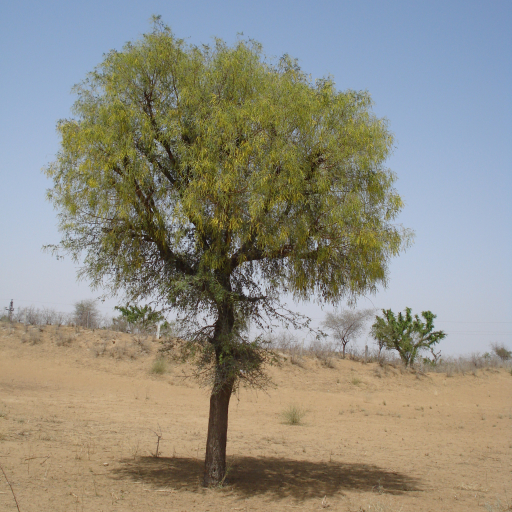
Plant Overview
Known as the "King of the Desert," the Prosopis cineraria—commonly called the Ghaf or Khejri tree—is a living symbol of resilience. In the arid landscapes of India and the Middle East, it is revered as a "Wonder Tree" that provides shade, food, and life-sustaining resources when almost nothing else can survive. In many cultures, it is considered sacred and a provider for both humans and livestock.
🔍 How to Identify
- 🍃 Foliage: The leaves are small, bipinnate (feather-like), and have a dusty grey-green hue. Their tiny size is a clever adaptation to minimize water loss under the scorching sun.
- 🌵 Thorns: Look for small, scattered, conical prickles along the branches. They aren't as densely packed as some acacia species but offer the tree protection from desert grazers.
- 🌼 Flowers & Pods: It produces tiny, creamy-yellow flower spikes. These develop into long, slender, bean-like seed pods that hang in clusters and turn a pale yellow-brown when ripe.
🏡 In Your Garden
- 🏜️ Drought Champion: This tree possesses a legendary taproot that can descend over 30 meters (nearly 100 feet) to reach deep groundwater. Because of this, it hates being moved once planted; choose its "forever home" carefully to avoid damaging that vital root.
- 🌱 Soil Enricher: As a member of the legume family, it "fixes" nitrogen into the earth. It is an altruistic plant that actually improves the soil quality for surrounding grass and smaller shrubs, making it a perfect centerpiece for a desert-style landscape.
⚠️ Safety & Toxicity
- ✅ Generally Safe: The Prosopis cineraria is non-toxic to humans, dogs, cats, and livestock. In many regions, the pods (Sangri) are actually harvested and eaten as a nutritious vegetable.
- ⚠️ Physical Hazard: The primary safety concern is its thorns. While small, they are sharp and can cause puncture wounds. Avoid planting it directly next to narrow garden paths or children’s play areas.
✨ Fun Fact
In 1730, 363 members of the Bishnoi community in Rajasthan, India, sacrificed their lives to protect Khejri trees from being cut down by the local Maharaja’s men. This incredible act of devotion is considered the historical precursor to the modern "Chipko" or "Tree Hugger" environmental movement.

Detailed Care Instructions
| Humidity | Dry |
| Lighting | Full Sun |
| Toxicity | Poisonous |
| Difficulty | Easy |
| Hibernation | Cold Period |
| Temperature | 16°C - 46°C |
| Hardiness Zones | 10 - 12 |
Here are some steps to help you grow Prosopis cineraria:
- Obtain seeds or young plants: You can get Prosopis cineraria seeds or young plants from local nurseries, online sources, or botanical gardens specializing in native plants. Ensure that the seeds or plants are healthy and suitable for your region.
- Choose a suitable location: Prosopis cineraria is a drought-tolerant tree that thrives in dry and arid climates. Select a sunny spot with well-draining soil for planting. Make sure it has enough space to grow, as the tree can reach a height of up to 12 meters.
- Prepare the soil: Improve the soil quality by adding organic matter like compost or well-rotted manure. This helps with moisture retention and provides nutrients to the plant.
- Planting from seeds: If you have seeds, soak them in water overnight to enhance germination. Sow the seeds directly in the prepared soil, making sure they are adequately spaced and not too deep. Water gently but thoroughly after sowing.
- Planting young plants: If you have young plants, dig a hole slightly larger than the plant's root ball. Place the plant in the hole, making sure it sits at the same depth as it was in the container. Backfill the hole with soil and gently firm it around the root ball. Water thoroughly after planting.
- Watering: Initially, water the plant regularly to help establish its roots. Once established, Prosopis cineraria is highly drought-tolerant and requires minimal watering. However, providing occasional deep watering during extended dry spells can be beneficial.
- Mulching: Apply a layer of organic mulch around the base of the tree to help retain moisture, suppress weed growth, and maintain a more stable soil temperature.
- Pruning and maintenance: Prune the tree during the dormant season to maintain its shape and remove dead or damaged branches. Regularly inspect the tree for pests or diseases and address any issues accordingly.
- Protection: Provide protection for young plants from extreme temperatures, strong winds, or grazing animals, as they may damage the growing tree.
- Patience: Prosopis cineraria is a slow-growing tree, so it may take time to establish and mature. Practice patience and provide consistent care to ensure its healthy growth.
Remember to check local regulations and guidelines regarding planting and growing native species to maintain ecological balance in your area.

Place in a bright room that is sun drenched almost all day. Or directly in a south-facing window.

To water this plant, it is recommended to give a thorough watering once a week during the growing season, and reduce watering during the dormant season. When watering, ensure that the soil is moist but not waterlogged. Avoid getting water on the leaves as this may cause damage or encourage fungal growth. Additionally, it is important to provide good drainage for the plant to avoid water accumulating in the soil, which can lead to root rot. The best time to water this plant is early in the morning or late in the evening when the temperatures are cooler, as this reduces water loss due to evaporation.
To fertilize this plant, apply a balanced fertilizer in early spring and again in mid-summer. Follow the manufacturer's instructions for application rates. Water the plant thoroughly after fertilizing to ensure the nutrients are absorbed properly. Avoid fertilizing during periods of drought or extreme heat.
The ideal soil for this plant has a pH range of 7 to 8 and is well-draining. The soil should be sandy or loamy with a mixture of organic matter such as compost or manure. It should be moderately fertile, with adequate levels of nitrogen, phosphorus, and potassium. The soil should also have good water-holding capacity to ensure the plant receives enough water during periods of drought. Avoid planting this plant in highly saline soils or poorly-draining soils, as it can negatively impact growth and viability.
There are several methods for propagating this plant:
- Seeds: Collect mature seeds from the parent plant. Soak the seeds in water for 24 hours before planting. Plant the seeds in well-draining soil, covering them with a thin layer of soil. Water the soil lightly and place the pot in a warm and sunny location. Germination can take anywhere from 2 to 4 weeks.
- Stem cuttings: Select a healthy stem from the parent plant and cut a section about 6 inches long. Remove any leaves from the lower half of the cutting. Dip the cut end in rooting hormone powder and plant the cutting in well-draining soil. Water the soil lightly and cover the cutting with a plastic bag to create a humid environment. Place the pot in a warm and sunny location. Rooting can take anywhere from 4 to 8 weeks.
- Layering: Select a low branch from the parent plant and bend it down to the ground. Make a slight wound on the branch where it touches the soil and cover that part with soil. Water the soil lightly and leave it alone for a few weeks. Roots should develop at the wound site. Sever the rooted branch from the parent plant and plant it in a separate pot or directly in the ground.
It is important to note that this plant can be highly invasive in certain environments and therefore, propagating should only be done with caution and consideration of the plant's potential impact on the local ecosystem.
Common pests of the shami include Spider mites. Make a habit of checking your shami frequently for pests so that any infestations can be caught and managed early.








