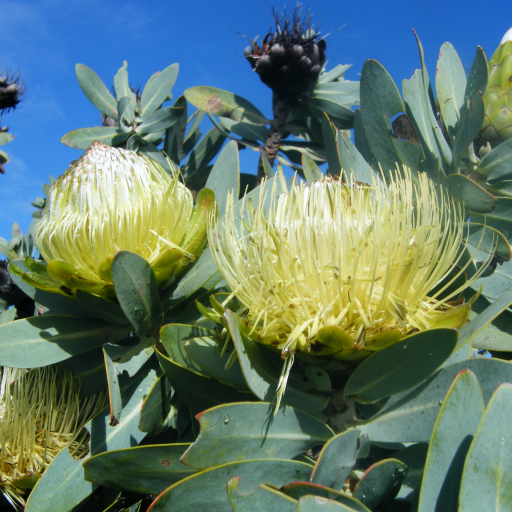
Plant Overview
Often called the Wagboom (Wagon Tree) or the Shaving-brush Protea, Protea nitida is a legendary giant of the South African fynbos. Unlike many of its smaller shrub relatives, this resilient species grows into a sturdy, slow-growing tree that has witnessed centuries of history. It carries a silver-blue metallic sheen on its leaves that catches the sunlight beautifully, making it a standout in any landscape.
🔍 How to Identify
- 🍃 Leathery Foliage: Large, oblong leaves with a distinct glaucous (blue-grey) tint and a smooth, waxy texture that helps the plant retain moisture.
- 🖌️ Brush-like Blooms: Large, cup-shaped flower heads filled with creamy-white styles that resemble an old-fashioned shaving brush.
- 🌳 Corky Bark: A thick, grey, fire-resistant bark that becomes deeply fissured as the tree ages, allowing it to survive the frequent wildfires of its native habitat.
🏡 In Your Garden
- ⛰️ Soil & Drainage: This plant is a specialist of rocky, acidic slopes. In a garden setting, it demands exceptionally well-draining soil; it will not tolerate "wet feet" or heavy clay which can lead to root rot.
- ⏳ Patience is Key: Because it invests so much energy into its thick, protective bark and deep root system, the Wagboom is a slow grower. Avoid transplanting it once established, as its sensitive root system dislikes being disturbed.
⚠️ Safety & Toxicity
- ✅ Safe Status: Protea nitida is generally considered non-toxic to humans and common household pets.
- 👐 Physical Safety: While not poisonous, the leaves are quite tough and leathery, and the woody stems can be heavy. Always use sharp bypass pruners if you are taking cuttings to avoid jagged edges.
✨ Fun Fact
The name "Wagboom" isn't just a nickname—it’s historical! Early settlers in the Cape used the exceptionally hard, dense wood of this tree to craft the wheel rims and brake blocks for their ox-wagons. One of the few proteas large enough to yield timber, it literally helped move a nation.

Detailed Care Instructions
To grow Protea Nitida plant, following steps can be taken:
- Climate and Soil Requirements:
- Protea Nitida prefers a Mediterranean climate with mild winters and warm summers.
- It grows best in well-draining sandy or loamy soil.
- The soil pH should be slightly acidic to neutral (pH 6.0-7.0).
- Protea Nitida prefers a Mediterranean climate with mild winters and warm summers.
- Planting:
- Choose a sunny location that receives at least 6-8 hours of direct sunlight daily.
- Dig a hole twice as wide and deep as the plant's container.
- Amend the soil with organic matter, like compost or well-decomposed manure, to improve drainage and fertility.
- Gently remove the plant from its container, loosen the root ball, and place it in the hole, ensuring that the top of the root ball is level with the surrounding soil.
- Backfill the hole with soil, firming it gently around the roots.
- Water thoroughly after planting.
- Choose a sunny location that receives at least 6-8 hours of direct sunlight daily.
- Watering:
- Protea Nitida prefers moderate watering.
- Water the plant deeply once or twice a week, depending on weather conditions and soil moisture.
- Ensure that the soil doesn't become excessively waterlogged, as this can lead to root rot.
- Protea Nitida prefers moderate watering.
- Mulching:
- Apply a layer of organic mulch around the base of the plant to help conserve moisture, suppress weeds, and protect the root system.
- Avoid mulching directly against the stem to prevent rot.
- Apply a layer of organic mulch around the base of the plant to help conserve moisture, suppress weeds, and protect the root system.
- Pruning:
- Pruning is necessary to maintain the plant's shape and remove dead or damaged branches.
- Prune after flowering, which is typically in late winter or early spring.
- Use clean and sharp pruning tools to make clean cuts.
- Pruning is necessary to maintain the plant's shape and remove dead or damaged branches.
- Fertilizing:
- Fertilize with a slow-release or controlled-release fertilizer specifically formulated for Proteas.
- Apply the fertilizer in spring or early summer, following the package instructions.
- Avoid over-fertilizing, as it can lead to excessive vegetative growth at the expense of floral production.
- Fertilize with a slow-release or controlled-release fertilizer specifically formulated for Proteas.
- Pests and Diseases:
- Proteas are generally resistant to pests and diseases if grown in suitable conditions.
- However, keep an eye out for common pests like aphids, mites, or snails and treat them promptly using appropriate methods.
Remember to check regional guidelines and consult local experts for specific recommendations for growing Protea Nitida in your area, as conditions may vary.
- Proteas are generally resistant to pests and diseases if grown in suitable conditions.

Place in a bright room that is sun drenched almost all day. Or directly in a south-facing window.

Protea Nitida is a type of plant that requires specific watering techniques to thrive. Here are some details on how to water this particular plant:
1. Frequency: Protea Nitida prefers infrequent but deep watering. It is important to mimic its natural growing conditions, which typically involve heavy rainfall followed by periods of drought. Watering once every 10-14 days, depending on the weather and soil moisture, is generally sufficient.
2. Soaking the Soil: When watering, it is crucial to ensure that the water reaches the root zone. To achieve this, water the plant deeply, allowing the soil to become thoroughly saturated. This encourages the roots to grow deeper, creating a stronger and more resilient plant.
3. Avoid Overwatering: As Protea Nitida is sensitive to excessive moisture, it is essential to prevent waterlogging. Avoid frequent light watering, as this can cause shallow root growth and lead to plant stress or even root rot. Allow the soil to partially dry out between watering sessions.
4. Watering Techniques: When watering a Protea Nitida plant, it is beneficial to use a slow and controlled approach. Direct the water flow towards the base of the plant, rather than overhead, to minimize wet foliage, which could promote disease or rot. Applying water in a slow, gentle manner allows thorough absorption and prevents runoff.
5. Consider the Season: During the plant's active growth period, typically in spring and early summer, Protea Nitida may require more regular watering. However, during its dormant phase in winter, reduce the watering frequency further to prevent root rot.
6. Mulching: Applying a layer of organic mulch around the plant's base can help regulate soil moisture by reducing evaporation. Mulching also assists in maintaining a more consistent soil temperature, which can benefit Protea Nitida, especially during extreme weather conditions.
Remember, these watering guidelines serve as general recommendations for Protea Nitida plants. Factors such as local climate, soil type, and individual plant requirements should be taken into account. Monitoring the plant's moisture needs and adjusting the watering schedule accordingly will ensure optimal growth and health.
To fertilize Protea Nitida, follow these instructions:
- Choose a high-quality, balanced fertilizer specifically formulated for native or acid-loving plants.
- Dilute the fertilizer according to the manufacturer's instructions. Generally, using half the recommended dosage is sufficient.
- Water the plant thoroughly before applying the fertilizer to ensure the soil is moist.
- Apply the diluted fertilizer around the base of the plant, avoiding direct contact with the stems or leaves.
- Gently work the fertilizer into the top inch of the soil using a small hand trowel or cultivator.
- Water the plant again after applying the fertilizer to help it absorb the nutrients.
- Repeat the fertilization process every 6-8 weeks during the growing season, typically from late winter to early fall.
- Avoid over-fertilizing, as it can lead to excessive foliage growth at the expense of flowers.
- Monitor the plant's growth and adjust the fertilization frequency or dosage as needed based on its response.
- Always follow the specific fertilization guidelines provided by the manufacturer of the fertilizer you choose.
The ideal soil for Protea Nitida plants is typically well-draining and slightly acidic. It should have a pH level between 5.5 and 6.5. The soil texture should be sandy or loamy to ensure good drainage. This type of soil allows the plant's roots to breathe properly and prevents waterlogging, which can be detrimental to the health of the plant.
The soil should contain a good amount of organic matter, such as compost or well-rotted manure, to provide essential nutrients and promote healthy growth. This organic matter helps to retain moisture in the soil while also improving its overall structure.
It is important to avoid using soils that are heavy in clay or have poor drainage, as this can lead to waterlogging and cause root rot. Additionally, soils that are too alkaline or have a high pH level can adversely affect the plant's ability to uptake nutrients.
Overall, a well-draining, slightly acidic soil enriched with organic matter is the best choice for the successful cultivation of Protea Nitida plants.
Protea Nitida is a species of flowering plant native to South Africa. It belongs to the Proteaceae family and is commonly known by various names such as Wagon Tree or Queen Protea. Here is a detailed guide on how to propagate Protea Nitida:
- Propagation Method:
- Protea Nitida can be propagated through both seeds and cuttings. However, seeds are the most common method employed for propagation.
- Protea Nitida can be propagated through both seeds and cuttings. However, seeds are the most common method employed for propagation.
- Seed Collection:
- Collecting mature seeds is the first step. Wait until the seedheads turn brown and start to split open naturally.
- Use a pair of scissors or pruners to carefully cut the seedheads from the plant and collect them in a clean container.
- Collecting mature seeds is the first step. Wait until the seedheads turn brown and start to split open naturally.
- Seed Preparation:
- The next step involves preparing the seeds for germination.
- Thoroughly clean the seedheads, removing any dead petals or debris.
- Gently rub the seedheads between your hands or use a sieve to separate the seeds from the seedheads.
- Rinse the seeds under running water to remove any remaining pulp or residue.
- The next step involves preparing the seeds for germination.
- Seed Storage:
- Place the cleaned seeds on a paper towel or a clean, dry surface to air dry for a few days.
- Once dry, transfer the seeds to airtight containers or small envelope packets.
- Store the seeds in a cool and dry place until you are ready to sow them.
- Place the cleaned seeds on a paper towel or a clean, dry surface to air dry for a few days.
- Sowing Seeds:
- Protea Nitida seeds require a specialized germination technique called "smoke treatment" to break their dormancy.
- Purchase commercially available "smoke primer" or "smoke water" products specifically designed for Proteaceae plants.
- Follow the instructions and soak the seeds in the prescribed concentration of smoke treatment for the recommended time.
- After the smoke treatment, remove the seeds from the solution or smoke water and rinse them well.
- Protea Nitida seeds require a specialized germination technique called "smoke treatment" to break their dormancy.
- Germination:
- Prepare a well-draining mix by combining equal parts coarse sand, perlite, and peat moss.
- Fill small pots or seed trays with the prepared mix and lightly moisten it.
- Place the seeds onto the surface of the mix, ensuring they are not buried.
- Cover the container with a clear plastic bag or a propagator lid to create a humid environment.
- Position the container in a warm and bright location, avoiding direct sunlight.
- Keep the soil consistently moist, misting with water as needed.
- Prepare a well-draining mix by combining equal parts coarse sand, perlite, and peat moss.
- Care and Transplanting:
- Germination may take anywhere from 4 to 12 weeks, depending on conditions.
- Once the seedlings have developed at least two sets of true leaves, they can be transplanted into individual pots.
- Prepare a well-draining soil mix similar to the germination mix, and gently transplant each seedling without disturbing the roots.
- Place the potted seedlings in a partially shaded spot and continue to water them regularly, ensuring the soil doesn't dry out completely.
- After a year or two, the plants can be transplanted into their permanent location in the garden.
Remember, Protea Nitida is a slow-growing plant, and it may take several years before it reaches maturity and starts producing its iconic large flowerheads.
- Germination may take anywhere from 4 to 12 weeks, depending on conditions.








