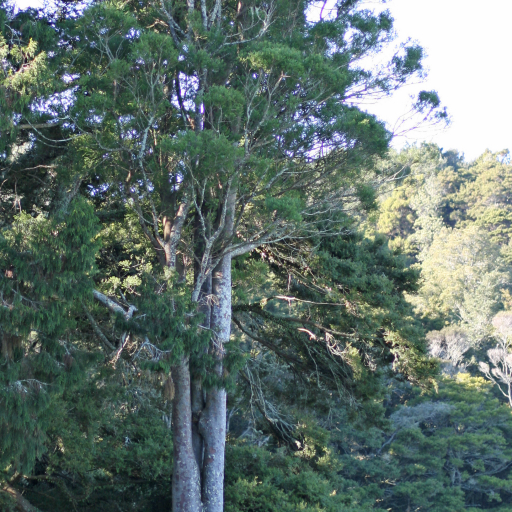
Plant Overview
Known as the Matai or Black Pine, this ancient New Zealand conifer is a master of transformation. For the first few decades of its life, it looks like a tangled, wiry bush, but it eventually rises into a majestic, towering forest giant that can live for over a millennium. Its timber was once the gold standard for flooring in grand homes due to its incredible hardness and smooth, honey-colored finish.
🔍 How to Identify
- 🌿 The Great Change: Young trees look like messy, bronze-tinted tangles of wiry branches (divaricating growth), while adults are straight, stately trees with dark green foliage.
- 🔨 Hammered Bark: The trunk features distinctive "hammer marks"—circular flakes of bark that fall away to reveal reddish-brown or grey patches beneath, looking as if a craftsman hit it with a ball-peen hammer.
- 🍃 Yew-like Leaves: The name taxifolia means "leaves like a Yew." They are linear, flat, and arranged in two rows along the stem, giving the twigs a delicate, feathered appearance.
🏡 In Your Garden
- ⏳ A Legacy Tree: This is a very slow-growing species. If you plant a Matai, you are planting a legacy for future generations rather than a quick garden filler. It can take decades to move past its "messy teenager" phase.
- 💧 Soil Preferences: In the wild, they thrive in fertile, well-drained lowland soils. While they are hardy once established, they appreciate consistent moisture and protection from harsh, drying winds when young.
- 🕊️ Bird Magnet: Mature trees produce dark purple, fleshy fruit (technically modified cones) that are a favorite snack for large birds, who help disperse the seeds throughout the landscape.
⚠️ Safety & Toxicity
- ✅ Generally Safe: Unlike the true Yew (Taxus), the Matai is not considered highly toxic. It is a common feature in New Zealand parks and wild spaces.
- 🐾 Mild Caution: While the fleshy fruit was historically eaten by indigenous people, the seeds and foliage are not for human consumption. Keep curious pets from chewing on the foliage to avoid potential minor digestive upset.
✨ Fun Fact
The Matai's tangled juvenile stage is a biological ghost story. Scientists believe the wiry, zig-zagging branches evolved as a defense mechanism to protect the inner leaves from being eaten by the now-extinct Moa, New Zealand's giant flightless bird that stood over 3 meters tall!

Detailed Care Instructions
To grow Prumnopitys taxifolia, also known as Mataī or Black Pine, you can follow these steps:
- Obtain seeds or seedlings: You can purchase seeds online or from a reputable nursery. Alternatively, you can collect seeds from mature trees if available.
- Select the right location: Mataī prefers a sheltered spot with partial shade or full sunlight. It is best to choose a location with well-draining soil.
- Prepare the soil: Ensure the soil is fertile and well-draining. You can add organic matter like compost to improve the soil's texture.
- Sow the seeds or plant the seedlings: If using seeds, sow them in individual pots or seed trays filled with a well-draining potting mix. Ensure the seeds are lightly covered with soil. Keep the pots in a warm place, ideally around 20-25 degrees Celsius (68-77 degrees Fahrenheit). Seeds may take several months to germinate.
If using seedlings, dig a hole in the ground that is slightly larger than the root ball of the plant. Place the seedling in the hole, making sure it is at the same soil level as it was in the pot. Gently backfill the hole with soil, firming it around the base of the seedling.
- Watering: Water the plant regularly, especially during dry spells. However, avoid overwatering, as the roots can become waterlogged.
- Mulching: Apply a layer of organic mulch around the base of the plant. This helps to retain moisture, suppress weed growth, and regulate soil temperature.
- Pruning: Prune the plant lightly to maintain its shape and remove any dead or damaged branches. This is best done in late winter or early spring.
- Fertilizing: Prumnopitys taxifolia usually doesn't require much fertilization, but if the growth seems weak, you can apply a balanced slow-release fertilizer in early spring.
- Protection from pests and diseases: Keep an eye out for common pests such as aphids or scale insects. Treat any infestations promptly with appropriate insecticides or soapy water. Watch for signs of diseases such as root rot or powdery mildew and take action if necessary.
- Patience: Growing a Prumnopitys taxifolia plant takes time, as it is a slow-growing species. Be patient and provide consistent care, and you will be rewarded with a beautiful and unique tree in your garden.
Remember to check the specific care requirements for your region, as some practices may vary depending on the climate and soil conditions.

Place in a bright room that is sun drenched almost all day. Or directly in a south-facing window.

Prumnopitys Taxifolia is a plant that requires a moderate amount of watering. When watering this plant, it is important to avoid overwatering as standing water around the roots can cause them to rot.
To water this plant properly, allow the top inch of soil to dry out before watering again. This can be checked by inserting a finger into the soil to see if it feels dry. When watering, use room temperature water and thoroughly saturate the soil around the plant's root system.
It is best to water this plant in the morning so that any excess water can evaporate throughout the day, preventing the development of fungal diseases. Additionally, it is recommended to use a watering can or a gentle hose to avoid damaging the foliage or disturbing the soil.
In summary, watering Prumnopitys Taxifolia should be done in moderation, allowing the top inch of soil to dry out before watering thoroughly with room temperature water. It is best to water in the morning and use a gentle method to avoid damaging the plant.
To fertilize this plant, use a slow-release granular fertilizer with a balanced N-P-K ratio, such as 10-10-10 or 20-20-20. Apply the fertilizer in early spring or early fall, according to the package instructions. Avoid over-fertilizing, as this can damage the plant. Water the plant thoroughly before and after applying fertilizer.
Prumnopitys Taxifolia plant prefers well-draining soil that is rich in organic matter. It also needs soil that has a slightly acidic pH level between 5.0 and 6.5. The soil should be moist but not waterlogged, as excessive moisture can lead to root rot. It is recommended to use a high-quality potting mix, or mix together equal parts of peat moss and perlite or vermiculite to create a well-draining soil mixture. Heavy clay soils should be amended with organic matter to improve drainage. Adding mulch around the base of the plant can also help to retain moisture and provide nutrients as it decomposes.
Propagation of the plant can be done through various methods, including seed propagation and vegetative propagation. For seed propagation, ripe seeds can be collected and sown in a suitable seedling mix. The seeds should be covered with a thin layer of soil and kept moist until they germinate. For vegetative propagation, stem cuttings can be taken from the plant and rooted in a propagation mix. The cuttings should be treated with rooting hormone and kept in a warm, humid environment until they develop roots. Once the new plants have developed a strong root system, they can be transplanted into individual containers or planted directly into the ground. It is important to ensure that the new plants are kept well-watered and protected from extreme weather conditions while they establish themselves.








