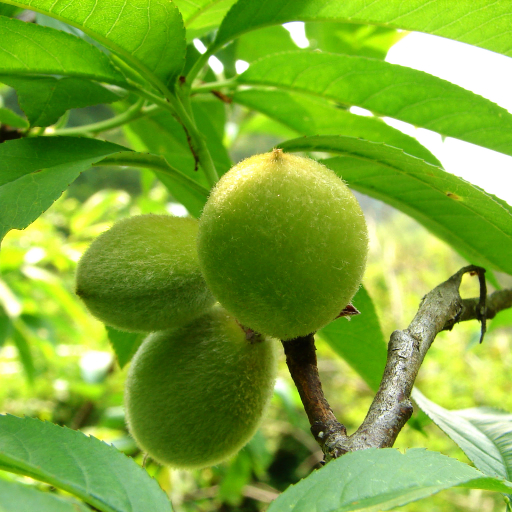
Plant Overview
Commonly known as David’s Peach or the Mountain Peach, this tree is a true harbinger of spring, often blooming while the ground is still dusted with late-winter snow. Native to the rugged landscapes of Northern China, it was named after the famous French missionary and naturalist, Père Armand David. While it closely resembles the common peach, this wild relative is built for endurance, surviving temperatures that would make a standard fruit tree shiver.
🔍 How to Identify
- 🌸 Early Blooms: It produces striking pink or white five-petaled flowers that appear on bare branches long before the leaves emerge in early spring.
- 🍃 Slender Foliage: The leaves are narrow, lance-shaped, and finely serrated, tapering to a sharp point, giving the canopy a delicate, airy texture.
- ✨ Polished Bark: The young branches and trunk feature a smooth, shiny, reddish-brown bark that provides beautiful visual interest even during the dormant winter months.
- 🍑 Wild Fruit: It produces small, spherical fruits (about 1 inch) that are yellowish-green and covered in fine fuzz, though they lack the juicy sweetness of commercial peaches.
🏡 In Your Garden
- 💪 The Iron Rootstock: Because of its incredible cold hardiness and resistance to alkaline soils, this plant is frequently used by orchardists as "rootstock" to help more delicate peach varieties survive harsh climates.
- ☀️ Sun Seeker: It thrives in full sun and requires well-draining soil. It is particularly sensitive to "wet feet," so avoid planting it in low spots where water tends to pool after rain.
- 🐝 Pollinator Lifeline: Since it blooms so early, it provides a critical first meal for bees and other pollinators waking up from hibernation.
⚠️ Safety & Toxicity
- 🚫 Potential Hazard: Like many members of the Prunus genus (cherries, plums, and peaches), the seeds (pits), leaves, and stems contain cyanogenic glycosides.
- 🐾 Pet & Child Safety: While the flesh of the fruit is generally harmless, the pits are toxic if cracked open and ingested. Keep a watchful eye on curious pets or toddlers who might try to chew on fallen twigs or fruit stones.
✨ Fun Fact
The Prunus davidiana is so resilient that it is currently being used in global genetic research to help create "climate-proof" peaches that can withstand extreme temperature fluctuations and drought!

Detailed Care Instructions
To grow Prunus Davidiana plants, follow these steps:
- Determine the planting location: Choose a spot in your garden that receives full sun or partial shade. The soil should be well-drained and slightly acidic.
- Prepare the soil: Before planting, improve the soil by adding organic matter such as compost or well-rotted manure. This will enhance drainage and provide essential nutrients to the plant.
- Planting: Dig a hole that is slightly larger and deeper than the plant's root ball. Place the plant in the hole, ensuring that the top of the root ball is level with the soil surface. Backfill the hole with soil, gently firming it around the plant.
- Watering: Water the plant thoroughly after planting to settle the soil around the roots. Prunus Davidiana plants require regular watering, especially during dry periods. However, ensure the soil does not become waterlogged as excessive moisture can harm the plant.
- Mulching: Apply mulch around the base of the plant to help retain moisture, suppress weed growth, and regulate soil temperature. Use organic materials like wood chips, straw, or compost.
- Pruning: Pruning is necessary for maintaining the shape of the plant and encouraging healthy growth. Prune during late winter or early spring before new growth begins. Remove any dead or damaged branches and trim the plant to the desired shape.
- Fertilizing: Prunus Davidiana plants benefit from regular fertilization. Apply a balanced, slow-release fertilizer in early spring or use a granular fertilizer specifically formulated for fruit trees, following the manufacturer's instructions.
- Pest and disease control: Watch for common pests such as aphids, scales, or caterpillars. If these pests are present, use insecticidal soap or horticultural oil to control them. Additionally, monitor the plant for signs of diseases like leaf spot or powdery mildew and treat accordingly.
- Harvesting: Prunus Davidiana plants produce small, edible fruits that resemble cherries. Harvest the ripe fruits when they have turned dark purple or black and enjoy them fresh or use them for jams, jellies, or pies.
- Winter care: Prunus Davidiana plants are hardy but may benefit from a thick layer of mulch around the base to protect the roots during cold winters. Additionally, consider covering the plant with a frost blanket during extreme cold spells.
By following these steps, you should be able to successfully grow Prunus Davidiana plants and enjoy their beautiful foliage and tasty fruits.

Place in a bright room that is sun drenched almost all day. Or directly in a south-facing window.

To properly water the Prunus Davidiana plant, you should first ensure that the soil is moist but not soggy. The frequency of watering will depend on factors such as the climate, humidity levels, and the type of soil.
One way to determine when to water the plant is by sticking your finger about 1 inch into the soil, and if it feels dry, it may be time to water. Alternatively, you can use a moisture meter to detect the moisture level in the soil.
When watering the Prunus Davidiana plant, it is best to use room temperature or lukewarm water, and to avoid getting water on the leaves. Water the plant slowly and deeply, allowing the soil to fully absorb water and preventing it from running off.
Finally, it is important not to overwater the plant, as this can lead to root rot and other issues. If you notice any yellowing or drooping leaves, it may be a sign that the plant is receiving too much water.
To fertilize this plant, use a slow-release fertilizer in the early spring just as new growth begins. Follow the instructions on the fertilizer packaging for the appropriate amount to apply. Alternatively, you can use a liquid fertilizer every two weeks throughout the growing season. Avoid fertilizing in the fall or winter when the plant is dormant.
The soil that is suitable for the Prunus Davidiana plant should be well-draining, rich in organic matter and hold moisture well. It should have a slightly acidic pH level ranging between 5.5-6.5. The plant prefers a loose and loamy soil texture that allows for proper root development, and it should be planted in a location that receives full to partial sun exposure. The soil should not be compacted or too heavy in clay content, as this can lead to drainage problems and stress on the plant. Adding compost or other organic amendments to the soil before planting can improve soil quality and promote healthy growth.
Prunus Davidiana can be propagated through different methods such as cuttings, layering, and seed sowing.
To propagate through cuttings, select healthy stem cuttings from the plant that has at least one node. Remove the leaves from the lower part of the cutting and dip the cut end into rooting hormone. Then, plant the cutting into a pot filled with well-draining potting soil. Keep the cutting moist and in indirect light until it roots.
To propagate through layering, select a low-growing stem and bend it down to the ground. Make a small cut on the underside of the stem and apply rooting hormone. Then, cover the cut with soil and leave it until roots develop. Once the layering has established roots, cut the stem from the parent plant and transplant it.
To propagate through seed sowing, collect ripe fruits from the plant and remove the seeds. Soak the seeds in water for 24 hours to soften the seed coat. Then, plant the seeds in a pot filled with well-draining potting soil and keep them moist in a warm and bright location. Germination can take several weeks to months, and once the seedlings have developed two true leaves, they can be transplanted into individual pots.








