Plant Overview
Often called the "Harbinger of Spring," the Sweet Almond (Prunus dulcis) is one of the first trees to wake up from winter dormancy, painting landscapes in delicate shades of blush and white. Celebrated in art by Van Gogh and rooted deep in Mediterranean history, this tree is more than just a source of protein—it is a symbol of hope and awakening. While we call its seed a "nut," it is botanically a stone fruit, much like a peach without the juicy flesh.
🔍 How to Identify
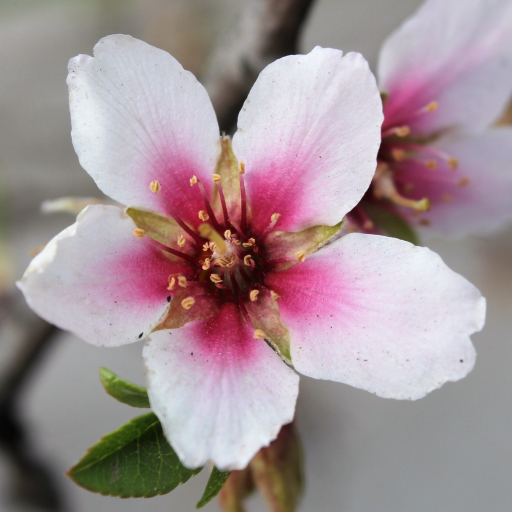
- 🌸 Blossoms: Pale pink to white flowers with five petals, appearing in early spring—often before the leaves even emerge.
- 🍃 Foliage: Long, lance-shaped leaves with finely serrated edges and a glossy green finish, arranged alternately along the branches.
- 🟢 The "Nut": Velvety, grey-green fruits (drupes) that look like small, fuzzy peaches. When ripe, the leathery hull splits open to reveal the hard wooden shell inside.
🏡 In Your Garden
- ☀️ Sun & Drainage: These trees are Mediterranean natives that crave full sun and "warm feet." They are highly susceptible to root rot, so they require deep, sandy, or loamy soil that drains quickly after rain.
- 🐝 The Pollination Puzzle: Many traditional almond varieties are not self-fertile. To get a harvest, you often need to plant two different varieties nearby so bees can move pollen between them.
- ✂️ Pruning Strategy: Because almonds fruit on short "spurs" that live for several years, light pruning is better than heavy hacking. Focus on opening the center of the tree to let light reach the inner branches.
⚠️ Safety & Toxicity
- 🐾 Pet Warning: While the store-bought "sweet" almond is safe for humans, the seeds, leaves, and stems contain cyanogenic glycosides, which are toxic to dogs, cats, and horses if ingested in large quantities.
- 🥜 Allergy Alert: As a major tree nut, those with nut allergies should handle the tree with caution, particularly during harvest when dust and oils are most prevalent.
- 🌳 Bitter vs. Sweet: Wild or "Bitter" almonds contain high levels of cyanide and are dangerous; however, the Prunus dulcis found in nurseries is the domesticated "Sweet" variety.
✨ Fun Fact
The almond is not a true nut! It is a "drupe," making it a close cousin to the peach, plum, and cherry. If you crack open a peach pit, the seed inside looks and smells exactly like an almond because they are genetically very close relatives.

Detailed Care Instructions
| Color | White, Pink |
| Soil Ph | 6.0-7.0 |
| Lighting | Full Sun |
| Toxicity | Toxic |
| Soil Type | Rich, Deep, Well-Drained Loam |
| Bloom Time | Spring |
| Plant Type | Deciduous Tree |
| Mature Size | 10-15 Feet Tall And Wide |
| Native Area | North Africa And The Middle East |
| Sun Exposure | Full Sun |
| Hardiness Zones | 6-9 |
To successfully grow Prunus Dulcis, also known as almond plant, you can follow these steps:
- Climate and location: Almond plants prefer a warm, Mediterranean-like climate. They require full sun for at least 6-8 hours a day. Choose a location with well-draining soil and protection from strong winds.
- Soil preparation: Almond plants thrive in well-draining soil with a pH level between 6.0 and 7.5. Improve the soil quality by adding compost or well-rotted manure to enhance its fertility and drainage.
- Plant selection: Obtain almond plant saplings or propagate them from cuttings. Make sure to choose a variety suitable for your climate and soil type.
- Planting: Dig a hole slightly larger than the root ball of the sapling. Place the sapling in the hole, ensuring that the soil line matches the original level of the plant. Gently backfill the hole with soil, firming it around the roots.
- Watering: Provide regular watering, especially during the first few years of growth, to encourage a strong root system. Almond plants have moderate water needs, so avoid overwatering, which can lead to root rot.
- Fertilization: Apply a balanced fertilizer in early spring or late winter to provide essential nutrients to the plant. Follow the manufacturer's instructions for proper dosage.
- Pruning: Prune your almond plant during the dormant season (late winter or early spring) to remove dead, diseased, or crossing branches. This encourages proper airflow and sunlight penetration.
- Pest and disease management: Monitor your plant regularly for signs of pests or diseases, like aphids or fungal infections. Treat them promptly with organic or chemical solutions, if necessary.
- Harvesting: Almond plants typically start producing nuts in their third or fourth year. The outer hull of the almond fruit will begin to split open, indicating the nuts are ready for harvest. Leave the nuts to dry for a few days, then remove the hulls and store the almonds in a cool, dry place.
Remember to research and choose varieties suitable for your specific climate and conditions, as different almond cultivars have varying adaptability.

Place in a bright room that is sun drenched almost all day. Or directly in a south-facing window.

The watering requirements for this plant will depend on several factors such as the temperature, humidity, soil moisture, and sunlight exposure. However, a general rule of thumb is to water the plant deeply once a week and adjust the frequency based on the aforementioned factors.
To water the plant, use a watering can or hose with a nozzle attachment to achieve a gentle flow of water. Direct the stream of water towards the soil and avoid wetting the leaves, as this may cause fungal diseases or sunburn.
Check the soil moisture regularly by inserting your finger a few inches into the soil. If the soil feels dry to the touch, it is time to water the plant. However, if the soil feels moist, wait a few days before checking again.
Avoid overwatering the plant, as this may cause root rot and other issues. Always allow the soil to drain and ensure adequate soil drainage by using a pot with drainage holes or planting the tree on a slope.
In summary, water this plant deeply once a week while avoiding wetting the leaves, checking soil moisture regularly, and allowing for adequate soil drainage.
To provide adequate nutrients for your Prunus Dulcis plant, begin by selecting a balanced fertilizer that is specifically formulated for nut trees. When applying the fertilizer, take care to avoid touching the trunk or foliage. Instead, disperse the granules evenly around the root zone, which extends outward from the base of the plant to the dripline. It is important to apply the fertilizer in the spring, just as the buds begin to swell. This will encourage healthy growth and development throughout the growing season. Additionally, be sure to water the plant well after application to help activate the fertilizing process. Finally, avoid over-fertilizing as this can harm the plant and lead to excessive growth that is vulnerable to disease and pest infestations.
The ideal soil for Prunus Dulcis plants should be slightly acidic to neutral in pH, with a pH range of 6.0 to 7.5. It should be well-draining, containing a mix of sand, silt, and clay. The soil should also be fertile, rich in nutrients such as nitrogen, phosphorus, and potassium, to support healthy growth and fruit production. Organic matter such as compost or manure can be added to the soil to improve its fertility and structure. Avoid soil that is too heavy or compacted, as it may inhibit root growth and make it difficult for water and nutrients to reach the plant's roots. Overall, providing the proper soil conditions for Prunus Dulcis plants is essential for their growth, health, and fruit production.
To propagate this plant, you will need to gather fresh seeds from the fruit of a mature plant. Remove the seeds from the fruit and wash them to remove any residual fruit flesh. Next, soak the seeds in water for 24 hours to soften the outer seed coat. After soaking, wrap the seeds in a moist paper towel and place them in a plastic bag or container. Keep the seeds in a warm, dark location for several weeks to allow them to germinate. Once the seeds have sprouted, transfer them to a pot filled with nutrient-rich soil and keep them in a sunny location with regular watering. Over time, the seedlings will grow into mature plants that can be transplanted to the garden or propagated further through seed production.
Common pests of the almond include Scale insect, aphids, larvae. Make a habit of checking your almond frequently for pests so that any infestations can be caught and managed early.








