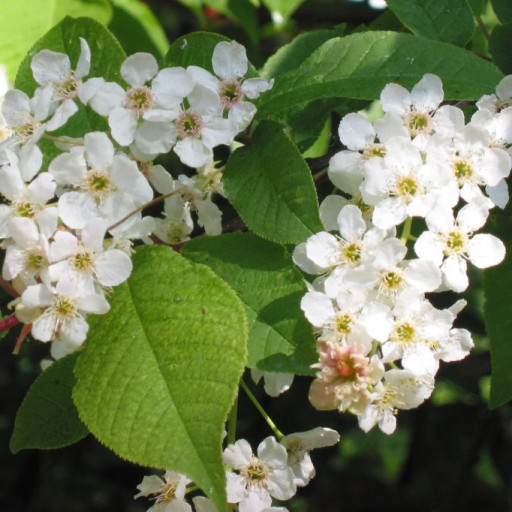
Plant Overview
Often called the Bird Cherry or Mayday Tree, this hardy deciduous beauty heralds the arrival of spring with cascading "foxtails" of almond-scented white flowers. Native across Northern Europe and Asia, it has been a staple of folklore for centuries, once believed to have the power to ward off the plague if placed near doorways. While it looks delicate, it is a rugged survivor, thriving in cool, damp climates where other cherry trees might falter.
🔍 How to Identify
- 🌸 The Blooms: Unlike common cherries that grow in small clusters, these flowers hang in long, drooping spikes (racemes) that can reach up to 6 inches in length.
- 🍃 The Foliage: Oval-shaped leaves with finely serrated "teeth" along the edges. In the spring, they are a vibrant green, turning a warm butter-yellow or bronze in the autumn.
- 🍒 The Fruit: Small, shiny black berries about the size of a pea. They have a bitter, astringent taste that puckers the mouth, earning them the nickname "Chokecherry" in some regions.
🏡 In Your Garden
- 💧 Moisture Lover: This tree is a specialist for damp spots. If you have a corner of the garden with heavy soil or near a pond where other trees suffer from "wet feet," the Bird Cherry will flourish.
- 🦋 Ecological Hero: It is a vital early-season food source. Its nectar-rich flowers draw in honeybees and emerging butterflies, while its late-summer berries are a favorite feast for thrushes and waxwings.
- 🏗️ Structure: It tends to grow with a somewhat wild, multi-stemmed habit. If you want a formal look, it requires early pruning to establish a single trunk; otherwise, it makes a magnificent, dense screen for privacy.
⚠️ Safety & Toxicity
- 🚫 Toxic Parts: Like many members of the Prunus genus, the seeds (pits), bark, and leaves contain cyanogenic glycosides, which turn into hydrogen cyanide when chewed or crushed.
- 🐾 Pet & Livestock Safety: While birds eat the fruit safely (the seeds pass through them whole), the wilted leaves are particularly dangerous to horses and cattle. Keep pets away from fallen branches or crushed seeds.
✨ Fun Fact
In Scotland, the tree was historically known as the Hagberry. Beyond its mystical associations, its wood is uniquely prized by craftsmen because it emits a pleasant, spicy scent when worked—making it a favorite material for traditional tobacco pipes and fine tool handles.

Detailed Care Instructions
| Lighting | Full Sun |
| Hardiness Zones | 4A - 8B |
To grow a Prunus padus plant, also known as bird cherry or hackberry, follow these steps:
- Choose a suitable location: Select an area with full sun to partial shade. Ensure that the soil is well-draining, as Prunus padus prefers moist but not waterlogged soil.
- Prepare the soil: Loosen the soil and remove any weeds or grass. Add organic matter such as compost to improve soil quality and drainage.
- Propagation: Prunus padus can be propagated through seeds or by taking softwood or hardwood cuttings. Collect ripe fruits from an existing plant and extract the seeds. Soak the seeds in water for 48 hours before sowing them in a seed tray or directly in the prepared soil. Alternatively, take cuttings from healthy stems and plant them in a rooting medium.
- Planting: If growing from seeds, sow them at a depth of 1/2 inch and keep the soil consistently moist until they germinate. For rooted cuttings, dig a hole slightly larger than the root ball and place the cutting in the hole. Fill the hole with soil and gently firm it around the base of the plant.
- Watering: Keep the soil consistently moist but not waterlogged during the growing season. Afterward, reduce watering frequency to allow the plant to adapt to slightly drier conditions.
- Mulching and fertilizing: Apply a layer of organic mulch, such as wood chips or shredded leaves, around the plant to help retain moisture and prevent weed growth. Fertilize the plant in early spring with a balanced, slow-release fertilizer according to the package instructions.
- Pruning: Prunus padus benefits from regular pruning to maintain its shape and remove any dead or diseased branches. Prune during the dormant season (late winter or early spring) to encourage healthy growth.
- Pest and disease control: Prunus padus is generally resistant to pests and diseases, but it may be susceptible to aphids, caterpillars, or fungal diseases in humid conditions. Monitor the plant regularly and address any issues as soon as they arise with appropriate organic or chemical treatments.
- Monitoring and care: Keep an eye on the plant's growth and health. Water during dry spells, ensure proper drainage, and watch for signs of pests or diseases. Provide support if needed as the plant grows taller.
Remember, some parts of the Prunus padus plant, especially the seeds and leaves, contain toxic compounds, so keep it away from children and pets.

Place in a window with dappled sun or a spot in the middle of a room. Or directly in a window facing west or east.

To water this particular plant, it is important to ensure that the soil is moist but not saturated. This can be achieved by watering the plant deeply and letting the topsoil dry out slightly before watering again. The frequency of watering will depend on various factors such as humidity, temperature, and soil type. It is important to monitor the plant regularly to ensure it is not under or over-watered. Additionally, it is recommended to water the plant at the base rather than overhead to prevent disease and fungal issues.
For optimal growth and development of this particular plant, it is recommended to use a balanced fertilizer with equal parts nitrogen, phosphorus, and potassium.
Apply the fertilizer in early spring, before new growth appears, and again in late summer or early fall. Use a slow-release, granular fertilizer or a liquid fertilizer diluted to half strength.
Spread the fertilizer evenly around the base of the plant, being careful not to let it touch the trunk. Water the plant thoroughly after fertilizing to help distribute the nutrients. Avoid fertilizing during periods of drought or extreme heat.
Prunus Padus is a plant that prefers well-drained and moderately fertile soil. It is recommended to use a soil mix that is rich in organic matter and has good drainage properties. A mixture of peat moss, coarse sand, and perlite can make a good soil mix for this plant. It is important to ensure that the soil is not waterlogged or excessively dry, as this can cause root damage or disease. A pH range of 6.5 to 7.0 is ideal for growing this plant. It is also recommended to use a slow-release fertilizer to provide the plant with the necessary nutrients over a longer period of time.
Propagation of the plant can be done through seed germination, hardwood cuttings, or layering. For seed germination, collect fresh seeds from the plant and sow in a pot with well-draining soil in the fall or spring. Cover the seeds with a thin layer of soil and keep it slightly moist. The seeds will germinate in 3-4 weeks.
For hardwood cuttings, take 6-8 inches long cuttings in the fall after the plant has gone dormant. Remove the leaves from the lower two-thirds of the cutting and dip the bottom end into rooting hormone powder. Plant the cutting in a pot with well-draining soil and keep it moist. The cutting will root in 4-6 weeks.
For layering, select a young, flexible stem near the base of the plant and bend it toward the ground. Remove the leaves from the stem where it touches the soil and wound it slightly. Cover the wounded area with soil and secure it with a rock or stake. Water the area regularly, and roots will form in 6-12 months. Once the roots have developed, cut the stem from the parent plant and transplant the new plant to a permanent location.








