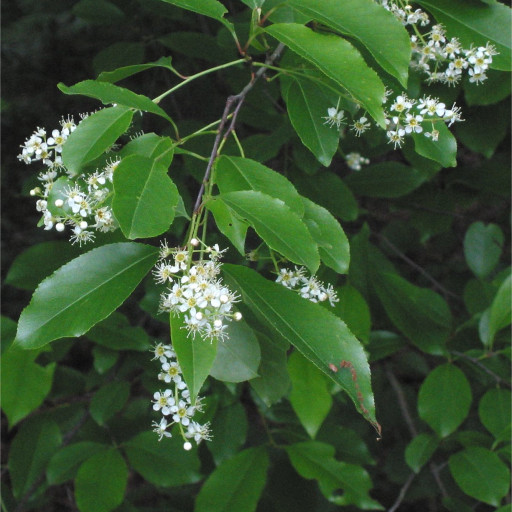
Plant Overview
Often called the "Wild Black Cherry" or the "Rum Cherry," this native North American giant is as famous for its high-quality timber as it is for its clusters of dark, bittersweet fruit. In the wild, it acts as a pioneer species, quickly reclaiming open fields and forest edges with its vigorous growth. While it looks like a typical forest tree, its history is deeply rooted in early American cabinet-making and traditional herbal tonics.
🔍 How to Identify
- 🥣 The "Burnt Cornflake" Bark: On mature trees, the dark gray bark breaks into small, brittle scales that look remarkably like burnt cornflakes—a primary ID feature for hikers.
- 🍃 Lustrous Foliage: The leaves are narrow, almond-shaped, and glossy green, featuring a fine, serrated edge and a curious "rusty" fuzz along the central vein on the underside.
- 🌸 Drooping Blooms: Unlike many cherries that bloom in bunches, Prunus serotina produces long, white, cylindrical clusters (racemes) that dangle from the branches in late spring.
🏡 In Your Garden
- 🦅 A Wildlife Magnet: If you have the space, this tree is a biological powerhouse. It supports hundreds of species of butterflies and moths, and its late-summer fruit is a primary food source for songbirds and small mammals.
- 🌳 Growth Nuance: Be mindful of its placement; Black Cherry has somewhat brittle wood and can drop twigs during heavy storms. It also possesses a deep taproot, meaning it resents being moved once it has established itself for more than a year or two.
⚠️ Safety & Toxicity
- 🚫 Toxic to Livestock and Pets: The leaves, twigs, and pits contain cyanogenic glycosides. When leaves wilt (after a storm or pruning), these compounds concentrate and can be lethal if ingested by horses, cattle, or curious dogs.
- 🍒 The Fruit Exception: While the pits are toxic, the dark flesh of the ripe berry is technically edible and was historically used in jellies and wines, though it is much more bitter than the cherries found in grocery stores.
✨ Fun Fact
The "Rum Cherry" nickname isn't just a coincidence—early American settlers used the bitter fruit to flavor brandy and rum, creating a popular colonial drink known as "Cherry Bounce." Additionally, the inner bark was once a primary ingredient in commercial cough syrups!

Detailed Care Instructions
| Color | White Blossoms And Dark Red Fruits |
| Soil Ph | 6.8-7.5 |
| Toxicity | Toxic |
| Soil Type | Moist, Fertile, Well-Draining |
| Bloom Time | Spring, Early Summer |
| Plant Type | Perennial |
| Mature Size | 50-90 Feet Tall |
| Native Area | North America |
| Sun Exposure | Full Sun, Partial Shade |
| Hardiness Zones | 3-9 |
To grow a Prunus serotina plant, also known as black cherry or wild cherry, you can follow these steps:
- Obtain seeds or seedlings: You can purchase Prunus serotina seeds online or at a nursery/garden center. Alternatively, you can collect seeds from wild cherry fruits or obtain seedlings.
- Prepare the planting site: Choose a location with well-draining soil and full sun or partial shade. Clear the area of weeds, rocks, and other debris.
- Sow the seeds or transplant seedlings: If using seeds, soak them in warm water for 24 hours before planting. Sow the seeds in early spring or late fall at a depth of 1 inch (2.5 cm) in the prepared soil. If using seedlings, dig a hole slightly larger than the root ball and plant them at the same depth they were growing in the container.
- Water regularly: Prunus serotina plants require consistent moisture during their first year of growth. Water the plants deeply whenever the top inch (2.5 cm) of soil feels dry.
- Mulch the soil: Apply a layer of organic mulch, such as wood chips or shredded bark, around the base of the plant. This helps retain moisture, suppress weed growth, and regulate soil temperature.
- Prune if necessary: Prunus serotina plants generally require minimal pruning. If you notice any dead, damaged, or diseased branches, prune them off. Additionally, you can shape the plant or remove any suckers that emerge from the base.
- Fertilize sparingly: Prunus serotina plants do not typically require heavy fertilization. However, you can apply a balanced slow-release fertilizer in spring to promote healthy growth.
- Protect from pests and diseases: Monitor the plant for common pests like aphids, spider mites, and tent caterpillars. If necessary, use organic insecticidal soaps or horticultural oils to control infestations. Prunus serotina is generally tolerant to diseases but can be susceptible to cherry leaf spot or brown rot in humid conditions. Maintain good airflow around the plant to prevent disease development.
- Harvest the fruit (optional): If you wish to harvest the black cherries, wait until they ripen to a deep purplish-black color in late summer or early fall. The fruits are typically enjoyed by wildlife or used in recipes like pies and jams.
By following these steps, you should be able to successfully grow a Prunus serotina plant. Good luck!

Place in a bright room that is sun drenched almost all day. Or directly in a south-facing window.

The best way to water this particular plant is to give it a deep watering once a week, allowing the soil to dry out slightly in between waterings. When watering, make sure to avoid getting water on the leaves or flowers as this can promote fungal growth. It is also important to ensure that the soil is well-draining to prevent root rot. You can check the soil moisture level by sticking your finger about an inch into the soil, if it feels dry it is time to water. If the plant is in a container, make sure there are drainage holes to allow excess water to escape.
For optimal growth and flowering, it is recommended to fertilize this plant in the spring before new growth appears and again in the fall after leaves have fallen. Use a balanced, slow-release fertilizer and apply according to package instructions. Avoid applying fertilizer directly to the base of the plant and instead sprinkle it evenly over the root zone. Water the plant thoroughly after fertilizing.
The ideal soil for Prunus Serotina is a loamy soil that is well-draining and slightly acidic with a pH level of 5.5-6.5. It should be rich in organic matter and provide good aeration for the roots. The soil should also be able to retain moisture without becoming waterlogged. Avoid using soils that are heavy in clay and compacted, as this can lead to poor root growth and drainage issues. Adding compost or other organic matter to the soil can improve its texture and nutrient content. Additionally, it is important to avoid using soils that have been treated with herbicides or pesticides, as these can be harmful to the plant.
To propagate this plant, you will need to collect ripe fruit from the tree and extract the seeds. The seeds should be soaked in water for 24 hours and then refrigerated for three months to induce stratification. After the three-month period, the seeds can be planted in a well-draining soil mix and kept moist. Germination should occur within 1-2 months. Once the seedlings have established a few leaves, they can be transplanted into larger containers or planted directly into the ground in a sunny location.
Common pests of the black cherry include Scale insect, aphids, larvae. Make a habit of checking your black cherry frequently for pests so that any infestations can be caught and managed early.








