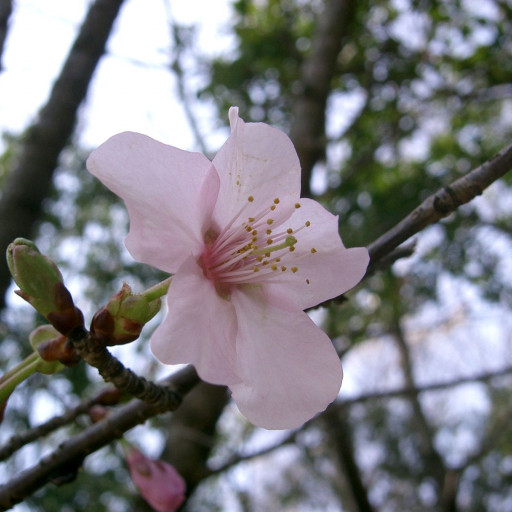
Plant Overview
Known worldwide as the Japanese Cherry Blossom or Sakura, Prunus serrulata is the undisputed herald of spring. In Japan, these trees are the center of "Hanami," a centuries-old tradition of picnicking under the blooming canopy to celebrate the fleeting beauty of life. While their floral display is explosive, it is famously brief, lasting only a week or two before the petals drift away like pink snow.
🔍 How to Identify
- 🌸 The Bloom: Clusters of showy flowers appear before or alongside the leaves. Depending on the variety (like the popular 'Kanzan'), they can be "double-flowered" with dozens of ruffled petals in shades ranging from snowy white to deep carnation pink.
- 🍃 Serrated Leaves: True to its name (serrulata means "finely toothed"), the dark green leaves have distinct, tiny serrations along the edges and often turn vibrant shades of bronze or red in the autumn.
- 🪵 Polished Bark: The trunk features smooth, reddish-brown bark marked by prominent horizontal slits called lenticels, which help the tree "breathe."
🏡 In Your Garden
- ☀️ Sun Seeker: To achieve that iconic cloud of blossoms, this tree demands full sun. Shady spots will result in sparse flowering and make the tree more prone to fungal "leaf spot" or powdery mildew.
- 🪴 Space and Air: These trees have a wide, vase-like spreading habit. They need plenty of elbow room and good air circulation to stay healthy, as they can be sensitive to urban pollution and compacted soil.
- ✂️ Pruning Caution: Avoid heavy pruning in winter. It is best to trim lightly immediately after the flowers fade to avoid cutting off next year’s buds and to minimize the risk of "silver leaf" disease.
⚠️ Safety & Toxicity
- 🐾 Status: Toxic to Pets: While the flowers are beautiful, the stems, leaves, and seeds (pits) contain cyanogenic glycosides.
- 🚩 Details: If ingested by dogs, cats, or horses, these parts can cause brick-red mucous membranes, dilated pupils, and respiratory distress. Always keep fallen leaves and dropped fruit pits away from curious pets.
✨ Fun Fact
The famous cherry trees in Washington, D.C., are primarily Prunus serrulata. They were a gift from the People of Japan to the United States in 1912 as a symbol of friendship—a gesture that survives to this day through the annual National Cherry Blossom Festival.

Detailed Care Instructions
Cherry trees aren't indoor plants, they needs outdoor sunlight and they are hardy enough to remain outdoors year-round. If you keep the tree indoors, it will likely not flower.
How long does it take for a cherry tree bonsai to bloom?
A bonsai grown from a cutting should bloom in two to three years.
Is it easy to grow a cherry tree bonsai?
It is not the easiest bonsai because you need to find the right balance between shaping the tree with wiring and pruning, and leave enough flower buds on the tree so you can enjoy the bloom.
| Color | Pinkish Red Blooms |
| Soil Ph | 6.7 To 7.1 |
| Humidity | Normal |
| Lighting | Full Sun |
| Soil Type | Well Drained Soil |
| Bloom Time | Spring |
| Difficulty | Hard |
| Plant Type | Deciduous Tree |
| Hibernation | Cold Period |
| Mature Size | Moderately Large; 15 Ft To 25 Ft Tall And 13 To 26 Ft Wide |
| Native Area | China, Korea, And Japan |
| Temperature | 16°C - 27°C |
| Sun Exposure | Full Sun |
| Hardiness Zones | 5 To 8 |
To grow Prunus serrulata, also known as Japanese cherry blossom or sakura tree, you can follow these steps:
- Choose a suitable location: Prunus serrulata prefers full sun but can tolerate partial shade. Ensure the soil is well-draining and fertile.
- Planting: Dig a hole that is wide and deep enough to accommodate the plant's root ball. Gently place the tree into the hole, making sure it is upright. Backfill the hole with soil and lightly firm it around the base of the tree.
- Watering: Keep the soil evenly moist during the first year of growth. Water deeply once or twice a week, depending on rainfall. Avoid overwatering, as it can lead to root rot.
- Mulching: Apply a layer of organic mulch around the base of the tree, such as wood chips or compost. This helps retain moisture, suppress weed growth, and regulate soil temperature.
- Pruning: Prunus serrulata generally requires minimal pruning. However, it's important to remove any dead, damaged, or diseased branches. Pruning is best done during late winter or early spring before new growth begins.
- Fertilizing: Apply a balanced, slow-release fertilizer in early spring, following the manufacturer's instructions. Avoid fertilizing in late summer, as it can promote late-season growth that may not have enough time to harden off before winter.
- Protection: If you live in an area with harsh winters, protect the tree from frost or freeze damage by covering it with burlap or using a winter wrap. This can help prevent extreme temperature fluctuations and desiccation.
- Patience: Prunus serrulata is a slow-growing tree, so be patient. It may take several years before the tree reaches its full size and blooms abundantly.
Remember to consult local gardening experts or nurseries for specific advice tailored to your region's climate and soil conditions.

Place in a bright room that is sun drenched almost all day. Or directly in a south-facing window.

To water this plant, ensure the soil is dry before watering it. Use a watering can or hose to apply water slowly and gently to the soil around the base of the plant. Avoid getting water on the leaves and flowers of the plant as this can cause damage or disease. Check on the plant regularly and adjust watering frequency and amount depending on the climate and location of the plant. In general, it is better to underwater than overwater this plant as it is susceptible to root rot in waterlogged soil.
To fertilize this plant, mix a balanced and slow-release fertilizer with soil in a 1:1 ratio. Apply the mixture to the soil around the plant, making sure to spread it evenly. Water the area thoroughly after fertilizing to help the nutrients reach the plant's roots. Do not fertilize during periods of drought or extreme heat, as it could harm the plant. Repeat this process every 6-8 weeks during the growing season for optimal growth and health.
The ideal soil for the Prunus Serrulata plant is a well-draining soil that is rich in organic matter and slightly acidic. It should be loose and crumbly to allow air and water to penetrate easily to the roots. A mix of peat moss, compost, and sand can be good for promoting drainage and adding nutrients to the soil. It is important to avoid compacted or heavy clay soils, as they can cause waterlogging and root rot in the plant. Maintaining a proper soil pH level between 5.5 to 6.5 is also essential for the healthy growth of the plant. Keeping the soil moist but not waterlogged is important, especially during the growing season.
Prunus Serrulata can be propagated using different methods such as seed propagation, cuttings, and grafting. To use the seed propagation method, one must collect the seeds from the plant after the fruit has ripened. Carefully remove the fleshy seed coat and soak the seeds in water for two days. Sow the seeds in a well-drained soil mixture and cover with a thin layer of sand. Keep the soil moist and warm until germination occurs.
Another method of propagation is through cuttings. Choose a healthy stem and take a cutting, about 6 to 8 inches long. Remove the leaves from the lower part of the cutting and dip it in rooting hormone powder. Insert the cutting into a well-draining soil and cover it with a plastic bag. Keep the soil moist until rooting occurs.
Lastly, Prunus Serrulata can also be propagated through grafting. This involves selecting a rootstock of a related species which is compatible with Prunus Serrulata. Prepare a scion, which is a small branch of the desired plant, and attach it to the rootstock using a grafting tape. Ensure the graft is secure and keep it in a humid environment until it has fully healed.
Common pests of the japanese flowering cherry include Scale insect, aphids, larvae. Make a habit of checking your japanese flowering cherry frequently for pests so that any infestations can be caught and managed early.








