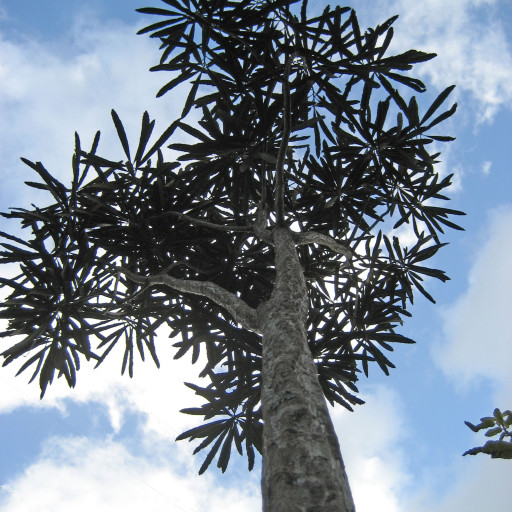
Plant Overview
Known as the "Lancewood" or Horoeka in its native New Zealand, this plant is one of nature’s most dramatic "Transformers." It goes through a bizarre puberty that lasts nearly 20 years, changing its appearance so completely that early European botanists mistakenly classified the juvenile and adult versions as two different species. It is a striking architectural choice for modern gardens, looking more like a prehistoric sculpture than a typical tree.
🔍 How to Identify
- ⚔️ Juvenile Foliage: In its youth, it features long, narrow, sword-like leaves that point sharply downward. These leaves are stiff, leathery, and dark green with a prominent orange or bronze midrib.
- 🦷 Serrated Edges: The juvenile leaves have distinct, coarse "teeth" along the margins, giving them a jagged, saw-like appearance.
- 🌳 Adult Transformation: Once the tree reaches about 4-5 meters (and escapes the reach of hungry animals), the leaves shorten, widen, and grow upward, eventually forming a rounded, leafy canopy on a thick trunk.
🏡 In Your Garden
- 🏗️ Architectural Growth: Because of its vertical, narrow habit in the first decade, it is perfect for tight spaces or as a "living pillar" in minimalist landscapes. It provides a vertical accent that few other plants can match.
- ⚓ The Taproot Factor: This plant develops a deep, stubborn taproot early on. It strongly dislikes being moved once planted, so choose its "forever home" carefully to avoid transplant shock.
- 🌬️ Wind & Hardiness: Having evolved in rugged New Zealand conditions, it is incredibly wind-tolerant and can handle coastal salt spray, making it a tough survivor for exposed garden spots.
⚠️ Safety & Toxicity
- 🐾 Pet Safety: Pseudopanax crassifolius is generally considered non-toxic to cats and dogs. However, the stiff, leathery leaves can be a choking hazard or cause minor mouth irritation if chewed.
- 👶 Child Safety: While not poisonous, the serrated edges of the juvenile leaves are quite sharp and rigid. It’s best to plant it away from play areas where skin might brush against the jagged foliage.
✨ Fun Fact
Scientists believe the Lancewood evolved its strange, downward-pointing, jagged juvenile leaves to defend itself against the Moa—a giant, extinct flightless bird. The leaves were difficult for the Moa to swallow and camouflaged against the forest floor, only changing to a "normal" tree shape once they grew taller than the bird could reach!

Detailed Care Instructions
To grow Pseudopanax crassifolius, also known as Lancewood, follow these steps:
- Choose the right location: Lancewood prefers partial shade or full sun. Ensure the chosen spot provides protection from strong winds, as the plant can topple over easily.
- Soil preparation: Lancewood thrives in well-draining soil with a pH level between 6 and 7. Amend the soil with organic matter like compost or well-rotted manure to improve its fertility and drainage.
- Planting: Dig a hole twice the size of the root ball and place the plant in it. Make sure the top of the root ball is level with or slightly above the soil surface. Fill the hole with soil and gently firm it around the plant.
- Watering: Lancewood requires regular watering, especially during dry periods. Keep the soil evenly moist but avoid overwatering, as it can lead to root rot.
- Mulching: Apply a layer of mulch around the base of the plant to help retain moisture, suppress weed growth, and regulate soil temperature.
- Pruning: Lancewood generally doesn't require heavy pruning. However, you can shape it by selectively pruning to maintain a desired size and form. Prune any dead, damaged, or crowded branches, preferably during the dormant season.
- Fertilizing: Lancewood generally doesn't require extensive fertilization, especially if grown in fertile soil. However, you can feed it with a balanced slow-release fertilizer in early spring or use a liquid fertilizer during the growing season.
- Protection: Provide protection against extreme temperatures, especially in colder regions. Consider wrapping the plant in burlap during winter or providing some form of shelter.
- Propagation: Pseudopanax crassifolius can be propagated from seeds or through semi-hardwood cuttings taken during the summer. Sow the seeds in a well-draining seed starting mix and keep them warm and moist until germination occurs, which may take several weeks.
Remember to check for specific guidelines based on your climate and local conditions.

Place in a window with dappled sun or a spot in the middle of a room. Or directly in a window facing west or east.

To water this plant, you need to ensure that the soil is consistently moist but not waterlogged. This can be achieved by watering thoroughly but allowing the top inch of soil to dry out before watering again. It is important to avoid letting the soil completely dry out, as this can cause damage to the roots. You should also be careful not to overwater, as this can lead to root rot. When watering, ensure that the water reaches the roots and doesn't just sit on the surface of the soil. It is recommended to use room temperature water and to avoid getting water on the leaves, as this can cause water spots. This plant prefers well-draining soil, so make sure to use a pot with a drainage hole and avoid letting it sit in standing water.
To fertilize this plant, it is recommended to use a balanced liquid fertilizer during the growing season, following the manufacturer's instructions for application rates. Apply the fertilizer every two to three weeks, watering the plant well before and after application. During the winter months, reduce fertilization to once a month or discontinue altogether. Be careful not to over-fertilize, as this can lead to leaf burn and other issues. Additionally, incorporate compost or organic matter into the soil for added nutrients and improved soil structure.
To provide optimal growing conditions for Pseudopanax Crassifolius plants, it is important to use a well-draining soil that is rich in organic matter. The soil should have a neutral pH level of around 6.5 to 7.0, and should not be too heavy or compact. A mixture of loam, sand, and peat moss can be used to create a balanced soil that will support healthy growth.
It is also important to ensure that the soil provides adequate moisture to the plant, while still allowing excess water to drain away. Regular watering is necessary, but care should be taken not to overwater, as this can lead to root rot.
In addition to soil quality, Pseudopanax Crassifolius plants require moderate levels of sunlight and regular fertilization to thrive. A balanced fertilizer with equal amounts of nitrogen, phosphorus, and potassium can be applied every 1-2 months during the growing season to encourage healthy growth and development.
To propagate this plant, first, select a healthy stem with a few leaves attached. Cut off the stem at a 45-degree angle with a sharp, sterilized knife. Remove any leaves from the lower half of the stem. Dip the cut end of the stem in rooting hormone powder.
Next, fill a pot with a well-draining potting mix and make a hole in the center. Insert the stem into the hole, making sure that the bottom half of the stem is covered with soil. Water the soil until it is moist but not waterlogged. Cover the pot with a plastic bag to create a humid environment for the cutting.
Place the pot in a warm, bright location but out of direct sunlight. Check the soil regularly and water as needed to keep it moist. After a few weeks, the cutting should start to develop new roots. When the roots have developed, remove the plastic bag and move the pot to a slightly brighter location.
Once the new plant has grown larger, it can be transplanted to a larger pot or into the ground. Take care not to damage the fragile roots during transplantation. Water the new plant regularly, and over time it will grow into a mature plant.








