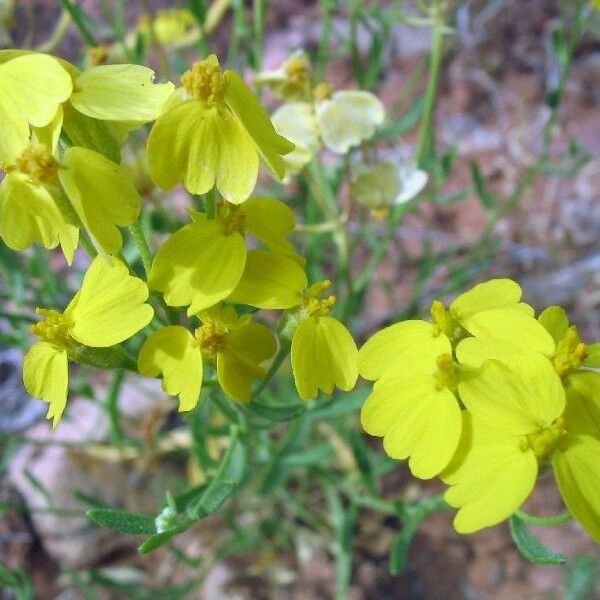
Plant Overview
Known as the Greenstem Paperflower, this golden-yellow beauty is a resilient survivor of the high deserts and plateaus of the American Southwest. It earns its charming nickname from a peculiar habit: rather than dropping its petals when they fade, the flowers dry out and remain on the stem, turning into delicate, tan-colored parchment. It is a favorite for those looking to add permanent "everlasting" color to a rugged, water-wise landscape.
🔍 How to Identify
- 🌼 The Blooms: Features bright yellow, daisy-like flower heads with three-lobed ray petals. As the season progresses, these petals lose their pigment but stay attached, looking like tiny crinkled paper stars.
- 🌿 The Foliage: The stems are noticeably green and slender, often covered in fine, silky hairs that give the plant a subtle silvery-grey cast.
- 🏗️ Growth Habit: It typically grows in a low, rounded mound. Its compact stature makes it look like a deliberate garden planting even when found growing wild on a rocky slope.
🏡 In Your Garden
- 🏜️ Thrives on Neglect: This plant is a specialist in poor, sandy, or gravelly soils. It hates "wet feet" and will likely suffer in heavy clay or over-watered garden beds. It is the perfect candidate for a rock garden or a xeriscape.
- 🦋 Pollinator Support: Despite its papery texture, the fresh blooms are rich in nectar. It serves as a vital pit stop for native bees and butterflies in arid regions where other flowers might wilt under the intense sun.
- ☀️ Sun Seeker: It requires full, unobstructed sunlight to maintain its mounded shape. In the shade, the plant becomes "leggy" and the stems may flop over.
⚠️ Safety & Toxicity
- 🐏 Livestock Warning: While beautiful, this plant is notorious among ranchers. It contains sesquiterpene lactones which are toxic to sheep and sometimes cattle, leading to a condition known as "spewing sickness" if grazed in large amounts.
- 🐾 Household Pets: It is generally not considered a high-risk plant for dogs or cats in a garden setting, but ingestion can cause digestive irritation. It is best kept out of reach of curious nibblers.
✨ Fun Fact
The flowers of the Greenstem Paperflower are so structurally sound once they dry that they are often used in dried floral arrangements and potpourri, retaining their shape for months without any chemical preservatives!

Detailed Care Instructions
To grow a Psilostrophe sparsiflora plant, also known as the brittlebush, you can follow these steps:
- Choose the right location: Psilostrophe sparsiflora prefers full sun and well-draining soil. Make sure to select a spot in your garden that receives at least 6-8 hours of sunlight per day.
- Prepare the soil: The plant can tolerate a variety of soil types, but it prefers sandy or gravelly soil with good drainage. If you have heavy clay soil, consider amending it with sand or compost to improve drainage.
- Planting the seeds: Psilostrophe sparsiflora can be grown from seeds. Sow the seeds directly into the soil after the last frost date. Scatter them over the prepared area and lightly press them into the soil.
- Watering: Water the seeds immediately after planting and keep the soil consistently moist but not waterlogged until they germinate. Once established, the brittlebush is drought-tolerant and does not require much water.
- Mulching: Apply a layer of organic mulch around the plants to help retain moisture and suppress weed growth. Keep the mulch a few inches away from the plant stems to prevent rot.
- Pruning: Psilostrophe sparsiflora does not require extensive pruning, but you can trim it back lightly in the late winter or early spring to maintain a compact shape.
- Maintenance: While the brittlebush is generally low-maintenance, you can give it a boost by fertilizing occasionally with a balanced slow-release fertilizer according to the package instructions. However, note that excessive fertilization may cause leggy growth.
- Pest and disease management: Psilostrophe sparsiflora is relatively resistant to pests and diseases. However, keep an eye out for common garden pests like aphids or spider mites. If necessary, treat them with insecticidal soap or neem oil.
- Propagation: If you already have a Psilostrophe sparsiflora plant, it can also be propagated through stem cuttings. Take a 4-6 inch cutting in the spring or early summer, dip it in rooting hormone, and plant it in a well-draining potting mix. Keep the soil consistently moist until the cutting establishes roots.
It's essential to note that Psilostrophe sparsiflora is native to the southwestern United States and does best in arid or semi-arid climates. If you live in a region with high humidity or heavy rainfall, it may be challenging to grow this plant successfully.

Place in a bright room that is sun drenched almost all day. Or directly in a south-facing window.

The best way to water this plant is to give it a deep watering once a week. Make sure to evenly saturate the soil around the base of the plant, allowing the water to penetrate deeply. Avoid watering too frequently or allowing the soil to become waterlogged, as this can damage the plant's delicate root system. In hot, dry climates, it may be necessary to water more often, but always check the soil moisture level before watering. To ensure the plant stays healthy, it is important to also provide it with proper drainage, as excess water can cause root rot.
To fertilize the plant, use a balanced, slow-release fertilizer with an N-P-K ratio of 10-10-10 or similar. Apply the fertilizer in the early spring when new growth is starting, and then again in the mid-summer. Be careful not to apply too much fertilizer, as this can lead to excessive growth and weaker stems. Follow the instructions on the fertilizer package and water the plant well after applying.
Psilostrophe Sparsiflora thrives in well-draining soil with low to moderate fertility. The ideal soil composition contains a mix of sand, gravel, and rocky fragments that allow for proper drainage and aeration. The soil should not trap water, as this can cause root rot and damage to the plant.
When planting Psilostrophe Sparsiflora, it is recommended to use a potting mix or soil that is specifically designed for desert plants. These soils are formulated with a mix of sand, perlite, and peat moss, which provide drainage while retaining some moisture.
If planting in the ground, it is best to amend the soil with sand and gravel to improve drainage. Adding compost or a slow-release fertilizer can help provide nutrients, but be careful not to over-fertilize as this can damage the plant.
Overall, the key to growing Psilostrophe Sparsiflora successfully is to provide well-draining soil that mimics its natural habitat in the desert southwest.
To propagate this plant, you will need to take stem cuttings. Choose a healthy, mature stem and use a pair of sharp scissors or pruning shears to cut a section that is about 3-4 inches in length. Remove any leaves from the bottom two-thirds of the stem, leaving a few at the top.
Next, dip the cut end of the stem into a rooting hormone powder, which can be found at most garden centers or online. This will encourage the stem to produce roots.
Fill a small pot with moist, well-draining soil and make a hole in the center. Insert the stem cutting into the hole, making sure the bottom leaves are just above the soil surface. Gently press the soil around the cutting to hold it in place.
Water the cutting thoroughly and place a clear plastic bag over the pot to create a humid environment. Keep the pot in a warm, bright location but out of direct sunlight. Mist the cutting daily to keep the soil moist and within a few weeks, you should begin to see new growth and roots forming.
After a few months, the cutting should be well-established and ready to be transplanted into a larger pot or directly into your garden.








