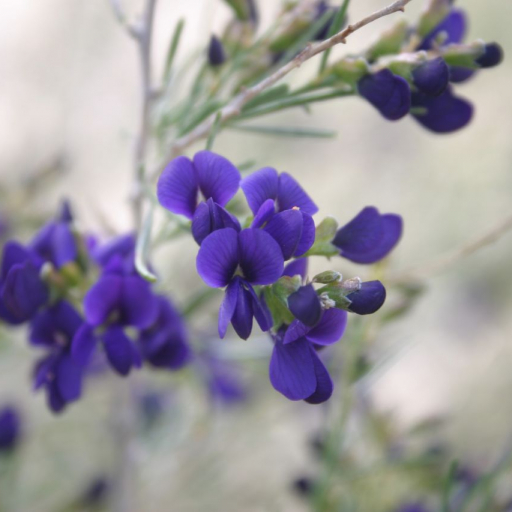
Plant Overview
Known as Schott’s Indigo Bush, this desert survivor is a master of minimalism. Named after Arthur Schott, a 19th-century naturalist and boundary surveyor, it transforms harsh, sandy washes into a sea of electric purple every spring. It is often mistaken for a pile of dry, silver sticks until the first bloom reveals its true, royal identity.
🔍 How to Identify
- 🌿 Stems: Slender, grayish-green branches that are stiff and rigid, often ending in sharp, thorn-like tips that protect it from grazing animals.
- 🍃 Minimalist Leaves: The leaves are narrow, linear, and often fall off early in the season. The plant compensates by using its green stems to perform photosynthesis.
- 💜 Pea-Like Flowers: The blossoms are small but striking, featuring a deep indigo or violet-blue hue with a tiny bright spot near the center, typical of the legume family.
🏡 In Your Garden
- 🏜️ The Ultimate Xeric Plant: Schott’s Indigo Bush is built for the desert. It thrives in sandy, porous soil and will struggle in heavy clay or "rich" garden soil that holds too much moisture.
- ☀️ Sun and Space: It requires full, intense sun to produce its signature deep-purple flowers. Because it develops a deep taproot to find water, it is notoriously difficult to transplant once established—pick its "forever home" carefully!
⚠️ Safety & Toxicity
- 🌵 Physical Hazard: While not known to be chemically toxic to humans or pets, the branch tips are very sharp. They can easily puncture skin or paws if brushed against too quickly.
- 🐾 Pet Note: It is generally considered non-toxic, but its "scabby" resinous glands can sometimes cause mild stomach upset if a curious pet decides to chew on the bitter branches.
✨ Fun Fact
The genus name Psorothamnus literally translates from Greek to "scabby bush." This sounds unappealing, but it actually refers to the fascinating, tiny orange glands dotted across the stems that release a spicy, resinous scent when crushed!

Detailed Care Instructions
To grow Psorothamnus Schottii plant, you can follow these steps:
- Choose the right location: Psorothamnus Schottii prefers full sun exposure. Make sure you find a sunny spot in your garden or a location where it will receive at least 6-8 hours of direct sunlight each day.
- Soil preparation: This plant prefers well-draining soil. If your soil is heavy or clayey, amend it with organic matter, such as compost, to improve drainage.
- Planting: Dig a hole that is slightly larger than the root ball of your Psorothamnus Schottii plant. Place the plant in the hole, making sure the top of the root ball is level with or slightly above the soil surface. Gently backfill the hole with soil, firming it gently around the roots.
- Watering: Water your Psorothamnus Schottii plant deeply immediately after planting. After that, water it regularly to keep the soil slightly moist but not waterlogged. Watering frequency will depend on factors such as temperature and rainfall, so adjust accordingly.
- Mulching: Apply a layer of organic mulch around the base of the plant to help retain moisture and suppress weed growth. However, make sure the mulch does not touch the stem of the plant directly.
- Pruning: Psorothamnus Schottii typically does not require extensive pruning. However, you can trim away any dead or damaged branches to promote healthy growth.
- Fertilizing: Psorothamnus Schottii is adapted to nutrient-poor desert soils and often does not require regular fertilization. If you feel your plant needs a nutrient boost, apply a balanced, slow-release fertilizer in early spring.
- Protecting from frost: Psorothamnus Schottii is native to desert regions and can be sensitive to frost. If you live in a colder area, consider providing protection, such as a frost cloth or temporary shelter, during freezing temperatures.
Remember to check local regulations before planting Psorothamnus Schottii, as it may require specific permits or permissions in some regions.

Place in a bright room that is sun drenched almost all day. Or directly in a south-facing window.

Psorothamnus Schottii is a plant that requires moderate watering. It is important to ensure that the soil is evenly moist but not waterlogged. While the plant can tolerate some level of drought, it is important to avoid letting the soil dry out completely.
To water the plant, fill a watering can with room temperature water and gently pour it onto the soil. Do not water the foliage as this can cause damage to the leaves. Ensure that the water penetrates the soil to a depth of at least 6 inches.
During the summer months, Psorothamnus Schottii may require more frequent watering as the heat can cause the soil to dry out faster. In contrast, during the winter months the plant may require less watering as it goes into a period of dormancy.
It is important to note that overwatering can cause root rot and other fungal diseases, so it is crucial to monitor the soil moisture levels and adjust watering accordingly.
To fertilize this plant, use a balanced fertilizer with equal parts Nitrogen, Phosphorus, and Potassium. Apply this fertilizer in early spring, before the plant starts to bloom. Use a low concentration of about ¼ to ½ of the recommended strength. Avoid over-fertilizing, as this can harm the plant. Water the plant deeply after fertilizing to help the nutrients reach the roots.
Psorothamnus Schottii plant thrives in well-draining soil that has good aeration to facilitate proper root growth. The soil should have a neutral to slightly alkaline pH level, ranging from 6.0 to 7.5. A sandy or sandy-loam soil mix with good drainage is recommended.
It is essential to ensure that the soil is not waterlogged, as this can cause root rot and other fungal diseases that can damage the plant. To improve drainage, gravel or sand can be added to the soil mix.
Organic matter such as compost or leaf mold can also be added to the soil to help retain water and nutrients. Before planting, it is essential to loosen the soil well so that the young roots can easily penetrate the soil and grow.
Adding a layer of mulch around the base of the plant can help retain moisture and nutrients in the soil. The mulch also acts as a barrier, preventing weed growth that can compete with the plant for nutrients.
Overall, the ideal soil conditions for Psorothamnus Schottii plant are well-draining, sandy or sandy-loam with a neutral to slightly alkaline pH level. A mix of organic matter is beneficial for retaining water and nutrients, and mulching is an effective method to maintain a healthy soil environment.
To propagate this plant, select a healthy stem that is at least 6 inches long and has several leaf nodes. Cut the stem just below a leaf node using a clean, sharp pair of pruning shears. Remove any leaves from the bottom of the stem so that the node is exposed.
Dip the cut end of the stem into rooting hormone, then plant it in a pot filled with well-draining soil mix. Make sure the soil is moist but not waterlogged. Place the pot in a bright, indirect light location and keep the soil consistently moist.
After a few weeks, new growth should appear on the stem, indicating that it has rooted. Once the new growth is healthy and established, you can transplant the plant into its permanent location in a well-draining soil mix in a sunny location.








