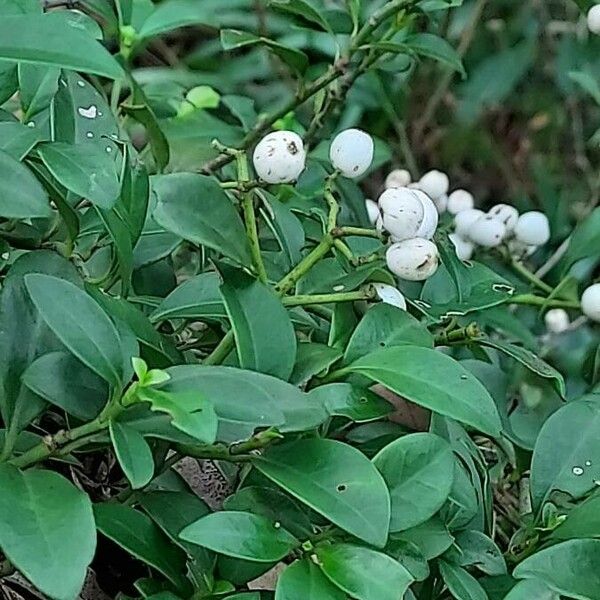
Plant Overview
Often called the Creeping Psychotria, this resilient evergreen vine earns its name from its serpent-like habit of winding around tree trunks and scaling rocky walls. Native to the subtropical forests of East Asia, it acts as a lush, living wallpaper that adds a deep, emerald texture to shaded gardens. It is a master of adaptation, equally comfortable as a dense groundcover or a vertical climber.
🔍 How to Identify
- 🍃 Leathery Foliage: The leaves are small, oval-shaped, and remarkably thick. They have a glossy, dark green finish that helps them reflect the limited light found on the forest floor.
- 🐍 Climbing Roots: Look for tiny, hair-like adventitious roots along the stems. These allow the plant to "glue" itself to bark or stone, mimicking the movement of a snake as it scales surfaces.
- ⚪ Pearl Berries: After its modest white flowers bloom, the plant produces striking, snow-white berries. These globose fruits look like tiny pearls scattered across a green velvet backdrop.
🏡 In Your Garden
- 🧗 Vertical Ambition: This plant is a "self-clinger." If you have a damp stone wall or a shaded fence, it will map its own path upward without much help. However, it hates being moved; once those aerial roots take hold, transplanting can cause significant shock to the vine.
- 💧 The Humidity Requirement: It thrives in the "Goldilocks zone" of moisture. It craves high humidity and consistently damp soil but will suffer from root rot if left in standing water. It is a perfect candidate for tropical-themed courtyards or large-scale indoor terrariums.
⚠️ Safety & Toxicity
- 🐾 Moderate Caution: While not as chemically potent as its famous cousin (Psychotria viridis), P. serpens contains various alkaloids that can cause gastrointestinal distress if eaten.
- 👶 Berry Hazard: The white berries are visually appealing to children and curious pets. Ingestion may lead to nausea, vomiting, or mouth irritation. It is best placed in areas where it can be admired from a distance.
✨ Fun Fact
Psychotria serpens belongs to the Rubiaceae family—the very same botanical family as your morning cup of Coffee! While you can't brew a latte from its leaves, it shares the same signature glossy leaf structure and hardy "woody" stems as the coffee plant.

Detailed Care Instructions

Place in a window with dappled sun or a spot in the middle of a room. Or directly in a window facing west or east.

When the top few inches of soil dry out, water your plants. If the top few inches of soil are still moist, do not water your plant. Wait a few days, then poke your finger into the soil to see if anything has changed. Overwatering poses a disease risk, such as the development of fungal diseases in the roots. These plants have adaptations in there leaves that allow them to survive in low water supply.








